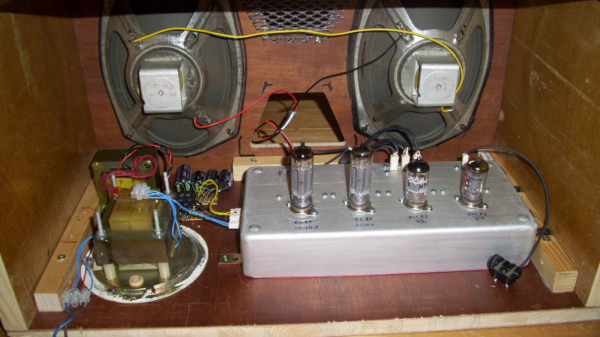
[Michael Wiebusch] found the leftovers of a wrecked vintage tube radio in a pile of electronics junk. Unfortunately, he could not recover any vacuum tubes in it. And to his dismay, it didn’t even have the output transformer, which he figured would have been useful in a guitar amplifier project. The output transformer is not easy to come by nowadays, so he was hoping to at least score that item for his future build. All he could dig out from his dumpster find was a pair of speakers and he ended up building nice Output-Transformer-Less Tube Guitar Amplifier around them.
Valve output stages are generally high-impedance which means they cannot be directly interfaced to low impedance speakers. An impedance matching output transformer is thus used to interface the two. Back in the day when valves were still the mainstay of audio electronics, many cheap amplifier designs would skimp on the output transformer to save cost, and instead use high impedance speakers connected directly to the amplifier output.
[Michael] found a nice reference design of an OTL amplifier for a 620 ohm single speaker. He decided to use the same design but because these speakers were about 300 ohm each, he would have to wire his two speakers in series. At this point, he decided to make his build useful as a proper guitar amplifier by adding a preamplifier stage replicated from another design that he came across. A regular halogen lamp 12V transformer takes care of the heater power supply for all the tubes, and a second, smaller 12V transformer is wired backwards to provide the 300V needed for the plate supply.
The final result is pretty satisfactory, considering that it all started with just a pair of junked speakers. Check out the result in the video after the break.
Continue reading “Dumpster Dive Speaker Results In Tube Amplifier”
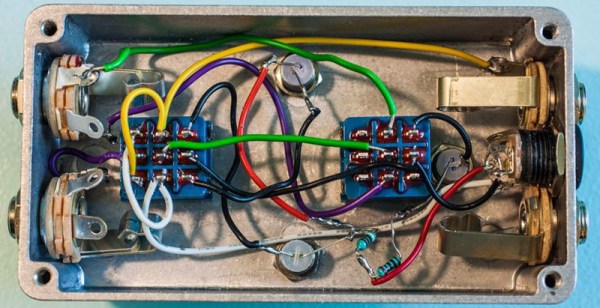
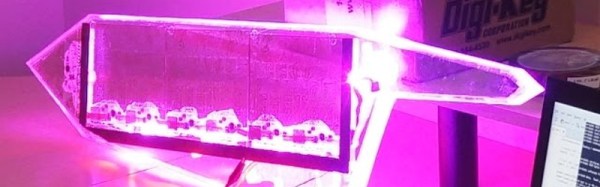
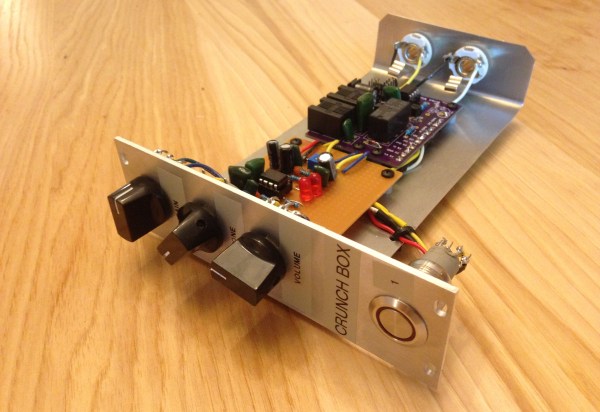
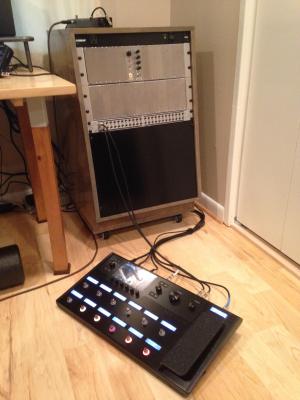 Taking inspiration from modular synthesizers, [Brian] built a rack out of wood to house the pedal modules. The rack uses 16U rack rails as a standard, with 3U Eurorack brackets. It looks like there’s space for 16 custom-built effects pedals to fit into the rack, and [Brian] can switch them out at will with a foot switch. Everything is tied together with MIDI and is programmed in Helix. The end result looks very polished, and helped [Brian] eliminate his rat’s nest of cables that was lying around before he built his effects rack.
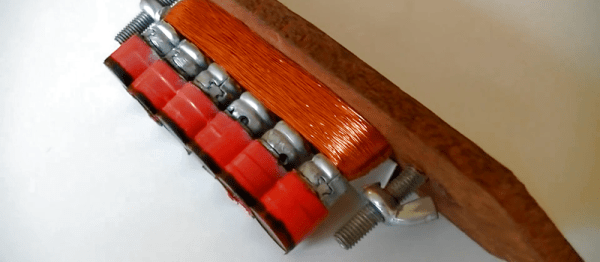
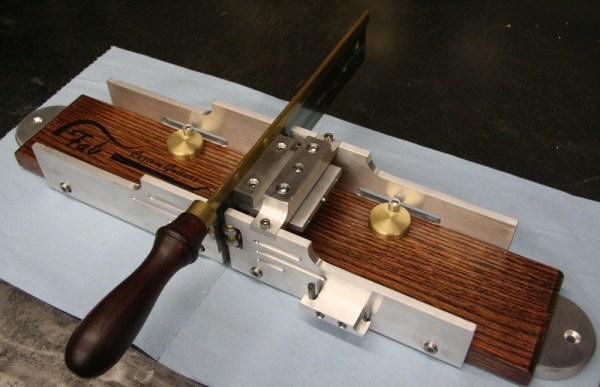
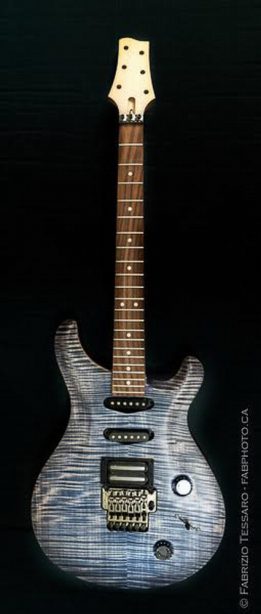 Cutting the slots in a guitar’s neck for the frets requires special tooling, and [Gord]’s contribution to his friend’s recent dive into lutherie was