Update: IR Controlled Lighting

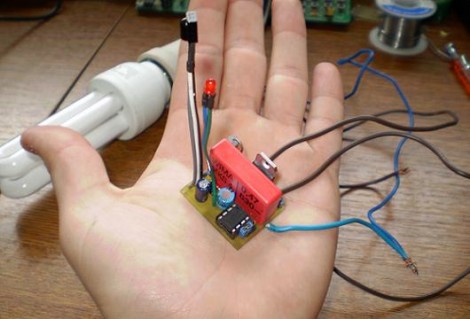
[Muris] is back with another infrared controlled lighting hack. When we checked in with him last year he was showing off an IR controlled dimmer module. Now he’s back with this device that is CFL friendly. Because standard CFL bulbs are not dimmer compatible he’s adapted the project away from dimming and toward switching. The new design still uses an infrared remote but now it can turn two devices on and off again or toggle between them. Our favorite part of the build is that the PIC based device can learn the codes of whichever remote you choose, rather than having to rely on one specific type of remote.

Infrared Transmission Decoding

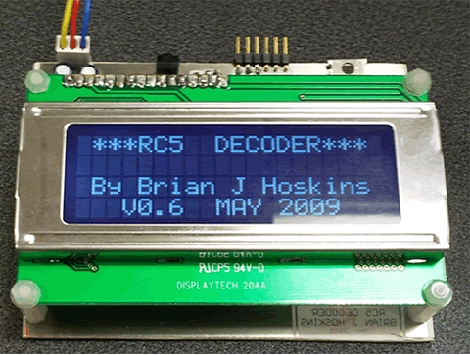
Alright class, quiet down and open your books to the chapter on Manchester Encoding. [Brian J Hoskins] did just that when building this RC5 decoder. This protocol is commonly used in television remote controls. You use them on a daily basis, don’t you think it’s time you understood what’s going on? Check out his writeup and learn the dark art of invisible light communication. Or just skip the learning and follow our how-to.

[Thanks Tim]

Location Tracking Using IR Throwies

[Joe] and his team hacked together some location tracking using IR throwies for their final project. The challenge they undertook was to find a way to track the orientation of a sculpture in the form of a rotating metal cube. The end result dips its toe into the augmented reality pool but the methods are what interest us.

They wanted this to work day or night so contrast would be a major issue if working completely with image manipulation. Having a simple way to pick out the corners of the monotone block would make this process a breeze. They ended up using magnetic throwies that have an infrared LED which can easily be picked up by a webcam no matter what the ambient light issues happen to be.

After the break you can see these guys out in the wild testing the system. We’d like to note the diffusers used in the project. We’re used to seeing ping-pong balls as diffusers but this is the first time we’ve noticed Styrofoam balls being used.

Continue reading “Location Tracking Using IR Throwies”

Mac Mini – Getting A Little More Useful

IMG_7559

We’re pretty sure Apple decided to implement an IR sensor in their Mac Mini line simply to mock the user. For those who are unaware, the built in sensor only works with the standard Apple Remote; unless you happen to have a programmable PDA or similar you’re SOL. An alternative solution would be to install a USB IR receiver. But then your beautiful Mac Mini is forced to sit alongside an ugly black box. Why not have the best of both worlds? [SqueeZe] wrote an (almost) entirely non invasive tutorial for placing a USB IR receiver inside his Mac Mini. Reminds us of a certain hack a while back, but the objective was to get the IR receiver outside of the unit rather than inside. Different people, different worlds.

[Thanks Kiran]

TV-B-Gone-zilla! Rawr!

tv-zilla

TV-B-Gone: antisocial nuisance or harmless prank? Whatever your feelings, there’s no denying this device has become a staple of the DIY hacking crowd, as evidenced by the countless derivatives since hatched. This latest mutation crushes them all.

[manekinen] from the Polish electronics blog Elektroda (“Electrode”) wasn’t satisfied with high-power TV-B-Gone designs using multiple 5mm infrared LEDs, so he created his own using a single one-Watt monster. The device is concealed in an ordinary flashlight casing, making it somewhat inconspicuous. A custom PCB containing an ultra-minimalist version of the TV-B-Gone circuitry sits just behind the reflector. The choice of reflectors determined maximum distance vs. coverage…they opted for distance. Specific figures aren’t given, but we estimate this thing could shut off televisions on Mars.

The original article (Polish or Google-ized English) includes construction photos and an archive (.rar) of project files including Eagle schematics and C source code.

Would it be totally irresponsible to mention there’s now a 3-Watt version of this LED? We’re just sayin’.

[thanks RicoElectrico]

Add IR Control To Your WiFi Router

wrt54g_ir_receiver

[Craig] wanted to use Boxee on his TV but his computer was in a different room. He rigged up a rather dubious method of delivering the A/V signal (this is a hack in the most guttural sense). More interesting to us is his solution for a remote control interface. We’re familiar with building USB connected infrared receivers but [Craig] decided to patch one into the serial connection on his Linksys WRT54G router. Continue reading “Add IR Control To Your WiFi Router”

Virtual Pool, Real-world Interface

[youtube=http://www.youtube.com/watch?v=2Wc_DXGe2fQ]

Sunday we saw robots playing pool and an augmented reality pool game. Today we’ll complete the pool trifecta: virtual pool using a real cue stick and ball in another vintage video from Hack a Day’s secret underground vault. The video is noteworthy for a couple of reasons:

First is the year it was made: 1990. There’s been much buzz lately over real-world gaming interfaces like the Nintendo Wii motion controller or Microsoft’s Project Natal. Here we’re seeing a much simpler but very effective physical interface nearly twenty years prior.

Second: the middle section of the video reveals the trick behind it all, and it turns out to be surprisingly simple. No complex sensors or computer vision algorithms; the ball’s speed and direction are calculated by an 8-bit processor and a clever arrangement of four infrared emitter/detector pairs.

The visuals may be dated, but the interface itself is ingenious and impressive even today, and the approach is easily within reach of the casual garage tinkerer. What could you make of this? Is it just a matter of time before we see a reader’s Mini-Golf Hero III game here?