Passive Infrared (PIR) Sensor Tutorial

pirsensor

[ladyada] has a freshly-published and amazingly thorough tutorial on passive infrared (PIR) motion sensors. Most often seen in security floodlights and automatic doors, in creative hands these sensors can be put to other uses—cat flaps, camera triggers and purely artistic applications—as you’ll see in several demo projects and videos. For the curious, the tutorial provides a good amount of background theory on how PIR sensors work, along with the associated fresnel lens optics. And for those who just want to get hacking, most PIR sensors (like the one above) come in a simple-to-interface module containing all the support hardware and providing a simple digital output; the article wraps up with one such example.

Poor Man’s Thermographic Camera

thermographic camera

Using an IR thermometer, there are two ways to go about building a thermographic camera. The first uses a pan and tilt head. Scan lines are emulated, as a computer controls panning from left to right, taking a temperature sample from each step. Vertical resolution is accomplished by tilting. Another method uses a web cam attached to the thermometer. The thermometer’s laser pointer is captured with temperature annotations, as the computer records the field of view. We think the best outcome can be found with a combination of both methods. The video embedded below demonstrates the results. This would be a good addition to the Autonomous paintball sentry.

Continue reading “Poor Man’s Thermographic Camera”

Magic Wands For Disney

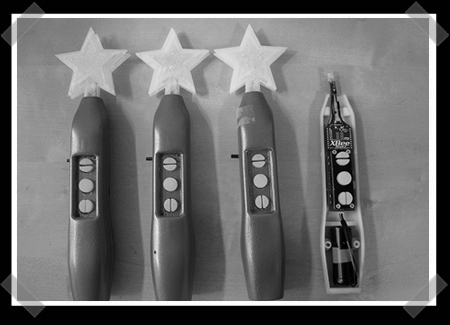
[NRP] sent us a few of his projects. The most notable of the bunch was a school project funded by Disney. They were to make some kind of interactive entertainment for people waiting in line for rides. They decided on a wand style interface. Each wand has an accelerometer, an IR LED for tracking, an XBee unit, and a few buttons for interaction. They wrote some custom games and a multi person white board to test it all out.  You can see those in action, along with a space themed pong game in the video after the break. Even though this was funded by Disney, you can still find all the source code and schematics, available for free.

Continue reading “Magic Wands For Disney”

Quick Cheap Remote Outlets

ir_plugs1

[jwad650] wanted a remote controlled power strip. These are fairly expensive, with a single outlet running roughly $15. He was able to build a 6 outlet version for about $50.  He is using an SIS-7c to decode signals from a universal remote. Each plug is individually controlled by a 3Amp relay. Be careful making this, there’s lots of nasty shock potential in that mess of wires. We recommend that you confine it in an enclosure as well. [jwad650] plans on adding an enclosure, as well as LED indicators and fuses. You can see a video of it in action after the break. If you want more information about working with relays, check out the working with relays writeup.

Continue reading “Quick Cheap Remote Outlets”

UIRemote: Universal Remote Application For IPhone

[youtube=http://www.youtube.com/watch?v=E-SlcjmqeYw]

When several students from the University of Toronto became tired of having multiple remotes lying around, they decided to do something about it. Their solution to this problem came in the form of UIRemote, a universal remote application for the iPhone. The application allows the iPhone to control anything that is normally controlled by an infrared remote, thanks to the use of a custom infrared adapter that plugs into the phone’s headphone port. It’s a technique similar to our iPod remote control from 2004. While the UIRemote application and adapter are still in beta, the students expect to release both things simultaneously sometime within the next two months.

[via Engadget]

A Welcome Train For The Holidays

[youtube=http://www.youtube.com/watch?v=hnFyI0a-55s]

[Eric] was charged with the task of setting up the train to welcome people on the porch.  The train had been in the family for a long time, so he didn’t want to modify the train itself. Luckily, it has an IR port. He recorded the IR signal from the remote and used a home made pressure sensor to signal the train to start.

Testing IR Camera Blocking

[youtube=http://www.youtube.com/watch?v=0u5hAfnq2-4&hl=en&fs=1&rel=0][randy] from F.A.T. tested the theory that infrared LEDs can actually hide you from the prying eyes of surveillance cameras. We’ve previously covered camouflage, IR, and other suggestions for eluding the cameras, but haven’t taken to sewing stuff onto our clothes yet. [randy] lined his hoodie with high-intensity infrared LEDs, hoping to create a halo effect that would hide his head, and tested his results. Unfortunately, his efforts were unsuccessful. He tested many many different combinations and we’re confident in his conclusion that it would be very hard to make this work.