Smother Yourself In Addressable LEDs

Guess where this guy’s headed in his suit of many colors? If you said Burning Man give your self a pat on the back. After making a half-hearted EL suit for the festival in 2010 [Sander] decided he needed to step it up this year. He bought and affixed 200 LED modules to this suit so that he could light up the night.

They’re mounted in a grid, and in order to keep the changing patterns orderly he mapped the physical location of each in his code using a two-dimensional array. The controller uses an Arduino nano to push the patterns out to the array via SPI.

[Sander] included several different visual effects for the controller. One strobes the suit starting from the right cuff when he shakes someone’s hand. There’s also an audio spectrum analyzer chip and microphone that let him pulse the lights to music. You can see how bright this thing is in the image above, but to get the full effect shouldn’t skip the video after the break.

He’s entered the project into the Full Spectrum Laser Cutter giveaway. If he wins, we expect laser cut goodness for next year’s festival!
Continue reading “Smother Yourself In Addressable LEDs”

Adding HTTP To Ikea DIODER

[Alex] sent in a neat Ikea DIODER build that controls strings of RGB LEDs with HTTP requests.

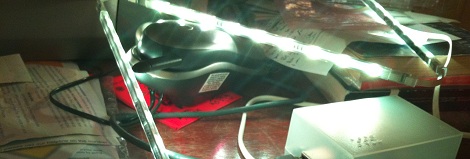
We’ve seen Ikea DIODERs controlled wirelessly and over USB, but using the Internet with a DIODER is new to us. For his build, [Alex] used a Nanode, a small Arduino-like board that has built-in web connectivity.

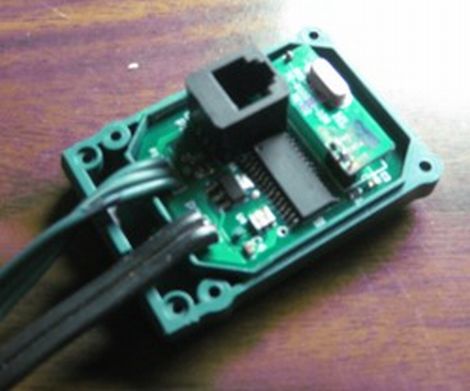
The hardware portion of the build is very simple. A MOSFET controls each LED strip on the DIODER. The stock controller of the DIODER was ditched, meaning [Alex] needed to figure out how to convert an RGB color space to a Hue, Saturation, and Lightness color space “for super-classy fading.” Once that was figured out, [Alex] implemented a 1D Perlin noise function to blend between two colors.

Finally, the great EtherCard library was used to turn HTTP requests into dancing LEDs. [Alex] is thinking about building a JQuery webpage so he won’t have to muck around with entering commands like 192.168.1.25/hsl?i=0&h=135&s=90&l=50 into a browser. Without a nice web interface, it’s not as futuristic as [Alex] would like, but it’s still cool to us.

Pee-light Gives Guidance For Nocturnal Tinkles

This light is a rather dim LED module whose purpose is to give you a very small bit of illumination when using the restroom at night. If you rely on it instead of using the overhead lighting in the bathroom, you’ll be able to find your way back to bed with your night-vision undisturbed.

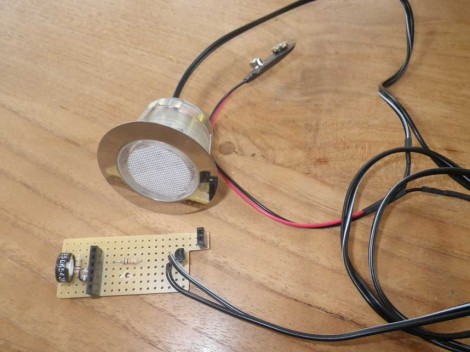
[Fred] built the project as a way to learn more about using MSP430 microcontrollers. The protoboard seen above has a pair of female pin headers designed to accept an MSP430-PIR board, which uses the low-power microcontroller to monitor a PIR motion sensor. The chip can be reprogrammed and [Fred] did just that, using the USB dongle side of the eZ430-F2013 dev stick. Now when the sensor detects motion the chip first checks the light-dependent resistor on the protoboard to see if it’s dark in the bathroom. If so, it switches on the LED and sets a timer to shut if off again.

The system runs on a 9V battery, which is a bit under-powered for the 12V-spec’ed LED module. But [Fred] says the light it produces is just the right intensity.

[Thanks Jeremy]

GE Color Effects Hacking For The Nautically Inclined

ge-color-effects-controller

[Jim] wrote in to share some work he did with GE Color Effects LED lights in an effort to create a light display for his boat. He saw our coverage of the Color Effects G-35 hacking efforts by DeepDarc last year, and knew that they would be prefect for the boat. He did some careful scouring of eBay to score 8 strings of lights at bargain basement pricing, then he got down to the business of hacking them.

He originally built a control circuit using a single PIC18F, but just before he started to put everything together, he realized that wiring everything up would be a huge undertaking. Going back to the drawing board, he decided it would be best to replace the lights’ stock board with one of his own. Now, he uses a single master controller board to send messages to his slave “pods”, significantly cutting down the amount of wiring required for the project.

The display looks great as you can see in the video below, though as many do, [Jim] has plenty of improvements in mind for the future.

Continue reading “GE Color Effects Hacking For The Nautically Inclined”

Lighted Fan Pull Saves You From Flailing Around In The Dark

lighted-fan-pull

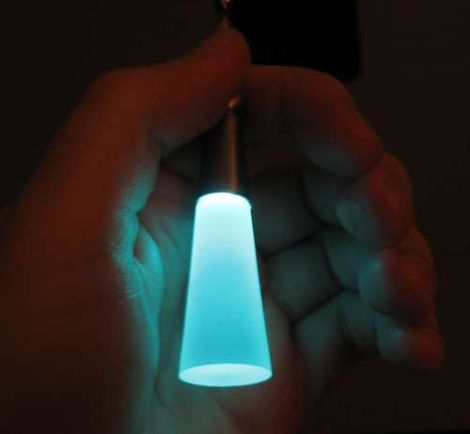
Like many people, [yardleydobon] had a hard time locating his ceiling fan’s pull chain at night when his room is completely dark. Rather than continue to flail around blindly grasping for the chain, he decided to find a way to illuminate it instead.

He started off by disassembling a solar garden light, retaining the solar cell, photoresistor, and batteries. After paring down the electronics to the bare essentials, he mounted them inside a plastic battery storage case which he attached to the outside of the fan’s lamp. [yardleydobon] then ran a pair of wires from the electronics box down to end of the chain, where he added an LED and a translucent pull to diffuse the light.

He admits that it’s not the nicest looking modification around, but it does the job in a pinch. He has some ideas that he may put into play if he has the time to revise the design, and we bet that many of you do as well. If so, be sure to share them in the comments.

Continue reading “Lighted Fan Pull Saves You From Flailing Around In The Dark”

Follow Up: Star Wars Tree Gets An Upgrade

star-wars-tree-sound

We asked, and [Zach] listened.

Earlier this week, we featured a circuit he built which allowed his tiny Star Wars Christmas tree to visually replicate the series’ theme song. Several of you, along with myself, thought it would be far cooler if the tree also played the music to accompany the light show, so [Zach] set off to add that functionality.

Worried that the music would get annoying if it played along with the lights constantly, he tweaked his circuit design to incorporate a piezo buzzer that could be easily switched on and off. After wiring it to the MSP430 driving the light show, he tweaked the program to output signals to both the light string and buzzer simultaneously.

While the light show accurately represented the song, he initially ignored flat and sharp notes as they would be indistinguishable to the eye. In audio form however, the missing notes would be glaringly obvious, so he re-transcribed the sheet music resulting in the video you see below.

If you happened to follow [Zach’s] lead and put one of these together in your own house, be sure to swing by his site and grab the latest code, complete with audio track.

Continue reading “Follow Up: Star Wars Tree Gets An Upgrade”

Hackaday Links: December 7, 2011

LED Neurons

[Alexandra Olivier] put up an art installation at Wellesley College that looks like a bunch of neurons built out of LEDs. The neurons are connected to a couple PIR sensors and ‘fire’ whenever movement is detected. The result is a lot like being inside a brain. Fitting, then, that the installation is called Social Synapses.

Last year’s big toy was always evil, though

Last year, [Andrew] had to fight the throngs of shoppers to get the must have toy of the season, a Zhu Zhu pet. Since these robotic hamster things have spent the last 11 months in the back of a closet, it seems reasonable to make them evil. They’re still not as evil as a demonic Furby….

So we call it a bifocal, right?

There’s an old photography trick for a really hacky macro setup – just turn the lens around. Well, what if you wanted automatic metering and flash control? Simple, just electrically reverse the lens. Bonus points for being able to use the lens regularly as well.

Control all the bands

Well here’s something cool: an all-in-one USB 315mhz, 433mhz, and 868mhz transceiver. What can you do with it? Well, [codeninja] can control the outdoor lights for two of his neighbors, open gates and doors, crash his weather station, and just about anything else in those bands. It’s pretty much like war driving for important stuff nobody cares about.

So this is our favorite holiday now

There’s a Dutch tradition to play Sinterklaas and make someone a present. [Jenor] decided to build an antique-looking DC voltmeter with a pair of vacuum tubes. The tubes don’t work anymore, but the heaters still provide a nice warm glow. It’s a bit large to be regularly used as a piece of test equipment, but it really does look awesome. Very steampunkey, and it’s the though that counts anyway.