One Sailing Pulley To Rule Them All

When thinking of humanity’s ability to harness wind energy, many people will conjure images of windmills from places like The Netherlands or Persia. But people have been using wind energy for far longer than that in the form of sailing ships. Using the wind for transportation goes back another four thousand years or so, but despite our vast experience navigating the seas with wind alone there is still some room for improvement. Many modern sailboats use a number of different pulleys to manage all of the rigging, but this new, open-source pulley can replace many of them.

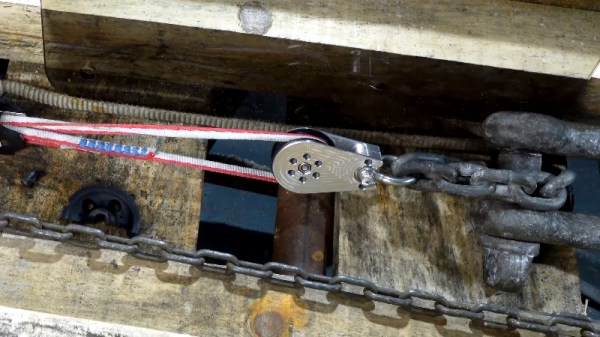
The pulley, or “block” as they are sometimes called, is built with a polymer roller made out of a type of nylon, which has the benefit of being extremely durable and self-lubricating but is a bit expensive. Durability and lack of squeakiness is important in sailing applications, though. The body is made from CNC-machined aluminum and is composed of two parts, which pivot around the pulley’s axis to allow various ropes (or “lines”) to be inserted without freeing one end of the rope. In testing, this design outperformed some proprietary stainless steel pulleys of similar size.

Another perk of this design is that it can be set up to work in many different applications on a sailboat, whether that’s for hoisting a mainsail or pulling in a jib or any other task a pulley could be used for. It can also be stacked with others in many different configurations to build custom pulleys of almost any type, and can support up to 14 mm lines. For a sailor this could be extremely valuable, because as it stands each pulley on a ship tends to be used in only certain applications, and might also be proprietary from a specific company. This pulley is being released into the open-source world, allowing anyone to create them who wants one.

Thanks to [Keith] for the tip!
Continue reading “One Sailing Pulley To Rule Them All”

Automatic Rewinder Makes Kite Retrieval A Breeze

So you’ve built a fine kite, taken it to the beach, and let it ride the wind aloft on a spool of line. Eventually it has to come down, and the process of reeling all that line that was so easily paid out is likely a bigger chore than you care to face. What to do?

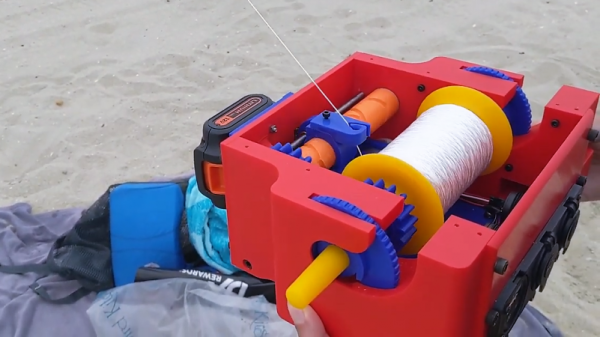
If you’re like [Matt Bilsky], the answer is simple: build a motorized kite reel to bring it back in painlessly. Of course what’s simple in conception is often difficult to execute, and as the second video below shows, [Matt] went through an extensive design and prototype phase before starting to create parts. Basic questions had to be answered, such as how much torque would be needed to reel in the kite, and what were the dimensions of a standard kite string reel. With that information and a cardboard prototype in hand, the guts of a cordless drill joined a bunch of 3D-printed parts to form the running gear. We really liked the research that went into the self-reversing screw used to evenly wind the string across the spool; who knew that someone could do a doctoral dissertation on yarn-winding? Check out the “Reeler-Inner” in action in the first, much shorter video below.

With some extra power left from the original drill battery, [Matt] feature-crept a bit with the USB charger port and voltmeter, but who can blame him? Personally, we’d have included a counter to keep track of how much line is fed out; something like this printer filament counter might work, as long as you can keep the sand out of it.

Continue reading “Automatic Rewinder Makes Kite Retrieval A Breeze”

Line Following Robot Without The Lines

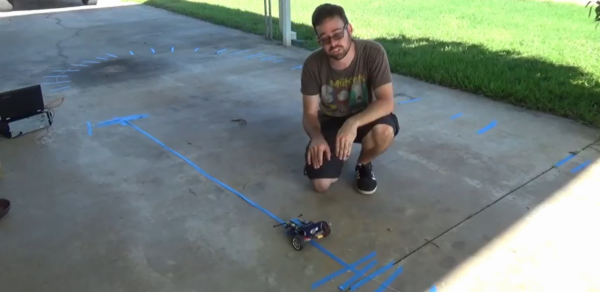
Line-following robots are a great intro to robotics in general, since the materials and skills needed to build a good one aren’t too advanced. It turns out that line-following robots are more than just a learning tool, too. They’re pretty useful in industry, but most of them don’t follow visible marked lines. Some, like this inductive guided robot from [Randall] make use of wires to determine their paths.

Some of the benefits of inductive guidance over physical lines are that the wires can be hidden in floors, so if something like an automated forklift is using them at a warehouse there will be less trip hazard and less maintenance of the guides. They also support multiple paths, so no complicated track switching has to take place. [Randall]’s robot is a small demonstration of a larger system he built as a technician for an autonomous guided vehicle system. His video goes into the details of how they work, more of their advantages and disadvantages, and a few other things.

While inductive guided robots have been used for decades now, they’re starting to be replaced by robots with local positioning systems and computer vision. We’ve recently seen robots that are built to utilize these forms of navigation as well.

Continue reading “Line Following Robot Without The Lines”