Hackaday Links: January 3, 2016

Cx5 is a strange material that’s a favorite of model makers and prop replicators. It’s kind of like a wax, kind of like a clay, and a little bit like a plastic. Now it’s a 3D printer filament. It looks very interesting for sculpted and highly detailed models, something the 3D printing scene hasn’t had yet.

So you want a CNC machine, right? Tormach makes a good one, and here’s what it takes to put a PCNC440 in your garage. This is an incredible amount of work and a great excuse to buy an engine hoist.

[Zemnmez] could find dozens of apps and webpages that would calculate resistor color codes for him automatically. What he couldn’t find is one that would do it in reverse – i.e. type in a resistor value and return the correct color code. He made this.

[aggaz] needed a way to connect multiple MIDI devices to his computer. The MIDI spec provides a neat piece of hardware for just this occasion – the MIDI thru box. The only thing you need to build a single MIDI thru box is an opto-isolator and a buffer. It’s easy enough to build, although the DIN5 jacks used for MIDI devices are pretty expensive nowadays. (FWIW- We get an invalid certificate error when loading this page but you should still be able to load it.)

AliExpress always has some interesting stuff on it, and [Ethan] found something very cool. They’re A8 CPUs found in the latest iPhone. Are they real? Who knows. I bought one, and you’re going to get pictures in another links post in a month or so.

The Game Boy Micro was released by Nintendo in 2005 and quickly became one of the coolest and most desired handheld consoles on the planet. You need only look at the eBay listings for the Micro as evidence of its desirability. [ModPurist] took an old DS Lite and converted it into a Game Boy Micro – same idea, larger package.
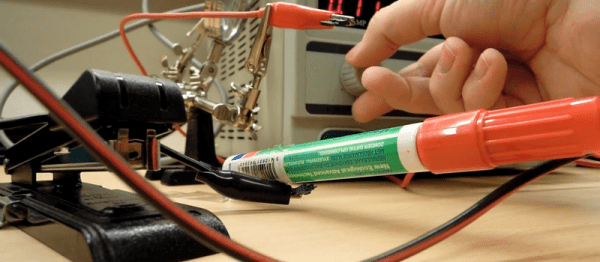
Muscle Wire Pen Dances To Duke Nukem

[serdef] is clearly just having a little bit of fun here. One never needs a whiteboard pen that’s syncronized by MIDI to dance along with the theme from Duke Nukem.

But if you had all of the parts on hand (a highly liquid MIDI-driven relay board that connects straight up to a soundcard, some muscle wire, tape, and a whiteboard pen, naturally) we’re pretty sure that you would. You can watch the dancing pen in a video below the break.

The project is really about documenting the properties of [serdef]’s muscle wire, and he found that it doesn’t really contract enough with a short piece to get the desired effect. So he added more wire. We’ve always meant to get around to playing with muscle wire, and we were surprised by how quickly it reacted to changing the voltage in [serdef]’s second video.

Now the dancing pen isn’t the most sophisticated muscle wire project we’ve ever seen. And that award also doesn’t go to this Nitinol-powered inchworm. Did you know that there’s muscle wire inside Microsoft’s Surface?

Continue reading “Muscle Wire Pen Dances To Duke Nukem”

Polyphonic FM Synthesizer Uses ARM

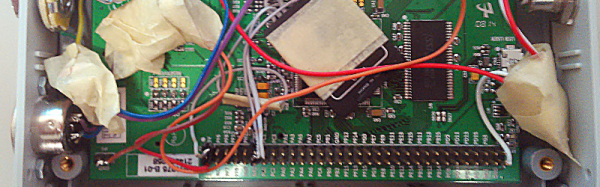
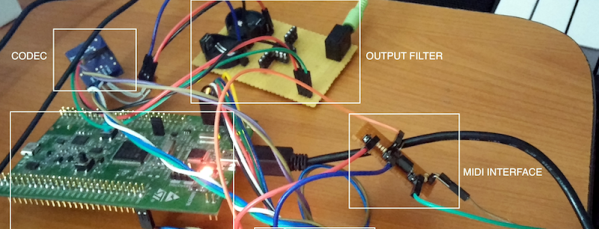
There seems to be a direct correlation between musicians and people who can program. Even programmers who don’t play an instrument often have a profound appreciation of music and so we see quite a few musical projects pop up. [Ihsan Kehribar’s] latest project is a good example. He married an STM32F031 ARM development board, an audio codec, and a simple op amp filter to make a playable MIDI instrument. Of course, it is hard to appreciate a music project from a picture, but if you want to listen to the results, there’s always Soundcloud.

He’d started the project using an 8-bit micro, but ran into some limitations. He switched to an STM32F031, which is a low-end ARM Cortex M0 chip. [Ihsan] mentions that he could have used the DSP instructions built into larger ARM chips, but he wanted to keep the project done on minimal hardware. The audio CODEC chip is from Cirrus Logic (a WM8524), and it produces two output channels at 192 kHz. As an unexpected benefit, the CODEC uses a charge pump to generate a negative voltage (much like a MAX232 does) and [Ihsan] was able to tap that voltage to provide the op-amps in the audio filter with a negative supply rail.

Continue reading “Polyphonic FM Synthesizer Uses ARM”

Start Gaming Early With IKEA High (Score) Chair

If you want your kid to be really great at something, you have to start them out early. [Phil Tucker] must want his kid to be a video gamer pretty badly. [Phil’s] build starts with a $20 IKEA high chair. He likes these chairs because at that price point, tearing into them isn’t a big risk. What’s more is you can buy extra trays so you can use it as a modular project with different trays serving different purposes.

The chair has two joysticks and two buttons, looking suspiciously like a video game controller. The current incarnation (see video, below) uses an Arduino Uno to trigger an Akai MPC1000 synthesizer via the MIDI interface.

Continue reading “Start Gaming Early With IKEA High (Score) Chair”

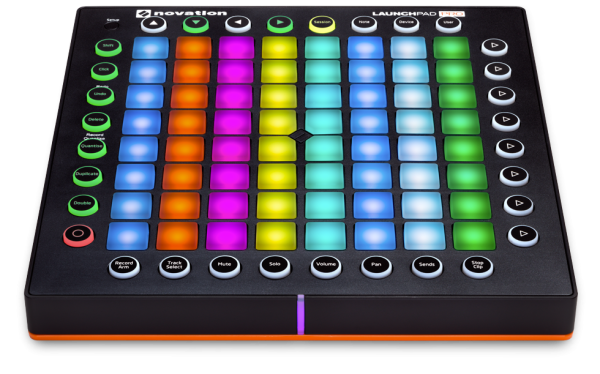
The Launchpad Pro, which now has an open-source API

Novation Launchpad MIDI Controller Moves Toward Open Source

The Novation Launchpad is a MIDI controller, most commonly used with the Ableton Live digital audio workstation. It’s an eight by eight grid of buttons with RGB LED backlights that sends MIDI commands to your PC over USB. It’s often used to trigger clips, which is demonstrated by the artist Madeon in this video.

The Launchpad is useful as a MIDI input device, but that’s about all it used to do. But now, Novation has released an open source API for the Novation Pro. This makes it possible to write your own code to run on the controller, which can be flashed using a USB bootloader. An API gives you access to the hardware, and example code is provided.

[Jason Hotchkiss], who gave us the tip on this, has been hacking around with the API. The Launchpad Pro has a good old 5 pin MIDI output, which can be connected directly to a synth. [Jason]’s custom firmware uses the Launchpad Pro as a standalone MIDI sequencer. You can check out a video of this after the break.

Unfortunately, Novation didn’t open source the factory firmware. However, this open API is a welcome change to the usual closed-source nature of audio devices.

Continue reading “Novation Launchpad MIDI Controller Moves Toward Open Source”

Zynq And The OPL3 Music Synthesizer

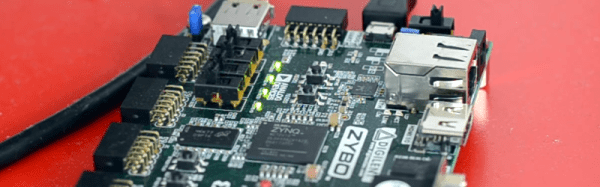
We’re big fans of the Zynq, which is an answer to the question: what do you get when you cross a big ARM processor with a big FPGA? So it isn’t surprising that [GregTaylor’s] project to emulate the OPL3 FM Synthesis chip in an FPGA using the Zynq caught our eye.

The OPL3 (also known as the Yamaha YMF262) was a very common MIDI chip on older PC sound cards. If you had a Sound Blaster Pro or 16 board, you had an OPL3 chip in your PC. The OPL3 was responsible for a lot of the music you associate with vintage video games like Doom. [Greg] not only duplicated the chip’s functions, but also ported imfplay from DOS to run on the Zynq’s ARM processors so he could reproduce those old video game sounds.

The Zybo board that [Greg] uses includes an Analog Devices SSM2603 audio codec with dual 24-bit DACs and 256X oversampling. However, the interface to the codec is isolated in the code, so it ought to be possible to port the design to other hardware without much trouble.

To better match the original device’s sampling rate with the faster CODEC, this design runs at a slightly slower frequency than the OPL3, but thanks to the efficient FPGA logic, the new device can easily keep up with the 49.7 kHz sample rate.

Using an FPGA to emulate an OPL3 might seem to be overkill, but we’ve seen worse. If you prefer to do your synthesis old school, you can probably get a bulk price on 555 chips.

Continue reading “Zynq And The OPL3 Music Synthesizer”