Looks Like A Glove, Plays Like A Musical Instrument

The GePS is a musical project that shows how important integration work is when it comes to gesture controls. Creators [Cedric Spindler] and [Frederic Robinson] demonstrate how the output of a hand-mounted IMU (Inertial Measurement Unit) and magnetometer can be used to turn motion, gestures, and quick snap movements into musical output. The GePS is designed to have enough repeatability and low enough latency that feedback is practically immediate. As a result, it can be used and played like any other musical instrument that creates sound from physical movements in a predictable way. It’s not unlike a Theremin in that way, but much more configurable.

To do this, [Cedric] and [Frederic] made GePS from a CurieNano board (based on Intel’s Curie, which also has the IMU on-board) and an XBee radio for a wireless connection to software running on a computer, from which the sounds are played. The device’s sensitivity and low lag means that even small movements can be reliably captured, meaning that the kind of fluid and complex movements that hands do every day can be used as the basis for playing sounds with immediate feedback. In a very real sense, the glove-based GePS is an experimental kind of new instrument, which makes it a fascinating contender for the Musical Instrument Challenge portion of the 2018 Hackaday Prize.

This Is Your Last Chance To Enter The Hackaday Prize

For the last seven months, we’ve been running the world’s greatest hardware competition. The Hackaday Prize is the Academy Awards of Open Hardware, and a competition where thousands of hardware hackers compete to build a better future. The results have already been phenomenal, but all good things must come to an end: we’re wrapping up the last challenge in the Hackaday Prize, after which the finalists of the five rounds will move on, with the ultimate winner being announced next month at the Hackaday Superconference.

We’re in the final hours of the Musical Instrument Challenge, where we’re asking everyone to build the next evolution of modern music instrumentation. We’re looking for the next electric guitar, theremin, synthesizer, violin, or an MPC. What we’ve seen so far is, quite simply, amazing. One of the finalists from the five challenges in this year’s Hackaday Prize will win $50,000 USD, but twenty projects from the Musical Instrument Challenge will each win $1000. We’ll be figuring out those winners on Monday, where they’ll move onto the final round, refereed by our fantastic judges.

It’s still not too late to get in on the action in this year’s Musical Instrument Challenge. We’re looking for the best musical projects out there, but time is of the essence. This round closes on October 8th at 07:00 PDT. There’s still time, though, so start your entry now.

Continue reading “This Is Your Last Chance To Enter The Hackaday Prize”

Sounding A Sour Note Can Save People From A Sour Stomach (Or Worse)

We’ve covered construction of novel music instruments on these pages, and we’ve covered many people tearing down scientific instruments. But today we’ve got something that managed to cross over from one world of “instrument” into another: a music instrument modified to measure a liquid’s density by listening to changes in its pitch.

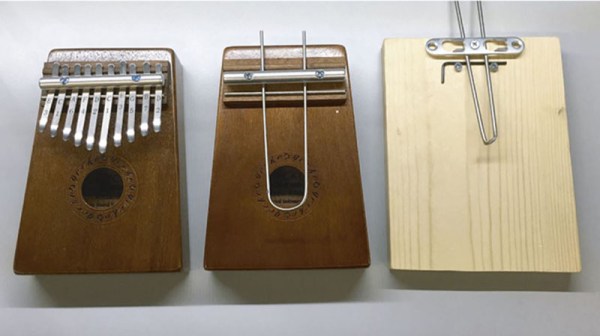
This exploration started with a mbira, a mechanically simple music instrument. Its row of rigid metal tines was replaced with a single small diameter hollow metal tube. Filling the tube with different liquids would result in different sounds. Those sounds are captured by a cell phone and processed by an algorithm to calculate the difference in relative density of those liquids. Once the procedure was worked out, the concept was verified to work on a super simple instrument built out of everyday parts: a tube mounted on a piece of wood.

At this point we have something that would be a great science class demonstration, but the authors went a step further and described how this cheap sensor can be used to solve an actual problem: detecting counterfeit pharmaceuticals. Changing composition of a drug would also change its density, so a cheap way to compare densities between a questionable sample against a known good reference could be a valuable tool in parts of the world where chemistry labs are scarce.

For future development, this team invites the world to join them applying the same basic idea in other ways, making precise measurements for almost no cost. “Any physical, chemical, or biological phenomena that reproducibly alters the pitch-determining properties of a musical instrument could in principle be measured by the instrument.” We are the ideal demographic to devise new variations on this theme. Let us know what you come up with!

If you need to do quick tests before writing analysis software, audio frequency can be measured using the Google Science Journal app. We’ve seen several hacks turning a cell phone’s camera into instruments like a spectrometer or microscope, but hacks using a phone’s microphone is less common and ripe for exploration. And anyone who manages to make cool measurements while simultaneously making cool music will instantly become a serious contender in our Hackaday Prize music instrument challenge!

[via Science News]

Strike A Chord With This LED Ukulele

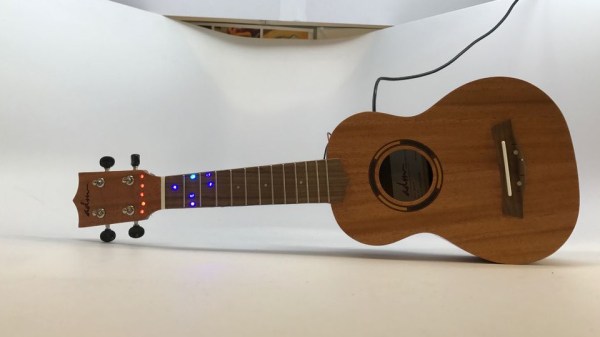
You may laugh off the ukulele as a toy or joke instrument, and admittedly, their starting price tag and the quality that usually comes with such a price tag doesn’t help much to get a different opinion on that. But it also makes it the perfect instrument for your next project. After all, they’re easy to handle, portable, and cheap enough to use a drill and other tools on them without too much regret. Plus, a little knowledge to play can get you far, and [Elaine] can teach you the essential, “all the pop songs use it”, four chords with her Arduino powered LED Ukulele.

As first step, [Elaine] drilled holes in her ukulele’s fingerboard to place some LEDs at all the positions required to play the four chords C, G, Am, and F. Connected to an Arduino attached to the ukulele’s back, each chord will light up its associated LEDs to indicate the finger positions required to play the chord itself. Taking the teaching part a step further, her next step is to extend each LED with a second, light sensing one, and read back if the fingers are placed at the correct position.

[Elaine] has already plans to turn the ukulele into an interactive game next. And if four chords are eventually not enough for you anymore, have a look at another LED based project teaching to play any major, minor and major seventh chord on the ukulele.

Students Hack An Unusual Violin

[Sean Riley] is a violinist who had a problem. He wanted to play one particular piece, but he couldn’t. It wasn’t that he lacked the skill — he a doctoral student at the University of Texas and has two degrees in violin performance from The Julliard School. The problem was that “The Dharma at Big Sur” by [John Adams] is made for an instrument with six strings, while most violins only have four. So he did what any of us would do. He stopped by the local hackerspace and fabricated one. You can hear (and see) [Sean] performing with the instrument in the video, below.

The University of Texas operates “The Foundry” which is a hackerspace with all the usual items: laser cutters, 3D printers, and the like. It is open to all their students and staff. [Sean] needed some help with the engineering, and was lucky to find a mechanical engineering senior, [Daniel Goodwin], working at The Foundry.

Continue reading “Students Hack An Unusual Violin”

Key-tar Lets You Jam At The Hackerspace

We’ve seen our share of stepper motors making music, but [Tanner Tech’s] key-tar takes it to a whole new level. Incorporating an acoustic drum to accentuate the stepper motor sounds and a preamp to feed a guitar amplifier, the key-tar is a fully playable instrument.

Moving the stepper via an Arduino at different speeds creates different notes. The user interface is an old PC keyboard. Apparently, [Tanner] recycled most of the parts in his model. The stepper came from an old printer and the keyboard was a dumpster rescue.

Continue reading “Key-tar Lets You Jam At The Hackerspace”

Autonomous Electro-musical Devices

Circuit-bending is tons of fun. The basic idea is that you take parts of any old electronic device, say a cheap toy keyboard, and probe all around with wires and resistors, disturbing its normal functioning and hoping to get something cool. And then you make art or music or whatever out of it. But that’s a lot of work. What you really need is a circuit-bending robot!

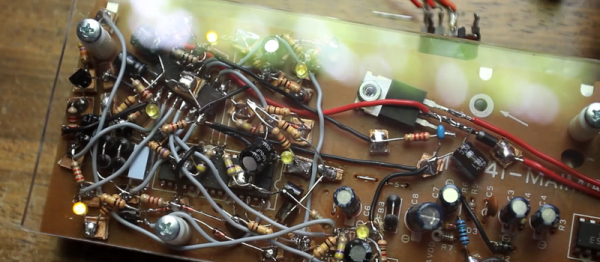
Or at least that’s what [Gijs Gieskes] needed, when he took apart a horrible Casio SA-5 and grafted on enough automatic glitching circuitry to turn it into a self-playing musical sculpture. It’s random, but somehow it’s musical. It’s great stuff. Check out the video below to see what we mean.

We also love the way the autonomous glitching circuit is just laid over the top of the original circuitboard. It looks like some parasite out of Aliens. But with blinking LEDs.

Continue reading “Autonomous Electro-musical Devices”