Cadsoft Eagle Migrating To XML

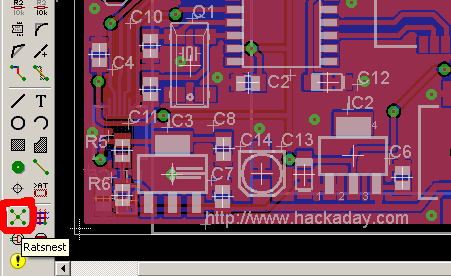
[PT] posted about an exciting development from Cadsoft, the migration to XML based parts, schematics, and board layouts. The adoption of this open standard goes hand-in-hand with the open hardware initiatives people like [PT] have been pushing for.

Cadsoft Eagle is our go-to schematic and PCB software. We even have a tutorial which guides you through preparing your files for PCB manufacture. But the files containing parts libraries, schematics, and board layouts have always been binaries. A transition to XML means a lot of things. They will be easier to edit, and much friendlier for tracking changes using version control systems like SVN, CVS, Mercurial SCM, Git, etc. But immediately on our minds is the accessibility for hacking. Think of how easy XML parsing is in programs like Python. It should be snap to write scripts on a whim that will manipulate the XML files in any way imaginable. This doesn’t discount the value of Eagle, it extends the usability far beyond what any team of engineers at Cadsoft could produce by themselves. And for that, we say Bravo.
Spinning POV Clock Done Oh-so-right

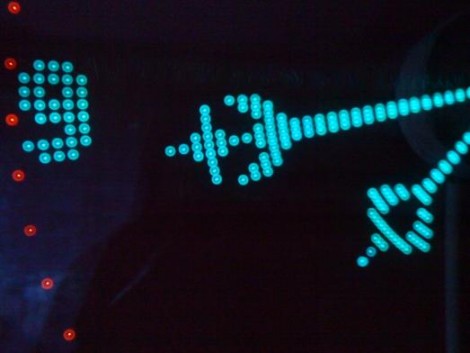
[Kizo] built an extraordinary persistence of vision clock. The design uses a PC cooling fan to spin the propeller-like PCB. As it goes around, a hall effect sensor synchronizes the illumination of the LEDs to draw the display. Power for the rotating electronics is transferred wirelessly via a transformer on the base and coil on the spinning board. The final version uses an ATmega324 microcontroller running at 20 MHz and has an IR receiver for changing the settings. The 3000 lines of code bring a lot of bells and whistles, including a menu system with a huge amount of settings from tweaking the clock display, to font selection for scrolling messages. Take a look at the demo after the break. The double-sided board looks like it’s pretty difficult to etch at home, but as you can see from the forum post (translated), [Kizo] did a great job on this build from start to finish. Continue reading “Spinning POV Clock Done Oh-so-right”

Open Source Pick-and-place

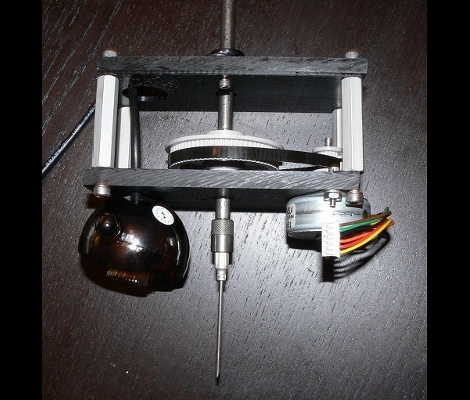
This is a vacuum tweezers head for an open source pick-and-place. Those are the machines that professional printed circuit board manufacturers use to populate a circuit board with components before heading to the reflow oven. [Drmn4ea] built it with at-home rapid manufacturing in mind. The black orb on the left is a webcam for optical placement. The needle in the middle is an interchangeable vacuum-tool head. The motor on the right allows for different attachments to be swapped in automatically to suit a variety of parts.

This interfaces with a 3-axis CNC machine and should be easily compatible with a RepRap, Makerbot, or similar device. We wonder how he plans to handle reels of components, but this is a well-executed first step in the journey to a complete solution.

Want to see a professional pick-and-place at work? Check out one of SparkFun’s machines busy build a board after the break.

Continue reading “Open Source Pick-and-place”

Next Generation Arduino Manufacturing Problems?

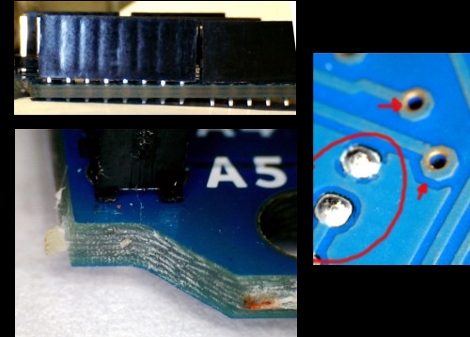
[The Moogle] just got his new Arduino Uno; wow, that was fast. What should have been a happy unboxing turned sour when he took a close look at the board. It seems that it exhibits several examples of sloppy fabrication. The the lower-left image shows unclean board routing, a discolored edge, and a sharp tooth sticking out from the corner. The shield header shown in the upper left is not flush with the board, resulting in a weaker physical union and a crooked connection. There are vias that look like they’re not be centered in the solder mask, and areas where raw copper is exposed.

It saddens us to see this because the original Arduino boards were so well manufactured. Keep in mind that this may be an isolated case, and as of yet the company hasn’t been given the chance to swap out the board for one that has passed a more rigorous quality control inspection. But if you’ve already ordered one of your own, take a close look and make sure you’re satisfied with it upon arrival.

Not sure what we mean by next generation Arduino? Take a look at the new hardware that was recently unveiled.

Update: Here’s a direct response from the Arduino blog.

Update #2: [Massimo Banzi], one of the founders of Arduino, took the time to comment on this post. It details the organization’s willingness to remedy situations like [The Moogle] encountered and also links to the recent Arduino blog post.

Analog Stylophone

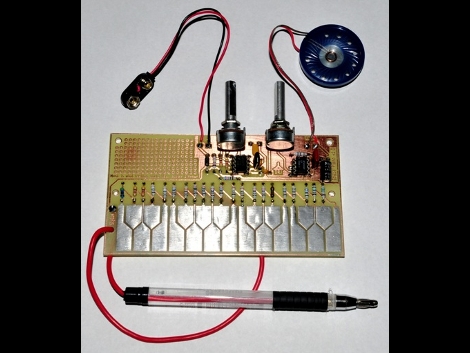
[Doug Jackson] just finished building an analog Stylophone. We’ve seen this instrument a few times before, most recently with an Arduino-based controller, but this one makes use of 555-timer, resistors, and potentiometers to generate the waveform for each note. If you’ve got the copper-clad and the means to etch the board everything else should be pretty easy to come by. We did note that since this is a single-sided board you’ll be soldering on the same side as the components, which can get a bit hairy but manageable. We just wish that [Doug] has posted a demonstration video so we could hear what this sounds like. But it can’t be too much different from that electronic vuvuzela that used a 555 timer as well.

Hackaday Links: August 29, 2010

Hotel room door lock picking

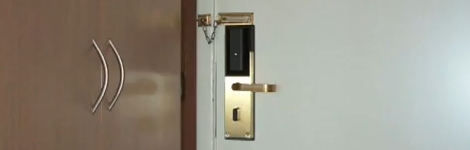
Here’s further proof that you should never leave anything of value in your hotel room. We’re not worried about someone getting in while the room is occupied. But these methods of defeating the chain lock and opening the door without a keycard (YouTube login required) do show how easy it is for the bad guys to steal your stuff.

iPhone frequency generator

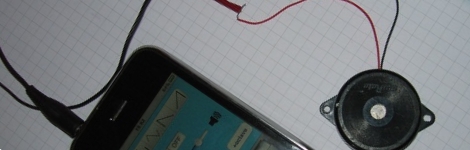
Need one more way to make that iPhone a useful lab tool? Why not use it as a frequency generator. Start with a free app and mix in an audio cable with test leads and you’re in business.

Drag Soldering

[Andrei] sent us a link to a video about drag soldering. This is a method of soldering fine-pitch chips using a small bit of solder and a fat solder tip. The link he sent is dead now but we found another great example of the process. We were just using this method earlier in the week to solder a TSSOP38 package for an upcoming project and it worked like a charm.

Laser etched PCB

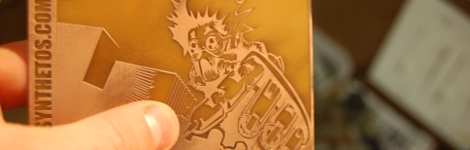
Here’s some art in PCB form thanks to a laser. We thought this might be interesting to share after seeing those art pieces made from old circuit boards. This example is laser etched, but not directly. As you probably guessed, the copper clad board is coated with resist and the laser etches some of it away. Whatever got zapped by the laser dissolves when the board is placed in acid, leaving [Riley Porter’s] art behind.

Art Piece From Board Artwork

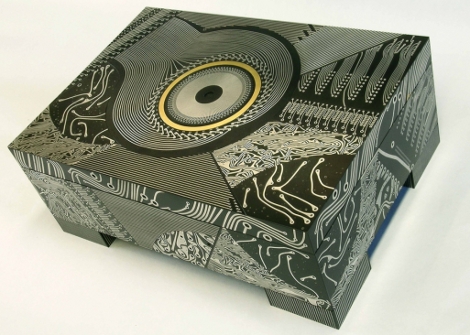
[Theo Kamecke] is an artist who produces striking pieces using printed circuit boards. We’ve seen PCBs used as faux stained-glass before, but [Theo’s] craftsmanship stands apart from everything we’ve seen. His webpage has at least one piece that sites the usage of vintage 1960’s circuit boards, but we wonder if he doesn’t design some of these to suit his work. Either way, we’d love to see him take on the finish work for that mechanized expanding round table we saw back in June. See more of his work on his photostream.

[Photo Credit]

[Thanks Mowcius]