Watch An Electro-Permanent Magnet In Action

Electro-permanent magnets (EPMs) are pretty nifty concepts, and if you aren’t familiar with them, they are permanent magnets with the ability to be electrically switched on or off. Unlike an electromagnet — which maintains a magnetic field only while power is applied — an EPM can remain “on” even when power is removed. Want to see one work? There’s a video embedded below that shows one off, but if you’d like to know how they work, we have you covered.

Inside are two types of magnet, one of which is permanent and the other being a semi-hard magnet paired with an electromagnetic coil. A semi-hard magnet’s flux can be changed by exposing it to a strong enough magnetic field, and that’s the key to making it work.
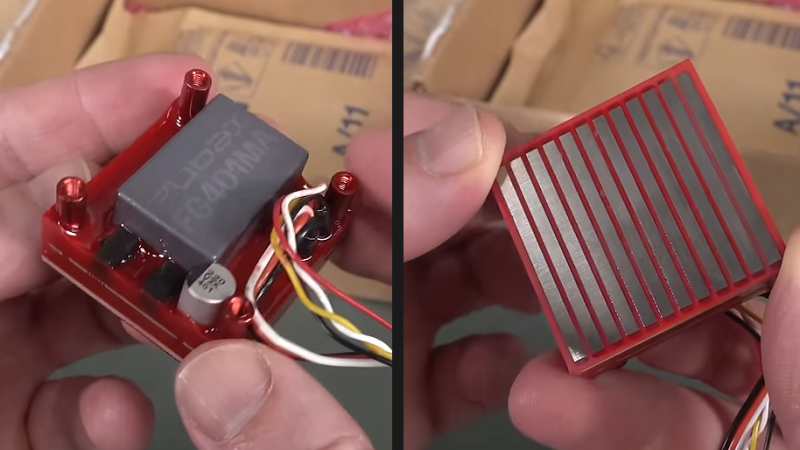
Being able to electrically switch a permanent magnet on or off is a neat trick.

When both magnets work together, the EPM is “on” and acts like a permanent magnet. To turn the EPM off, the polarity of the semi-hard magnet is flipped with a short and powerful electromagnetic pulse, after which the two magnets oppose one another and more or less cancel each other out. So rather than generating a magnetic field, an EPM more accurately reconfigures it.

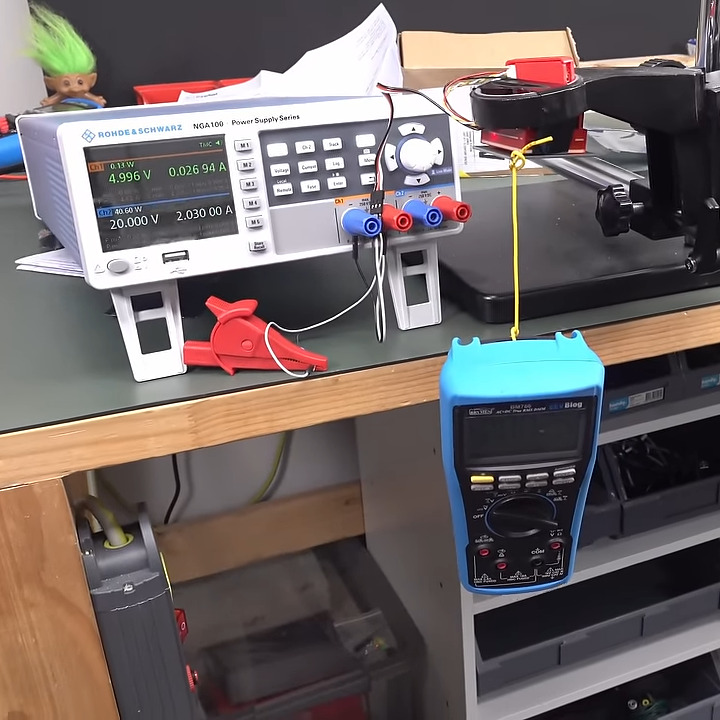
As intriguing as EPMs are, we haven’t really seen one properly in action until it was brought to our attention that [Dave Jones] of EEVblog tried one out last year. He received a Zubax FluxGrip EPM, which is intended for drone and robotic applications and can hold up to 25 kg. Watch [Dave] fire it up in the video (link is cued up to the 7:30 mark), it’s pretty interesting to see one of these actually work.

EPMs are not prohibitively expensive but they are not exactly cheap, either. But if a switchable magnet sounds up your alley and you can’t afford an EPM, consider an alternative “switchable” magnet design that works by momentarily canceling out a permanent magnet with a paired electromagnet. Unlike an EPM, it’s not a permanent switch but it would be enough to drop a payload.

Continue reading “Watch An Electro-Permanent Magnet In Action”

Finding A Way To Produce Powerful Motors Without Rare Earths

The electric vehicle revolution has created market forces to drive all sorts of innovations. Battery technology has progressed at a rapid pace, and engineers have developed ways to charge vehicles at ever more breakneck rates. Similarly, electric motors have become more powerful and more compact, delivering greater performance than ever before.

In the latter case, while modern EV motors are very capable things, they’re also reliant on materials that are increasingly hard to come by. Most specifically, it’s the rare earth materials that make their magnets so good. The vast majority of these minerals come from China, with trade woes and geopolitics making it difficult to get them at any sort of reasonable price. Thus has sprung up a new market force, pushing engineers to search for new ways to make their motors compact, efficient, and powerful.

Continue reading “Finding A Way To Produce Powerful Motors Without Rare Earths”

Trees Turned Into Wind Turbines, Non-Destructively

Trees and forests are an incredibly important natural resource — not only for lumber and agricultural products, but also because they maintain a huge amount of biodiversity, stabilize their local environments, and help combat climate change as a way to sequester atmospheric carbon. But the one thing they don’t do is make electricity. At least, not directly. [Concept Crafted Creations] is working on solving this issue by essentially turning an unmodified tree into a kind of wind turbine.

The idea works by first attaching a linear generator to the trunk of a tree. This generator has a hand-wound set of coils on the outside, with permanent magnets on a shaft that can travel up and down inside the set of coils. The motion to power the generator comes from a set of ropes connected high up in the tree’s branches. When the wind moves the branches, the ropes transfer the energy to a 3D printed rotational mechanism attached to a gearbox, which then pumps the generator up and down. The more ropes, branches, and generators attached to a tree the more electricity can be produced.

Admittedly, this project is still a proof-of-concept, although the currently deployed prototype seems promising. [Concept Crafted Creations] hopes to work with others building similar devices to improve on the idea and build more refined prototypes in the future. It’s also not the only way of building a wind energy generator outside of the traditional bladed design, either. It’s possible to build a wind-powered generator with no moving parts that uses vibrations instead of rotational motion as well.

Continue reading “Trees Turned Into Wind Turbines, Non-Destructively”

Visual Magnetic Fields

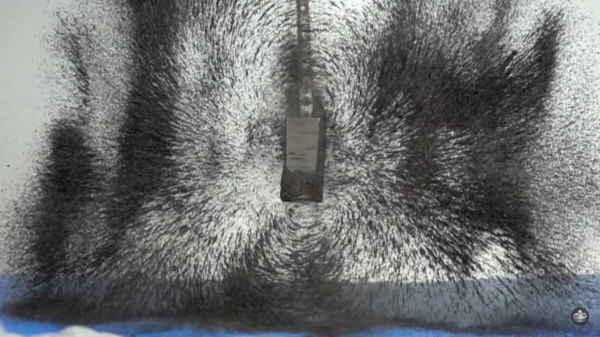
If you need help visualizing magnetic fields, these slow-motion video captures should educate or captivate you. Flux lines are difficult to describe in words, because magnet shape and strength play a part. It might thus be difficult to visualize what is happening with a conical magnet, for a person used to a bar magnet. We should advise you before you watch the video below the break, if you are repelled by the sight of magnetite sand clogging a bare magnet then flying on the floor, this is your only warning.

The technique and equipment are simple and shown in the video. A layer of black sand is spread on a piece of tense plastic to make something like a dirty trampoline, and a neodymium magnet is dropped in the middle. The bouncing action launches the sand and magnet simultaneously so they are hanging in the air and the particles can move with little more than air resistance.

These videos were all taken with a single camera and a single magnet. Multiple cameras would yield 3D visuals, and the intertwining fields of multiple magnets can be beautiful. Perhaps a helix of spherical magnets? What do you have lying around the hosue? In a twist, we can use magnets to simulate gas atoms and trick them into performing unusual feats.

Continue reading “Visual Magnetic Fields”

Hovering Questions About Magnetic Levitation

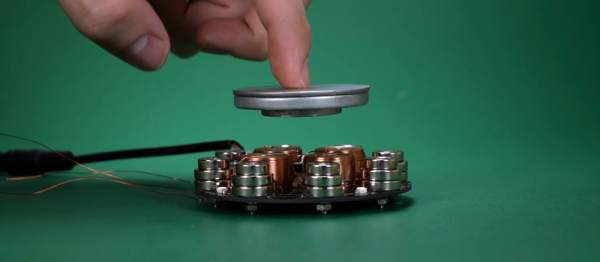
Who doesn’t love magnets? They’re functional, mysterious, and at the heart of nearly every electric motor. They can make objects appear to defy gravity or move on their own. If you’re like us, when you first started grappling with the refrigerator magnets, you tried to make one hover motionlessly over another. We tried to position one magnet over another by pitting their repellent forces against each other but [K&J Magnetics] explains why this will never work and how levitation can be done with electromagnets. (YouTube, embedded below.)

In the video, there is a quick demonstration of their levitation rig and a brief explanation with some handy oscilloscope readings to show what’s happening on the control side. The most valuable part, is the explanation in the article where it walks us through the process, starting with the reason permanent magnets can’t be used which leads into why electromagnets can be successful.

[K&J Magnetics]’s posts about magnets are informative and well-written. They have a rich mix of high-level subjects without diluting them by glossing over the important parts. Of course, as a retailer, they want to sell their magnets but the knowledge they share can be used anywhere, possibly even the magnets you have in your home.

Simpler levitators can be built with a single electromagnet to get you on the fast-track to building your own levitation rig. Remember in the first paragraph when we said ‘nearly’ every electric motor used magnets, piezoelectric motors spin without magnets.

Continue reading “Hovering Questions About Magnetic Levitation”