USBPIC Controls Just About Anything

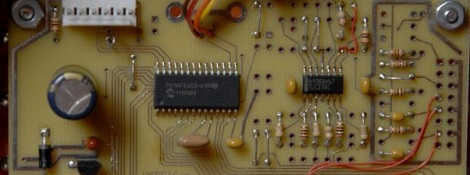
Over the last few years, [Michael] has been developing a PIC microcontroller board. He calls his project USBPIC, and with the addition of a few FET drivers, H-bridges, and LED drivers his homemade dev board can handle just about anything thrown at it.

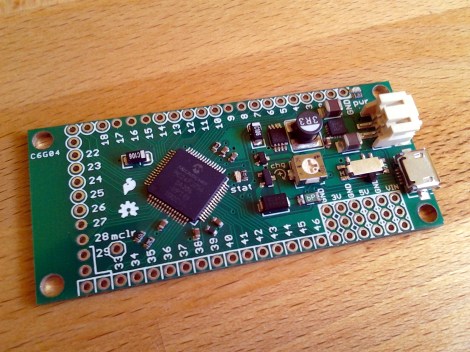
[Michael]’s board is build around a PIC18F2455 microcontroller with both an In Circuit Serial Programming header and support for a USB port included. Instead of going for a modular format where the board can expanded through shields or expansion cards, [Michael] decided to make three different versions of the USBPIC.

The TRANS USBPIC includes eight FETs for switching off high current devices totaling 32 Amps. The MATRIX board has twice as many outputs as the TRANS board, but uses ULN2803 or UDN2982 chips for driving smallish-current devices. Finally, the HBSW board takes a TRANS board and replaces four FETs with a an L298 H-bridge chip for driving two DC motors.

For what [Michael] lost in modularity, we think he gained a very tidy microcontroller board capable of driving everything from robots to LED matrix displays.
How To Build Your Own Dedicated Pandora Radio

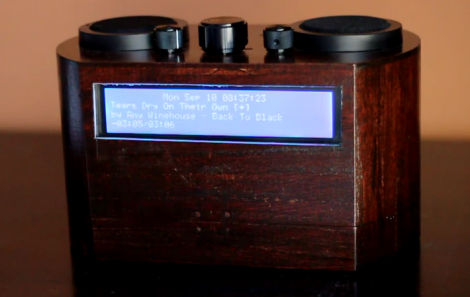
This mix of modern and retro acts as a standalone Pandora client. It’s certainly a radio upgrade, falling somewhere in between the passive listening of traditional broadcasts, and the complete control of music players that use playlists.

Inside the wooden case a BeagleBoard does most of the work. It’s running Ubuntu 12.04 on which pianobar, a command line interface package for Pandora is running. Those components alone would make a pretty nice listening experience, but since Pandora rolls different music into the mix it’s nice to be able to see what you’re listening to. The four-line LCD is wide enough to display plenty of information. It’s being controlled by a PIC24 microcontroller which also monitors the controls on the top. As you can see in the video after the break, the user interface offers almost everything you could want. It’s easy to switch stations, and you can still register your preferences on each track being played.

Continue reading “How To Build Your Own Dedicated Pandora Radio”

Programming Without A Toolchain; Crafting PIC Op Code By Hand

We’ve been living a life of luxury, writing our microcontroller code in a text editor and using — of all things — a compiler to turn it into something the chip can use. [Dan Amlund Thomsen] shows us a different way of doing things. He’s actually crafting the operation codes for a PIC microcontroller by hand. We’re glad he’s explained this in-depth because right now we feel way over our heads.

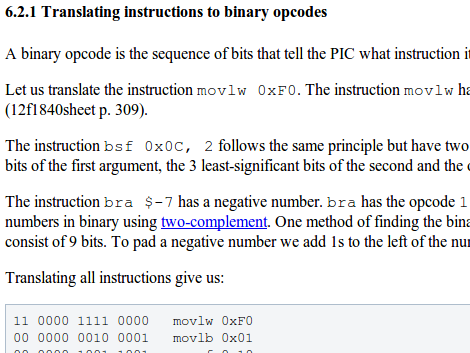
His program is pretty simple, it blinks a single LED and he’s chosen t work with a PIC 12F1840. The first order of business is to issues the words that configure the chip using 14-bit binary values from the datasheet. From there he goes on to write the program in assembly code. At this point he could pretty much just run this through the assembler, but he’s really just getting started now. He walks through the format necessary to package the configuration words, then goes on to illustrate the translation of assembly commands to binary op codes. We’re not sure we’ll ever get around to trying this ourselves, but it was certainly fun to read about it.

Video Preview: New IOIO Prototype

We got our hands on this prototype of the new IOIO design. It’s a breakout board that makes adding hardware to an Android device pretty easy.  [Ytai Ben-Tsvi] sent it our way, and took a bit of time to explain some of the differences between this board and the original version. You can see our video preview embedded after the break.

The size and form factor of the board remain the same, but the choice and layout of parts has changed. Most obviously, the USB-A connector is gone, replaced by a USB mini-B micro-B connector. This makes it possible to use the board as a USB-on-the-go device, or as a USB host device with the help of an adapter that will ship with the board. The JST connector is for external power. The previous revision included a footprint for it but it was never populated. There has also been an upgrade to the voltage regulation circuit, using a newer part as the switch-mode regulator.

There was a last-minute bug discovered in the layout. [Ytai] wants iron-clad 5V to ground short protection and is re-spinning the board to ensure he achieves that goal. He can’t say for sure, but as we mentioned in our previous post about the prototype, a price cut is planned. It could cut the current price of $50 down to just $30, but that won’t be decided until all of the choices have been made for the first production run.

Continue reading “Video Preview: New IOIO Prototype”

Dumping A C64 Kernel

[Blark] picked up a couple of Commodore 64 machines on Craig’s List so that he could play around with the SID chips inside. But there’s some other fun stuff in there and his attention was drawn to the PROM which stores the kernel. He thought it would be a fun adventure to build a ROM dumper capable of storing binary images.

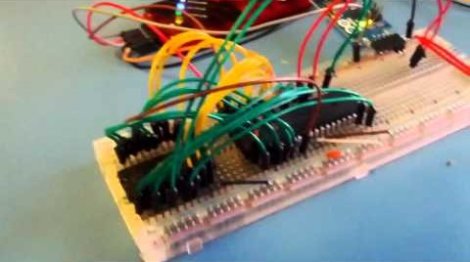
In the video after the break you can see that when powered up the dumper immediately starts streaming hex values to the terminal. The system is set up to feed a Python script which packs the data stream into an image file. The reading is done by a PIC 18F4520, streaming the data in at 9600 baud with a generous delay between each address read to get the cleanest read possible. He had a bit of help from the AVR Freaks to get to this point.

We’d guess he’s going to pull the image off the chip several times and compare results to filter out any possible data corruption. From there we’re not sure what he’ll do with the files but there’s always the possibility of making is own emulator using this kernel image.

Continue reading “Dumping A C64 Kernel”

2708 EPROM Dumper

[Andrea “Mancausoft” Milazzo] has been restoring old equipment which often contain EPROM chips. He thought he was all set with an EPROM reader which easily dumped the data from 2716 chips and a few others. But he found that the hardware was unable to read 2708 and 2704 chips. His solution was to build a PIC-based EPROM dumper.

You may remember from some of our recent features that these chips are something of a ticking clock. They store program code and other information vital to the functioning of old hardware. Since they’re erased with UV light, years of exposure to ambient light can zap some of the data.

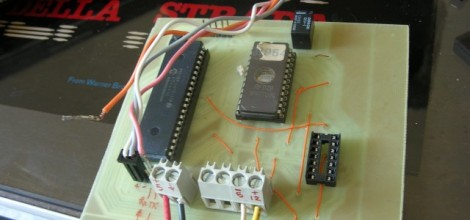
The specs needed to read a chip of this type are rather rudimentary. There are ten address pins and eight data pins. [Andrea] also needed a way to get data from the microcontroller to a computer for backup. He uses two more pins for this purpose, bringing the I/O count to 20. He went with  PIC 18F4610 and built the rest of the reader around it.

Adding Features To A DX6i Transmitter

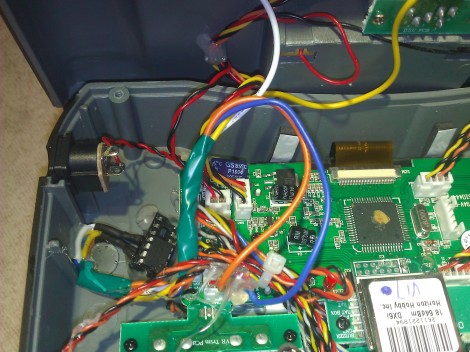
About thirty cents and some wire are all it takes to start hacking extra features into this DX6i transmitter. The DX6i is a six-channel, two-mode transmitter used to control hobby airplanes and helicopters. There are several built-in features but [Ligius] found an easy way to add a few more. In the upper left portion of the case you can see the eight-pin microcontroller he brought to the project.

It’s a PIC 10F222 mounted in a DIP socket so that it may be removed for reprogramming. The hardware page of the wiki shows the connections he made. By reading from the throttle, and tapping into the trainer wire, he is able to add features without any apparent alterations to the controller (no extra buttons, etc). You can see in the clip after the break that the throttle position when power is switched on selects between different modes. This can be the delay for turning off the LCD backlight, or presets for helicopter or airplane modes. [Ligius] thinks there’s a lot more potential here, even the possibility of fixing a bug in this particular model of transmitter.

Continue reading “Adding Features To A DX6i Transmitter”