Giant working NERF gun runs on Arduino.

Giant Working NERF Gun Runs On Tiny Arduino

Well, here it is: a shoe-in for the new world’s largest NERF gun. (Video, embedded below.) The Guinness people haven’t shown up yet to award [Michael Pick], but at 12.5 feet, this baby is over twice as long as the current record holder, which belongs to former NASA mechanical engineer Mark Rober and his now-puny six-foot six-shooter.

We have to wonder if it is technically bigger than the six-shooter, because they seem to be roughly the same scale, except that [Michael] chose a much bigger model to start from. The main body is made from wood, and there are a ton of 3D-printed details that make it look fantastically accurate. The whole thing weighs over 200 pounds and takes at least two people to move it around. We especially love the DIY darts that [Michael] came up with, which are made from a PVC tube inside a section of pool noodle, topped off with a 3D printed piece for that distinctive orange cap.

Propelling those darts at around 50 MPH is a 3,000 PSI air tank connected to an Arduino Pro Mini that controls the trigger and the air valves. While [Michael] hasn’t run the thing quite that high, it does plenty of damage in the neighborhood of 40-80 PSI. As you’ll see in the video after the break, this is quite the ranged weapon. Watch it blow a hole clean through a sheet of drywall and much more.

Want to build something with a bit more stealth? Make it death from above with a NERF quadcopter.

Continue reading “Giant Working NERF Gun Runs On Tiny Arduino”
USB Mouse Hack For Pachyderm Protection

When most of us think of seismometers, our minds conjure up images of broken buildings, buckled roads, and search and rescue teams digging through rubble. But when [Subir Bhaduri] his team were challenged with solving real world problems as frugally as possible as part of the 2020 Frugal Science course, he thought of farmers in rural India for whom losing crops due to raiding elephants is a reality. Such raids can and have caused loss of life for humans and elephants alike. How could he apply scientific means to prevent such conflicts, and do it on the cheap?

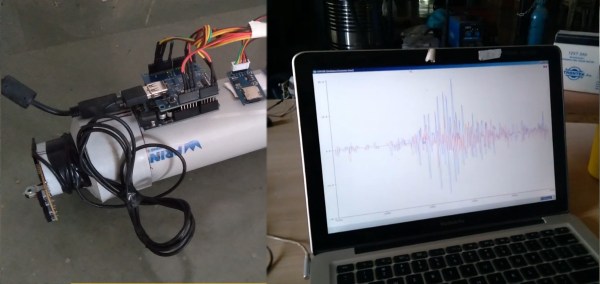
Whether inspiration came from using a computer mouse with the cursor speed turned up to “orbital velocity” is debatable, but [Subir] set forth to find out if such sensitivity could be leveraged for the seismic detection of the aforementioned elephants. His proof of concept is a fantastically frugal low cost seismograph using an optical mouse and some cheap PVC pipe and fittings.

We invite you to watch the video below the break to find out how it works. You’ll be impressed as we were by [Subir]’s practical application of engineering principles. And keep your eyes open for the beautiful magnetic damper hack. It’s a real treat!

If pontificating pesky pachyderms p-waves piques your interest, perhaps you’ll appreciate previous projects which produce data with piezo pickups and plumbing parts.

Continue reading “USB Mouse Hack For Pachyderm Protection”

Automatic Coil Winder Gets It Done With Simple Hardware And Software

We’ve grown to expect seeing mechatronics project incorporate a standard complement of components, things like stepper motors, Arduinos, lead screws, timing belts and pulleys, and aluminum extrusions. So when a project comes along that breaks that mold, even just a little, we sit up and take notice.

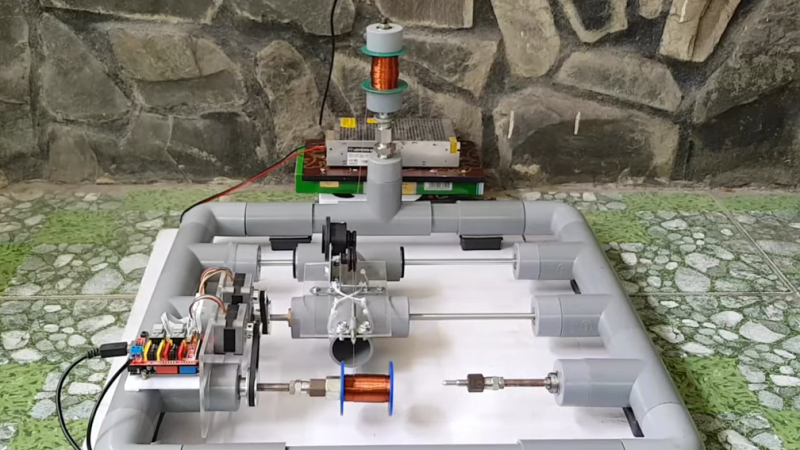
Departing somewhat from this hardware hacking lingua franca is [tuenhidiy]’s automatic coil winder, which instead of aluminum extrusions and 3D-printed connectors uses simple PVC pipe and fittings as a frame. Cheap, readily available, and easily worked, the PVC does a fine job here, and likely would on any project where forces are low and precision isn’t critical. The PVC frame holds two drive motors, one to wind the wire onto a form and one to drive a lead screw that moves the form back and forth. An Arduino with a CNC shield takes care of driving the motors, and the G-code needed to do so is generated by a simple spreadsheet that takes into account the number turns desired, the number of layers, the dimensions of the spool, and the diameters of the wire. The video below shows the machine going through its paces, with pretty neat and tidy results.

Being such a tedious task, this is far from the first coil winder we’ve seen. Some adhere to the standard design language, some take off in another direction entirely, but they’re all instructive and fun to watch in action.

Continue reading “Automatic Coil Winder Gets It Done With Simple Hardware And Software”

Teach Your Air Compressor To Blow Eggs

As fun as it is to decorate Easter eggs, the road to a hollow hen’s egg is a gross and gooey avenue. Trust us, it sucks to blow out eggs, and it’s hard to get it right. Plus, you know, there’s that whole salmonella thing. [Phil] decided to speed things up this year by using an air compressor to do the dirty work.

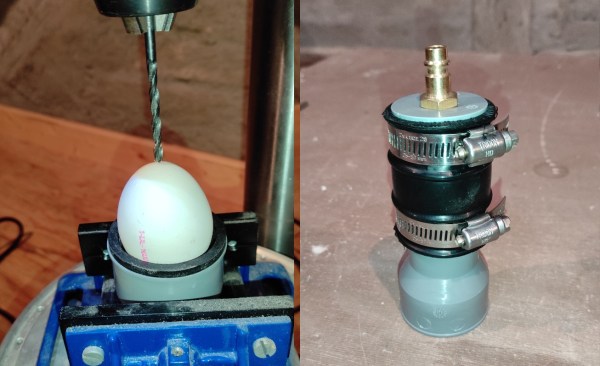
Of course, one must approach this problem delicately because eggs are fragile. It would be nice to drill the egg instead of poking the end with a needle, but how are you gonna pull that off without breaking it? As it turns out, all you need is a bench vise, the right piece of PVC, a bit of rubber to keep the egg safe, and some hose clamps to keep the business part together.

[Phil] built a two-stage contraption that serves both purposes — the bottom cup safely cradles the egg for drilling, and the identical top cup connects to the air compressor, which blows the goo out of the bottom hole. [Phil] might have used negative pressure instead, but doesn’t have a vacuum pump or hose. Be sure to check out the brief demo video below.

Don’t want to mess around with real eggs? There are tons of ways to beautify fake eggs, but few of them are as cool as lasers.

Continue reading “Teach Your Air Compressor To Blow Eggs”

Pool Temperature Monitor Mollifies Fortunate But Frustrated Children

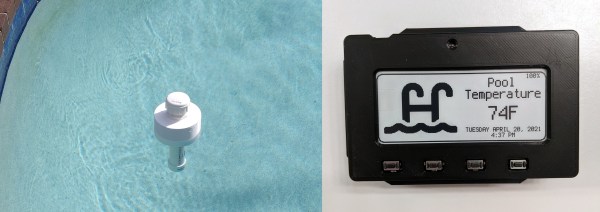
Who needs the city pool when you can party in the private pool over at Grandma and Grandpa’s house? No need to wait until Memorial Day weekend when it hits 90° F in the first week of May. But how can you placate grandchildren who want to know each and every day if it’s finally time to go swimming, and the pool itself is miles away? Although grandparents probably love to hear from you more often there’s no need to bother them with hourly phone calls. You just have to build a floating, remote pool temperature monitor which broadcasts every 30 minutes to an Adafruit MagTag sitting at kid’s eye level on the refrigerator.

Between the cost of commercial pool temperature monitors and all the reviews that mention iffy Wi-Fi connections, it sounds like [Blake] is better off rolling his own solution. Inside the floating part is an ESP32, a DS18B temperature sensor, and a 18650 cell. Most of the body is PVC, except for the 3D-printed torus that holds some foam for buoyancy. A handful of BBs in the bottom keep the thing pointed upright. For now, it shows the water temperature, but [Blake]’s ultimate goal is to show the air temperature as well.

Maybe it’s still too cold to swim, but the sun shines brightly most days. Why not harness its energy to heat up the water?

Two-Player PVC Racing Rig Plays Daytona USA

SEGA’s Daytona USA is that big orange arcade racing machine you remember from the 90s that still seems to hang on in cinemas and pizza joints worldwide. Its controls may be floaty and physics unrealistic, but it’s probably the one racing game that almost everyone has played at one point or other. [Tom Tilley] decided to build a PVC racing rig for the game during his travels in Thailand.

As a bonus, the lightweight rigs can be broken up and transported easily by scooter.

PVC pipe is used to whip up the frames for the budget simulator, inside which each player sits. Different sizes of PVC pipe and various adapters are used to create a basic steering wheel, to which a potentiometer is attached, while the centering mechanism is simply a rubber band. The pedals are built similarly and fitted with microswitches. The build relies on a cheap USB gamepad that mimics the typical PlayStation Dual Shock design, with the pot and switches wired in place of the existing thumbstick and buttons. A computer running the PC version of Daytona USA is then used to complete the setup, along with a projector for split-screen fun.

It’s certainly not a high-end simulator by any means, but for the price of some pipes and cheap controllers, [Tom] was able to create a two-player racing rig for a fraction of the cost to hire the real arcade machine for a weekend. The kids that playtested the system certainly seemed to have a good time, as well. We’ve seen similar low-tech builds before, too – with impressive results. Video after the break.

Continue reading “Two-Player PVC Racing Rig Plays Daytona USA”

PVC Pipes Play “Popcorn” Perfectly

There are all sorts of fun ways to make music with empty jugs and other things that resonate with a popping sound when poked with a finger. Should you ever get stuck on that proverbial desert island, you can entertain yourself by making cheerful, staccato music with nothing but a fingertip and the inside of your cheek. At the very least, it will keep your spirits up until you can fashion an ocarina from a coconut.

[Nicolas Bras] loves to make homemade instruments. When he saw all the scrap pieces of perfectly finger-sized PVC tubing piling up around the workshop, he decided to make an instrument specifically to play the effervescent synth tune “Popcorn”. (Video, embedded below.) He plays it by plugging and quickly unplugging wood-capped pipes with his fingers, and using another PVC tube to blow across the tops of them to fill out the orchestration.

[Nicolas] started by making a two-octave chromatic scale with 25 pipes ranging from C4 to C6. He kept building on it from there in both directions, ultimately ending up with a poppin’ 68-note pipe organ that sounds fantastic. If you’re interested in getting the sound samples, [Nicolas] has those and the instrument plans available through Patreon.

Be sure to check out the build and demo video below — it’s a joy to see it come together, and the whole thing clocks in under six minutes. Take our word for it and don’t jump to the “Popcorn” cover, because the build-up is necessary for maximum enjoyment.

Hungry for more “Popcorn”? Here’s a robotic glockenspiel busting out a striking cover.

Continue reading “PVC Pipes Play “Popcorn” Perfectly”