A Vintage Interface For A Modern Radio

The arrival of affordable software defined radio technologies over the last couple of decades has completely changed the way that radio amateurs and other radio enthusiasts approach the airwaves. There’s a minor problem with most software defined receivers though, being by their nature software driven they will usually rely on a host computer for their interface. Thus the experience is one of clicking mouse buttons or using keyboard shortcuts rather than the mechanical analogue dial interfaces that provided easy control of older radios.
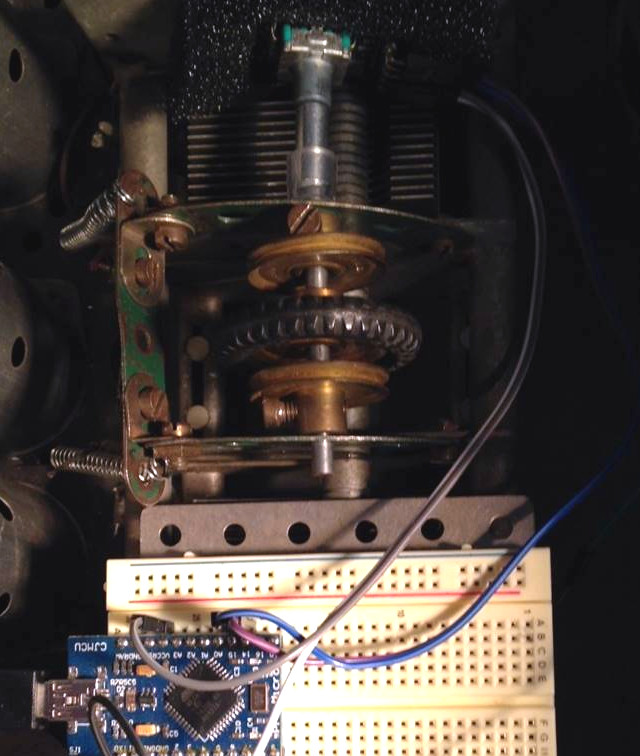
Meccano encoder mounts for the win!

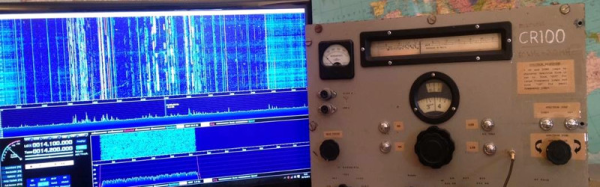
This is a problem that has been addressed by [Jon Hudson, G4ABQ], with one of his SDRplay receivers. He’s mounted it and its control PC in the chassis of a very aged and non-functional Marconi CR100 communication receiver, and given it a control interface that only uses the Marconi’s front panel controls (YouTube link). A rotary encoder has been grafted onto the Marconi tuning capacitor with what looks like some Meccano, and in turn that feeds an Arduino which behaves as a keyboard for the benefit of the PC. Some extra buttons have been added for mode selection, spectrum zoom and shift, and care appears to have been taken to give their labels a period feel. Arduino code came courtesy of [Mike Ladd, KD2KOG]. The result is a very controllable SDR receiver, albeit one in a rather large case.

If you are interested in the project then we are told that it will be on the RS stand at Electronica in Munich next week, meanwhile we’ve put the video below the break.
Continue reading “A Vintage Interface For A Modern Radio”

Internet Doorbell Gone Full-Hipster

There are things and there are Things. Hooking up an Internet-connected doorbell that “rings” a piezo buzzer or sends a text message is OK, but it’s not classy. In all of the Internet-of-Things hubbub, too much attention is paid to the “Internet”, which is actually the easy part, and too little attention is paid to the “Things”.

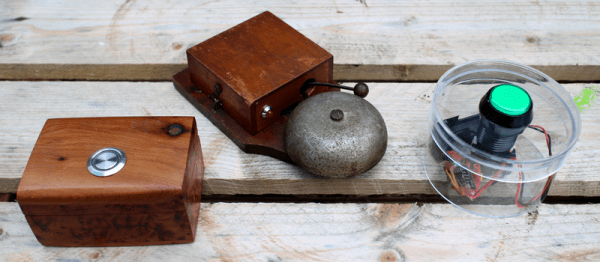
[Moris Metz] is a hacker in Berlin who has a bi-weekly national radio spot. (Only in Germany!) This week, he connected the ubiquitous ESP8266 to a nice old (physical) bell for his broadcast over the weekend. (i”Translated” here.) Check out the video teaser embedded below.

Continue reading “Internet Doorbell Gone Full-Hipster”

Minecraft Sword Lights Up When Nearby Friends

With All Hallow’s Eve looming close, makers have the potential to create some amazing costumes we’ll remember for the rest of the year. If you’re a fan of the hugely addict-*cough* popular game Minecraft, perhaps you’ve considered cosplaying as your favorite character skin, but lacked the appropriate props. [Graham Kitteridge] and his friends have decided to pay homage to the game by making their own light-up Minecraft swords.

These swords use 3D-printed and laser-cut parts, designed so as to hide the electronics for the lights and range finder in the hilt. Range finder? Oh, yes, the sword uses an Arduino Uno-based board to support NewPixels LEDs and a 433Mhz radio transmitter and receiver for ranged detection of other nearby swords that — when they are detected — will trigger the sword to glow. Kind of like the sword Sting, but for friendlies. Continue reading “Minecraft Sword Lights Up When Nearby Friends”

Amateur Radio Parity Act Passes US House

Most new houses are part of homeowners associations, covenants, or have other restrictions on the deed that dictate what color you can paint your house, the front door, or what type of mailbox is acceptable. For amateur radio operators, that means neighbors have the legal means to remove radio antennas, whether they’re unobtrusive 2 meter whips or gigantic moon bounce arrays. Antennas are ugly, HOAs claim, and drive down property values. Thousands of amateur radio operators have been silenced on the airwaves, simply because neighbors don’t like ugly antennas.

Now, this is about to change. The US House recently passed the Amateur Radio Parity Act (H.R. 1301) to amend the FCC’s Part 97 rules of amateur stations and private land-use restrictions.

The proposed amendment provides, ““Community associations should fairly administer private land-use regulations in the interest of their communities, while nevertheless permitting the installation and maintenance of effective outdoor Amateur Radio antennas.” This does not guarantee all antennas are allowed in communities governed by an HOA; the bill simply provides that antennas, ‘consistent with the aesthetic and physical characteristics of land and structures in community associations’ may be accommodated. While very few communities would allow a gigantic towers, C-band dishes, or 160 meters of coax strung up between trees, this bill will provide for small dipoles and inconspicuous antennae.

The full text of H.R. 1301 can be viewed on the ARRL site. The next step towards making this bill law is passage through the senate, and as always, visiting, calling, mailing, faxing, and emailing your senators (in that order) is the most effective way to make views heard.

High Impedance Headphones? They’re In The Can!

[George Trimble] likes to build crystal radios. The original crystal radio builders used high impedance headphones. In modern builds, you are as likely to include a powered amplifier to drive a speaker or normal headphones (which are usually around 4 to 16 ohms).

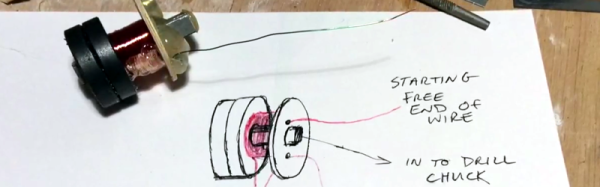
[George] builds his own speakers using chile cans, some wire, a few magnets, part of a Pepsi can (we are pretty sure someone will leave a comment that Coke cans sound better), and the iron core out of an audio transformer. You can see a very detailed video of the process, below.

There is a little woodworking and hot gluing involved. The result is decidedly homemade looking, but if you want to say you built it yourself (or, if you are a prepper trying to get ready to  rebuild after the apocalypse and you can’t find a cache of headphones) this might be just the ticket.

Most of the headphone hacks we see start with a pair of headphones. That’s a bit tautological, but the goal is usually to add features, not make the whole thing. It does give you some hacker cred, though, to be able to look at the other guy’s radio and say, “Oh. I see you used commercial headphones.”

Continue reading “High Impedance Headphones? They’re In The Can!”

Wilderness Radio Build

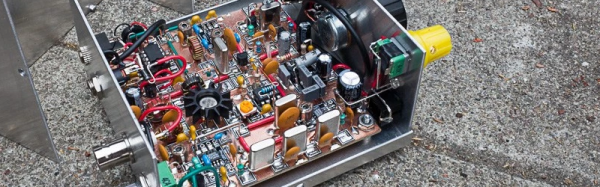
[AA7EE] is no stranger to building radios. His latest is a from-scratch build of a 20 meter QRP transceiver based on the popular SST design. Although the SST has been available as a kit, [AA7EE] incorporated some design changes from others and some of his own, too. He even added an onboard keyer to simplify operation. You can see videos of the radio below.

The build uses Manhattan-style PCB pads. Although the construction is very attractive, the real value of the post is the detailed explanation of not only how, but why everything is the way it is. This isn’t a simple project, and being able to see it completed step-by-step is very educational. About the only decision not adequately explained was the change of red and yellow knobs to black! You can see both versions in the videos below.

The Manhattan construction is tidy, but the radio also has an attractive case. The size is just big enough to stack a pair of paddles on top.

There may be some more enhancements for the little radio coming. We’ve covered [AA7EE’s] RF exploits before, including a physically attractive radios and details about the same construction method used in this radio.

Continue reading “Wilderness Radio Build”

High Performance Crystal Radio

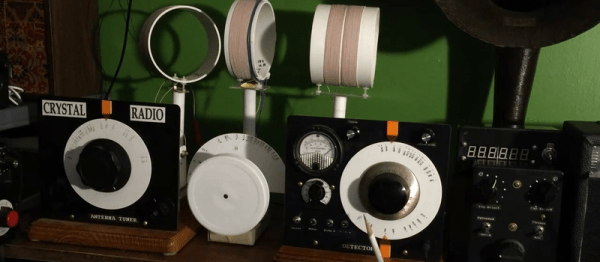
When you think of a crystal radio, you probably think of something simple maybe built out of household scraps. Not if you are [Chris Wendling]. He recently posted a video (see below) of his high-performance crystal set. He doesn’t take any shortcuts: he has several hundred feet of antenna wire, and uses a cold-water pipe ground system. With no amplifier, a strong signal input is crucial.

The radio has four subsystems: an antenna tuner, a bandpass filter, a detector, and a powered audio output system. He also has a truly enormous system of speakers on the ceiling–this isn’t the crystal radio you made in the boy scouts.

Continue reading “High Performance Crystal Radio”