THP Semifinalist: A Continuous Wave Radar

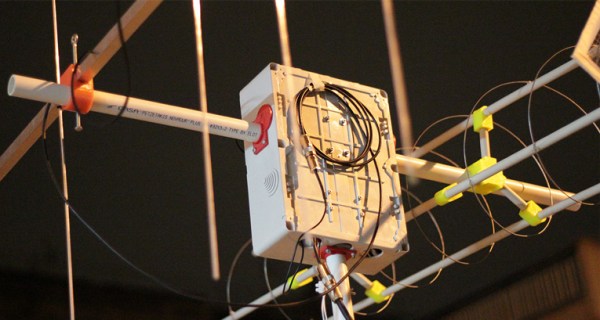
There aren’t many Hackaday Prize entries playing around in RF, save for the handful of projects using off the shelf radio modules. That’s a little surprising to us, considering radio is one of the domains where garage-based tinkerers have always been very active. [Luke] is bucking the trend with a FM continuous wave radar, to be used in experiments with autonomous aircraft, altitude finding, and synthetic aperture radar imaging.

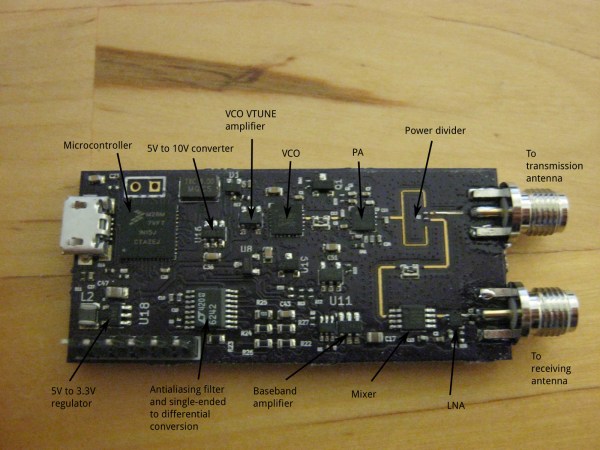
[Luke]’s radar operates around 5.8-6 GHz, and is supposed to be an introduction to microwave electronics. It’s an extremely modular system built around a few VCOs, mixers, and amplifiers from Hittite, all connected with coax.

So far, [Luke] has all his modules put together, a great pair of cans for the antennas, everything confirmed as working on his scope, and a lot of commits to his git repo.

You can check out [Luke]’s demo video is available below.


SpaceWrencherThe project featured in this post is a quarterfinalist in The Hackaday Prize.

Continue reading “THP Semifinalist: A Continuous Wave Radar”

THP Semifinalist: Cheap Satellite Transponder

In 2016, a communications satellite will be launched into geostationary orbit somewhere over the middle east. Normally, this is fairly ordinary occurrence. This satellite, however, will be carrying two amateur radio transponders for hams all across europe, africa, the middle east, and India. [2FTG] is building a satellite transponder to talk to this satellite, and he’s doing it with junk sitting around his workbench.

The uplink frequency for this satellite will be in the neighborhood of 2.4 GHz, and [2FTG] needed a way to deal with the out of band interference in this part of the spectrum. The easy and cheap way to do this is with filters made for the WiFi band. Instead, [2FTG] had a few cavity filters in his junk box and decided to go that route. It meant he had to retune the filters, a process that should be annoyingly hard. [2FTG] did it in thirty minutes.

Antennas are another matter, but since [2FTG] has a supply of metal coffee cans, this part of the build was just a matter of soldering a bit of wire to an SMA connector, drilling a hole (using a log as a drill stop, no less), and soldering the connector to the can.


SpaceWrencherThe project featured in this post is a quarterfinalist in The Hackaday Prize.

Continue reading “THP Semifinalist: Cheap Satellite Transponder”

[Sprite_TM] Puts Linux In A Clock Radio

[Sprite] needs an alarm clock to wake up in the morning, and although his phone has an infinitely programmable alarm clock, his ancient Phillips AJ-3040 has never failed him. It’s served him well for 15 years, and there’s no reason to throw it out. Upgrading it was the only way, with OLED displays and Linux systems inside this cheap box of consumer electronics.

After opening up the radio, [Sprite] found two boards. The first was the radio PCB, and the existing board could be slightly modified with a switch to input another audio source. The clock PCB was built around an old chip that used mains frequency as the time base. This was torn out of the enclosure along with the old multiplexed LCD.

A new display and brain for the clock was needed, and [Sprite] reached into his parts drawer and pulled out an old 288×48 pixel OLED display. When shining though a bit of translucent red plastic, it’s can be a reasonable facsimile of the old LEDs. The brains of the clock would be a Carambola Linux module. After writing a kernel module for the OLED, [Sprite] had a fully functional Linux computer that would fit inside a clock radio.

After having a board fabbed with the power supplies, I2C expanders, USB stereo DAC, and SPI port for the OLED, [Sprite] had a clock radio that booted Linux on an OLED screen. In the video below, [Sprite] walks through the functions of the clock, including setting one of the many alarms, streaming audio from the Internet, and changing the font of the display. There’s also a web UI for the clock that allows alarms to be set remotely – from a phone, even, if [Sprite] is so inclined.

Continue reading “[Sprite_TM] Puts Linux In A Clock Radio”

THP Quarterfinalist: 3GHz Spectrum Analyzer

Radio seems to be an unofficial theme for The Hackaday Prize, with a few wireless frameworks for microcontrollers and software defined radios making their way into the quarterfinal selection. [roelh]’s project is a little different from most of the other radio builds. It’s a simple spectrum analyzer, but one that works up to 3GHz.

The hardware is a mishmash of chips including an ADL5519 power detector, an Si4012 for the local oscillator, and a MAX2680 mixer. An Atmel XMega takes care of all the on board processing, displaying the spectrum on a small LCD, writing data to an SD card, and sending data over a 3.5mm jack that doubles as either an analog input or a half duplex RS232 port.

Seen in the video below, [roelh]’s spectrum analyzer is more or less finished, complete with a nice looking enclosure. Now [roelh] is working on documentation, porting his source to English, and getting all the files ready to be judged by our real judges.


SpaceWrencherThe project featured in this post is a quarterfinalist in The Hackaday Prize.

Continue reading “THP Quarterfinalist: 3GHz Spectrum Analyzer”

THP Hacker Bio: Felix Rusu

As far as entries for The Hackaday Prize go, Moteino is exceptionally interesting. It’s the only project to be used in other projects for The Hackaday Prize. The two other projects making use of the Moteino, 433MHz transceiver and Plant Friends didn’t make the cut, but [Felix]’s Moteino did.

Like many of the Internet of Things project, Moteino is a radio module and a microcontroller in an extremely convenient package. The radio is a HopeRF RFM69 operating in the  315, 433, 868 and 915MHz ISM bands. The microcontroller is everyone’s favorite – the ATMega328, but [Felix] also has a Mega version with the ATMega1284 on board. Already there are a few great examples of what the Moteino can do, including a mailbox notifier, a sump pump monitor, and a way to Internetify a water meter.

[Felix]’s bio below.

Continue reading “THP Hacker Bio: Felix Rusu”

Welcome To The Old School: Restoring Antique Radios

Before the second world war Radio was a revolution in mass-communication much like the internet today. Fortunes were made and lost, empires built, epic patent battles ensued, all of which resulted in the world being more connected than ever before, which makes for a really great story (and a great Ken Burns documentary).

Last month we showed you how to modify a vintage radio to play your own audio source through it while re-using the existing electronics and maintaining its functionality. In this post we will show you how to restore any vacuum tube radio. You will learn basic repair/restoration procedures from a different era when it was actually worth repairing consumer electronics. Plug into history and get your hands on the most influential technology of the first-half of the 20th century!

Continue reading “Welcome To The Old School: Restoring Antique Radios”

THP Hacker Bio: Michael R Colton

With many hackers out there realizing how much you can do with a few RF blocks connected to a computer, it’s no surprise software defined radio would make a showing in the semifinalists for The Hackaday Prize. [Michael]’s project is the PortableSDR, a small, self-contained unit that handles just about everything below 30MHz. No, [Michael] isn’t dealing with gigahertz accessible with fancier SDRs, but that’s not the point: PortableSDR is meant to do everything – vector analysis, a neat waterfall display, transmit and receive – in a small, portable package you can take anywhere. It’s also fairly cheap to build, and of course completely open source.

This isn’t [Michael]’s first rodeo; he’s built a number of equally cool projects before. He was kind enough to send in a short bio, available below.

Continue reading “THP Hacker Bio: Michael R Colton”