38C3: Taking Down The Power Grid Over Radio

You know how you can fall down a rabbit hole when you start on a project? [Fabian Bräunlein] and [Luca Melette] were looking at a box on a broken streetlamp in Berlin. The box looked like a relay, and it contained a radio. It was a Funkrundsteueremfänger – a radio controlled power controller – made by a company called EFR. It turns out that these boxes are on many streetlamps in many cities, and like you do, they thought about how cool it would be to make lights blink, but on a city-wide basis. Haha, right? So they bought a bunch of these EFR devices on the used market and started hacking.

They did a lot of background digging, and found out that they could talk to the devices, both over their local built-in IR port, but also over radio. Ironically, one of the best sources of help they found in reversing the protocol was in the form of actually pressing F1 in the manufacturer’s configuration application – a program’s help page actually helped someone! They discovered that once they knew some particulars about how a node was addressed, they could turn on and off a device like a street lamp, which they demo with a toy on stage. So far, so cute.

But it turns out that these boxes are present on all sorts of power consumers and producers around central Europe, used to control and counteract regional imbalances to keep the electrical grid stable. Which is to say that with the same setup as they had, maybe multiplied to a network of a thousand transmitters, you could turn off enough power generation, and turn on enough load, to bring the entire power grid down to its knees. Needless to say, this is when they contacted both the manufacturer and the government.

The good news is that there’s a plan to transition to a better system that uses authenticated transmissions, and that plan has been underway since 2017. The bad news is that progress has been very slow, and in some cases stalled out completely. The pair view their work here as providing regulators with some extra incentive to help get this important infrastructure modernization back on the front burner. For instance, it turns out that large power plants shouldn’t be using these devices for control at all, and they estimate that fixing this oversight could take care of most of the threat with the least effort.

National power grids are complicated machines, to say the least, and the impact of a failure can be very serious. Just take a look at what happened in 2003 in the US northeast, for instance. And in the case of real grid failure, getting everything back online isn’t as simple a just turning the switches back on again. As [Fabian] and [Luca] point out here, it’s important to discover and disclose when legacy systems put the grid in potential danger.

Handheld Satellite Dish Is 3D Printed

Ham radio enthusiasts, people looking to borrow their neighbors’ WiFi, and those interested in decoding signals from things like weather satellites will often grab an old satellite TV antenna and repurpose it. Customers have been leaving these services for years, so they’re pretty widely available. But for handheld operation, these metal dishes can get quite cumbersome. A 3D-printed satellite dish like this one is lightweight and small enough to be held, enabling some interesting satellite tracking activities with just a few other parts needed.

Although we see his projects often, [saveitforparts] did not design this antenna, instead downloading the design from [t0nito] on Thingiverse. [saveitforparts] does know his way around a satellite antenna, though, so he is exactly the kind of person who would put something like this through its paces and use it for his own needs. There were a few hiccups with the print, but with all the 3D printed parts completed, the metal mesh added to the dish, and a correctly polarized helical antenna formed into the print to receive the signals, it was ready to point at the sky.

The results for the day of testing were incredibly promising. Compared to a second satellite antenna with an automatic tracker, the handheld 3D-printed version captured nearly all of the information sent from the satellite in orbit. [saveitforparts] plans to build a tracker for this small dish to improve it even further. He’s been able to find some satellite trackers from junked hardware in some unusual places as well. Antennas seem to be a ripe area for 3D printing.

Continue reading “Handheld Satellite Dish Is 3D Printed”

Subchannel Stations: The Radio Broadcasts You Didn’t Know Were There

Analog radio broadcasts are pretty simple, right? Tune into a given frequency on the AM or FM bands, and what you hear is what you get. Or at least, that used to be the way, before smart engineers started figuring out all kinds of sneaky ways for extra signals to hop on to mainstream broadcasts.

Subcarrier radio once felt like the secret backchannel of the airwaves. Long before Wi-Fi, streaming, and digital multiplexing, these hidden signals beamed anything from elevator music and stock tickers to specialized content for medical professionals. Tuning into your favorite FM stations, you’d never notice them—unless you had the right hardware and a bit of know-how.

Continue reading “Subchannel Stations: The Radio Broadcasts You Didn’t Know Were There”

The 6GHz Band Opens In The US

On December 11th, the FCC announced that the band around 6GHz would be open to “very low-power devices.” The new allocation shares space with other devices already using these frequencies. The release mentions a few limitations over the 350 MHz band (broken into two segments). First, the devices must use a contention-based protocol and implement transmit power control. The low-power devices may not be part of a fixed outdoor infrastructure.

The frequencies are 6.425-6.525 GHz, 6.875-7.125 GHz and the requirements are similar to those imposed on 802.11ax in the nearby U-NII-5 and U-NII-7 bands.

Continue reading “The 6GHz Band Opens In The US”

Amateur Radio Operators Detect Signals From Voyager 1

At the time of its construction in the 1950s, the Dwingeloo Radio Observatory was the largest rotatable telescope in the world with a dish diameter of 25 meters. It was quickly overtaken in the rankings but was used by astronomers for decades until it slowly fell into disuse in the early 2000s. After a restoration project the telescope is now a national heritage site in the Netherlands where it is also available for use by radio amateurs. Recently this group was able to receive signals from Voyager 1.

Famously, Voyager 1 is the furthest manmade object from Earth, having been launched on a trajectory out of the solar system in 1977. As a result of distance and age, the signals it sends out are incredibly faint. The team first had to mount a new antenna to the dish, which was not originally designed for signals in this frequency which added to the challenge. They then needed to use orbital predictions of the spacecraft in order to target the telescope and also make the correct adjustments to the received signal given that there is significant Doppler shift now as well. But with that all out of the way, the team was successfully able to receive the Voyager 1 signal on this telescope.

Only a few telescopes in the world have ever been able to accomplish this feat, making it all the more impressive. Normally Voyager 1 is received using the Deep Space Network, a fleet of much larger dishes stationed around the world and designed for these frequencies. But this team is used to taking on unique challenges. They also decoded the first ham radio station on the moon and made a radar image of the moon using LoRa.

Dwingeloo telescope receives signals from Voyager 1

Creating A Radiation King Radio In The Real World

If you’re a fan of the Fallout series of games, you’ve probably come across a Radiation King radio before. In the game, that is, they don’t exist in real life. Which is precisely why [zapwizard] built one!

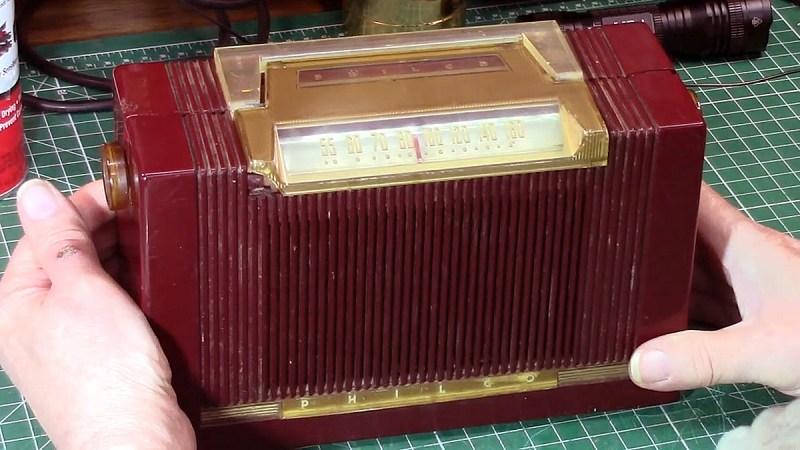
Externally, the design faithfully recreates the mid-century design of the Radiation King. It’s got the louvered venting on the front panel, the chunky knobs, and a lovely analog needle dial, too. Inside, it’s got a Raspberry Pi Zero which is charged with running the show and dealing with audio playback. It’s paired with a Pi Pico, which handles other interface tasks.

It might seem simple, but the details are what really make this thing shine. It doesn’t just play music, it runs a series of simulated radio stations which you can “tune into” using the radio dial. [zapwizard dives into how it all works—from the air core motor behind the simulated tuning dial, to the mixing of music and simulated static. It’s really worth digging into if you like building retro-styled equipment that feels more like the real thing.

It’s not just a prop—it’s a fully-functional item from the Fallout universe, made manifest. You know how much we love those. If you’re cooking up your own post-apocalyptic hacks, fictional or non-fictional, don’t hesitate to let us know.

Pushing 802.11ah To The Extreme With Drones

It might come as a surprise to some that IEEE, the Institute for Electrical and Electronics Engineers, does more than send out mailers asking people to renew their memberships. In fact, they also maintain various electrical standards across a wide range of disciplines, but perhaps the one most of us interact with the most is the 802.11 standard which outlines WiFi. There have been many revisions over the years to improve throughput but the 802.11ah standard actually looks at decreasing throughput in favor of extremely increased range. Just how far you can communicate using this standard seems to depend on how many drones you have.

802.11ah, otherwise known as Wi-Fi HaLow, operates in the sub-gigahertz range which is part of why it has the capability of operating over longer distances. But [Aaron] is extending that distance even further by adding a pair of T-Halow devices, one in client mode and the other in AP (access point) mode, on a drone. The signal then hops from one laptop to a drone, then out to another drone with a similar setup, and then finally down to a second laptop. In theory this “Dragon Bridge” could allow devices to communicate as far as the drone bridge will allow, and indeed [Aaron] has plans for future revisions to include more powerful hardware which will allow even greater distances to be reached.

While there were a few bugs to work out initially, eventually he was able to get almost two kilometers of distance across six devices and two drones. Something like this might be useful for a distributed network of IoT devices that are just outside the range of a normal access point. The Dragon Bridge borrowed its name from DragonOS, a Linux distribution built by [Aaron] with a wide assortment of software-defined radio tools available out of the box. He’s even put in on the Steam Deck to test out long-distance WiFi.

Continue reading “Pushing 802.11ah To The Extreme With Drones”