RC Car Upgraded To Bluetooth Control

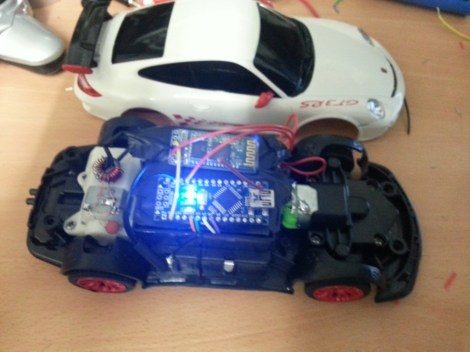
[Chet] is showing off the Bluetooth controller upgrade for this RC car. The donor vehicle is a rather inexpensive Porche which he purchased to make sure he didn’t start hacking up his more expensive toys.

He took a bit different route than the IOIO RC truck we saw earlier in the week, but the concept is basically the same. That build used an IOIO board with a USB Bluetooth dongle. This one uses an Arduino Mini with a serial Bluetooth module. He patched into the motor driver circuits on the original PCB. While he was at it he also soldered in some LEDs to use as switchable headlights.

There was one issue which he had to overcome. The current draw from the motor starting up would sometimes dip the voltage low enough to reset the Arduino. He tried using a bigger capacitor to feed the board, but in the end opted to add a boost converter.

IOIO Controller Replacement For An RC Truck

This RC truck can be controlled with the tip of your thumb or the tilt of a wrist. That’s thanks to the IOIO which was inserted in place of the toy’s original controller. [Exanko] made the hardware changes in order to use his Android phone as the controller. The white circle is a software joystick that acts as throttle when your thumb moves along the Y axis, and steering when it moves along the X axis. But while he was at it he also included accelerometer input as an alternative control option.

The IOIO board has a Bluetooth dongle connected to its USB port as a means of wireless communication. The dongle was hacked to accept an external antenna, thereby increasing the truck’s range. There is also some on-board flair like LEDs for lights and even a laser diode for… well we’re not sure what that’s for. Get a better look at the hardware internals in the clip after the break.

Continue reading “IOIO Controller Replacement For An RC Truck”

Adding Features To A DX6i Transmitter

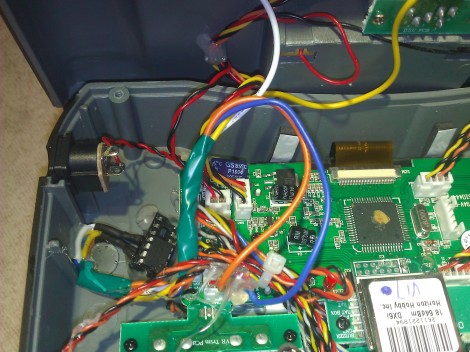
About thirty cents and some wire are all it takes to start hacking extra features into this DX6i transmitter. The DX6i is a six-channel, two-mode transmitter used to control hobby airplanes and helicopters. There are several built-in features but [Ligius] found an easy way to add a few more. In the upper left portion of the case you can see the eight-pin microcontroller he brought to the project.

It’s a PIC 10F222 mounted in a DIP socket so that it may be removed for reprogramming. The hardware page of the wiki shows the connections he made. By reading from the throttle, and tapping into the trainer wire, he is able to add features without any apparent alterations to the controller (no extra buttons, etc). You can see in the clip after the break that the throttle position when power is switched on selects between different modes. This can be the delay for turning off the LCD backlight, or presets for helicopter or airplane modes. [Ligius] thinks there’s a lot more potential here, even the possibility of fixing a bug in this particular model of transmitter.

Continue reading “Adding Features To A DX6i Transmitter”

Excavate Your Basement Using RC Equipment

basement excavation

Although it could be debated as to whether or not this is a “hack,” since the equipment used is built for excavation, the scale of it seems deserving of a mention. In the linked article, [Joe] is quoted as saying, “the common misconception here is that the RC’s are not here to excavate my basement, but rather the basement excavation project is here for the RC’s.”  This could be a motto for most makers/hackers in that projects are frequently not done for the resulting product, but for the experience of making something your own.

According to [Joe], he excavates 2 – 3 cubic yards per year with his little RC vehicles.  Living in Canada as a rancher and farmer, he’s required to be near his home to feed his hungry animals even during the cold winter months. During this time, there can be very little to do. After sometimes working 16 hour days during the summer, he needed something to keep him occupied close to home. Be sure to check out the excavation video after the break, or check out the original article for even more pictures and video! Continue reading “Excavate Your Basement Using RC Equipment”

RC PVC Bot

This hunk of PVC pipe is radio controlled. The wheels on the ends provide the locomotion, but it wouldn’t be going anywhere if it weren’t for that little tail strapped to the center of the tube.

When the motors are turning the body of the bot needs something to push against. In this case the tail hits the ground and keeps the chassis from spinning. We have seen attempts to go without a tail by using lopsided wheels to provide angular momentum, but this method is much more reliable.

The control for the bot is scrapped from a toy RC car. Once hooked up to the gearhead motors it’s ready to roll. The real difficulty of the build came in fitting everything into the pipe. A frame was built from a few disks used as mounting platforms which were separated by threaded rod. See it making its way around a gravel road in the clip after the break.

Continue reading “RC PVC Bot”

Arduino Rover Doubles Up On Obstacle Avoidance

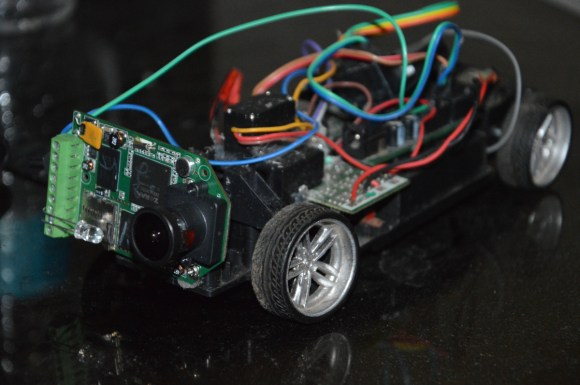
[Eduard Ros] wrote in show off his first attempt at building an autonomous rover (translated). As with many of these projects, he started with the base of a remote control toy truck. This solves so many mechanical issues, like steering, locomotion, and power source.

He just needed a way to control the vehicle. The recent LayerOne badge hacks either did this through the wireless controller protocol or by adding an Arduino directly to the vehicle. [Eduard] chose the latter, and also included obstacle avoidance sensors in the process. We’ve seen quite a few that use these ultrasonic rangefinders. He decided to go a different route by adding two of them rather than scanning by mounting one on a servo motor.

The video after the break shows the vehicle successfully navigating through a tight space. This makes us wonder how much data can be processed from the stationary sensors? We’re not familiar with how wide the horizontal sensitivity is on the devices. If you have some insight, please share you knowledge in the comments section.

Continue reading “Arduino Rover Doubles Up On Obstacle Avoidance”

Wi-Fli Copter Broken? Harvest The Parts!

[Nick] was somewhat disappointed when the Wi-Fly helicopter he bought his son broke in less than 10 minutes. The main gear that turns the rotor split in half, rendering the copter WiFi enabled trash. [Nick] however decided that he didn’t want to waste an opportunity and harvested the receiver parts.  To test them out, he wired them up to the controller for an R/C truck. This gave him a WiFi truck with a nifty android interface. It actually works pretty well, as you can see in the video below. [Nick] points out that, while this works fine, he could ultimately repurpose this fancy little WIFI controlled 3v switch to whatever he wants. He mentions garage doors and lights (and terminators), so this might be an opportunistic way for him to get into some fun home automation.

Continue reading “Wi-Fli Copter Broken? Harvest The Parts!”