Roomba 4000 Teardown Ready For Your Doomba Build

In addition to getting a haircut, [Dino] spent his week editing an old video of him tearing down a Roomba 4000. These robots can be picked up for just a few dollars on eBay, making them one of the cheapest bodged up robotics dev platforms available.

After [Dino] goes over how to unscrew the cover and disassemble the Roomba 4000, he goes over the layout of the motherboard and takes a look at the sensors. The wheels on the Roomba are actually very neat pieces of technology with a very cool planetary gear system that is the perfect drive system for your next robot build.

There are a ton of ways to use the electronics in Roombas for a few interesting robotics projects. [Dino] built 2/3rds of a all terrain rocker bogie robot – just like the Curiosity rover – out of a Roomba, and a small two wheeled indoor robot using a Parallax Propeller. If you’re a redditor there’s always the possibility of building a Doomba, but we think [Patrick] has a better idea than a knife strapped to a vacuum cleaner.

As always, [Dino]’s vidia after the break.

Continue reading “Roomba 4000 Teardown Ready For Your Doomba Build”

Robotic Hand With Haptic Feedback

While I was at Heatsync Labs in Mesa Arizona, [Nate] mentioned that he was really proud of helping someone build a robotic hand. I have tracked down that project because it looked pretty cool.

[Macguyver603] built this robotic hand that is controlled by a glove with flex sensors. He was originally going to 3d print the structure for the hand but the availability of the laser cutter allowed him to create something a that would be a little more structurally sound. Haptic feedback is supplied by vibrating pager motors that are triggered by sensors in the tips of the robotic hand’s fingers.

The total cost of the project was roughly $240, and there’s unfortunately no video. It did, however, earn him second place at the state fair!

Android Controlled Robot Extravaganza

We have no idea why, but since we featured Botiful, the Android-powered telepresence robot a few days ago, the tip line has been awash in robot/Android mashups. Here’s a few of the cool ones.

Using an Android as a remote control

[Stef] used a Samsung Galaxy S3 to control an old rc tank. The Android sends accelerometer and gyro data over Bluetooth to an Android where it powers a pair of H-bridges to turn the wheels.

Turning Android into a Robotic Operating System

ROS, or the Robot Operating System, provides a bunch of utilities for any type of robot such as point-cloud mapping to multi-joint arm control. [Lentin] sent in a guide on installing ROS on Android. So far, he can get accelerometer data, stills from the on-board camera, have the robot speak and use the small vibrator motor. Here’s a (somewhat limited) demo of [Lentin] playing with ROS in a terminal.

“Just a quick procrastination project”

Last May, [Josh] wrote in asking if a tread-based robot controlled through Skype would be a cool idea. We said ‘hell yeah’ and [Josh] scurried off to his workshop for a few months. He’s back with his tank-based robot. One really interesting bit is the robot responds to DTMF tones, allowing it to be controlled through Skype without any additional hardware. That’s damn clever. You can see a video of the SkypeRobot after the break.

Continue reading “Android Controlled Robot Extravaganza”

Robot Trash Can Catches Anything You Throw Near It

This guy is about to toss the blue ball half way between the book shelf and the waste basket. By the time it gets there the waste basket will have moved into position to catch the ball perfectly. It’ll do the same for just about anything you throw.

We’re unable to read the captions but it looks like this may have been made as part of a commercial which is shown in the first few seconds of the video after the break. From there we see the development of a locomotive mechanism which will fit into the bottom of the bin. It start as a single swivel wheel, but gets more complicated quite quickly. Once the low-profile three-wheeler is milled and assembled it’s time to start writing the code to translate input from a Kinect 3D camera and extrapolate the position for catching the trash. The final result seems to do this perfectly.

Continue reading “Robot Trash Can Catches Anything You Throw Near It”

GSM Controlled Car Without Needing A Microcontroller

Nope, no microcontroller here, just a full-blown cellphone used as the brains of this little robot. The secret behind how it works is in the sounds the phone makes. The touch tones, known as DTMF, are monitored by the circuit mounted on the front half of the chassis and are responsible for driving the motors.

[Achu Wilson] built the circuit around an MT8870 chip which decodes the DTMF sounds and uses the BCD output to feed some logic chips. A 4 line to 16 line decoder and an inverter chip format the signals for use as inputs to the L293D motor driver. The video after the break shows him driving the rover directly by pressing number on the phone (like a tethered remote control). But he mentions that it’s possible to call the phone and press the numbers remotely. We assume you need to connect the call manually as we see no way to automatically answer calls.

This is certainly a fun way to play around with the DTMF protocol.

Continue reading “GSM Controlled Car Without Needing A Microcontroller”

Building A Pick And Place With 3D Printed Parts

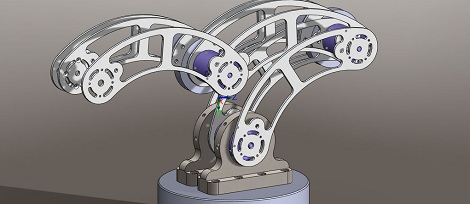
For the last few months, [HeliumFrog] has been building a SCARA bot to serve as the basis for a pick and place machine. Somewhat amazingly, this is the first robot of its kind to be printed on a 3D printer.

A SCARA-type robot is an articulated arm perfectly suited for transferring components from tubes and reels to a PCB. [HeliumFrog] began his build with an arm with large gears in joints driven by stepper motors and toothed belts. The Z axis was originally driven with a lead screw, but after a thoughtful redesign that was changed over to another toothed belt.

We’ve seen our share of DIY pick and place machines, but most of those have been based on a traditional X/Y Cartesian frame. [HeliumFrog]’s SCARA bot should be – theoretically, at least – faster and more accurate while taking up a smaller footprint in the workshop.

[HeliumFrog] is more or less done with the basics of his build, and is now moving on to building a plastic extrusion tool head for his SCARA bot. Very cool, and should make this robot capable of self-reproduction for under £400 (~$600).

You can check out a video of this articulated arm bot after the break.

Thanks, [Kyle] for sending this one in.

Continue reading “Building A Pick And Place With 3D Printed Parts”

Two Motor Walking Robot With A TI Launchpad

Last month, [Vinod] bought a pair of hobby servos on a whim. These servos sat on the shelf for a while until [Vinod] asked his friend what he should use them for. [Achu] suggested using the servos for a walking robot, so after checking out a few YouTube videos of some servo-powered walkers, [Vinod] built his own.

The robot is built around a TI Launchpad housing an MSP430 microcontroller. An extremely simple circuit (just some servos and a cap) power the robot along by alternating the direction the servos turn.

[Vinod]’s two-servo locomotion mechanism is very reminiscent of BEAM robots, extremely simple walking (or rolling) robots made out of just a few logic circuits. This TI Launchpad is in some ways even simpler; where [Mark Tilden]’s Walkman robot used several 74-series octal buffers, [Vinod]’s project is just a Lanuchpad and a pair of servos.

All the code is available on [Vinod]’s blog. Check out the demo video after the break.

Continue reading “Two Motor Walking Robot With A TI Launchpad”