Build A Kinect Bot For 500 Bones

[Eric] sent in his tutorial on building a Kinect based robot for $500, a low-cost solution to a wife that thinks her husband spends too much on robots.

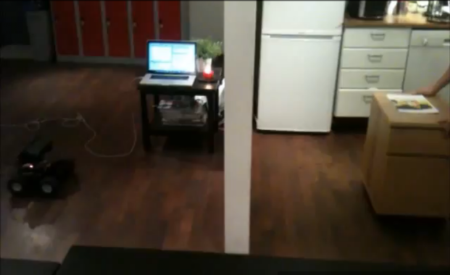
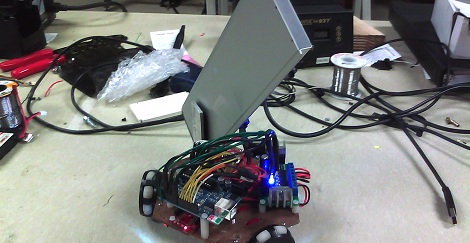
For the base of his build, [Eric] used an iRobot Create, a derivative of the Roomba that is built exclusive for some hardware hackery. For command and control of the robot, an EEE netbook takes data from the Kinect and sends it to the iRobot over a serial connection.

The build itself is remarkably simple: two pieces of angle aluminum were attached to the iRobot, and a plastic milk crate was installed with zip ties. The Kinect sits on top of the plastic crate and the netbook comfortably fits inside.

A few weeks ago, [Eric] posted a summary of the history and open-source software for the Kinect that covers the development of the Libfreenect driver. [Eric] used this same driver for his robot. Currently, the robot is configured for two modes. The first mode has the robot travel to the furthest point from itself. The second mode instructs the robot to follow the closest thing to itself – walk in front of the robot and it becomes an ankle biter.

There is a limitation of the Kinect that [Eric] is trying to work around. Objects closer than 19 inches to the Kinect appear to be very far away. This caused a lot of wall bumping, but he plans on adding a few ultrasonic sensors to fill the gap in the sensor data. Not bad for a very inexpensive autonomous robot.

Bomb Disposal Robot With Lego Gripper

[Krash] had a lot of fun hacking up his Spy Gear TRAKR; we’re just lucky he was able to move a suspicious Shrek doll before it detonated.

The now discontinued Spy Gear TRAKR serves as the basis for [Krash]’s build. This tiny remote-controlled toy transmits video back to its remote and makes us very jealous of the awesome toys our nephew has. Thankfully, the engineers behind the TRAKR made it extremely hackable, as proved by Hack A Day’s very own [Phil Burgess].

[Krash] began his build by putting a few male headers in the GPIO pins on the TRAKR’s board. After that, the TRAKR SDK was downloaded. He used a few Snap Circuits to verify his TRAKR software was working, then set off to build a Lego gripper arm. The arm is powered through an H-bridge IC [Krash] found alongside the rest of his Snap Circuits stuff.

Not a bad build for what amounts to a pile of toys. Check out [Krash]’s video of his bomb disposal bot after the break.

Continue reading “Bomb Disposal Robot With Lego Gripper”

Video: Analog To Digital Conversion On The ATmega328p

In this week’s video, we continue on where we left off last week with another in our series of videos where we discuss how to program for the ATmega328p processor. This week, [Jack] takes a look at the analog to digital converter and takes us through how to set things up and then how to perform a conversion using the potentiometer on the 3pi as the analog source. Playing with potentiometers isn’t the most interesting thing in the world, but after watching this video, you will be able to do things like take light readings using a cadmium sulfide cell, read the weight applied to a sensor, calculate the temperature from a resistor and a thermistor, or interface with an analog gyroscope.

If you have missed our previous videos, here are some links:
Part 1: Setting up the development environment
Part 2: Basic I/O
Part 3: Pulse Width Modulation

Stay tuned for next week’s* video where we will take a look at how to interface with the 3pi’s line sensors.

Video is after the break…

* HAD is in the process of moving our secret headquarters so next week’s video may come some time later than next week.

Continue reading “Video: Analog To Digital Conversion On The ATmega328p”

Robotic Farming Means More Corn For Everyone

You know we’re all going to starve, right? If the world’s population keeps growing exponentially and food production grows linearly, we’re eventually going to find out what Soylent Green is made of. This is where [David Dorhout]’s Prospero robot farmer comes in. [David] has come up with the idea of using small autonomous robots to plant, tend and harvest fields. Right now, he’s working on stage 1: planting seeds.

A swarm of six-legged Prospero robots are dispatched to a field. There, each member of the swarm plants seeds one at a time. The robots keep in contact with each other over a wireless connection to ensure the optimal planting pattern for an entire field.

The Prospero prototype is based on the Parallax Propeller with a Ping ultrasonic sensor used to avoid obstacles. Each hexapod is equipped with a bunch of seeds, a small auger, and a supply of fertilizer for the future corn plant. The next step in the plan is to build a ‘tending’ robot that will monitor and apply nutrients if needed. Check out the Prospero video after the break.

Continue reading “Robotic Farming Means More Corn For Everyone”

Creepy Delta Bot Follows Your Every Move

tim_tracking_interactive_mechanism

The creation you see above is the work of art student [Daniel Bertner] who is wrapping up his Bachelor of Fine Arts degree at the School of the Art Institute of Chicago. He calls the incredibly intriguing, yet somewhat disturbing device “TIM”, which is short for Tracking Interactive Mechanism.

A culmination of different projects he has tinkered with over the last year or so, TIM is an interactive delta bot with an attitude. Mounted on the wall of the Art Institute’s Sullivan Galleries, TIM is as interested in you as you are in it. While passers by investigate the curious device, it watches them back, following their every movement.

The robot’s motors are controlled using an Arduino, and its ability to track people standing nearby is provided via a video stream processed with Open CV.

It really is a cool project, and we think it would make for an awesome prop in some sci-fi horror flick. Check out the video below to see TIM’s personality in action – he doesn’t like it when people stand too close!

Continue reading “Creepy Delta Bot Follows Your Every Move”

Robotic Disco Floor Is A Mobile Party

[Chris Williamson] designed the Rave Rover, a mobile disco floor with integrated stripper pole for this year’s DragonCon.

[Chris] started building combat robots back in 2000 for Battlebots and Robot Wars and cofounded the South Eastern Combat Robot league. He’s a lover and not a fighter, so for the DragonCon robotics track [Chris] built his mobile dance party. He put up an Instructable of his build and some of the features are really clever. Whenever the dance floor is being ‘used’, pneumatic cylinders lower the disco floor so it rests directly on the ground. A good idea, especially considering what we imagine happens on the Rave Rover.

For the light-up disco floor, [Chris] cut black ABS sheets on a CNC router and installed RGB LED modules controlled by an Arduino. The floor can display low-res animations, but random patterns look just a cool.

The Rave Rover was designed and built over a one month span to get ready in time for DragonCon. The build was a little hurried but the quality is still there. Check out video of the Rave Rover at DragonCon after the break.

Continue reading “Robotic Disco Floor Is A Mobile Party”

Print The Best Mascot, Win A Shiny New Makerbot

If you’ve always wanted a 3D printer, here’s your chance to win one. Makerbot Industries wants the Internets to design a new mascot for them. The contest winner will receive a Makerbot Thing-o-matic.

Don’t worry about a chicken or egg situation with this contest. You don’t actually need to print your design (although printability is a quality considered when judging). All you need to do to enter is upload your design files before the deadline on September 28th. Designs must be robot themed, and anything uploaded as Private will be made Public after contest results are announce. It should be fun looking through all of the submissions. There’s several other design restrictions so make sure to read carefully before you get to work.

Those that would rather work with a soldering iron than design plastic robot parts need not despair. You haven’t missed the deadline for the 7400 Logic contest, which is accepting entries through October 21st.