Motor Controller Also Does Nyan Cat

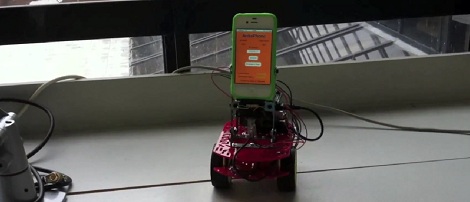
As a freshman at UC Berkeley, [Keegan] has been helping out with his school’s Pioneers in Engineering program that gives high school students some hands on experience with engineering principles, usually by building robots. This year, [Keegan]’s project is a motor controller that just so happens to play the nyan cat song over the motor PWM output.

The motor controller is meant to replace the Pololu simple motor controller the PiE team is currently using. Onboard is an H-bridge chip and an ATmega328 that takes commands from an I2C bus. The ‘328 is loaded up with the Arduino bootloader making the firmware very accessible – a good thing for the high school students that will be building and programming these robots.

[Keegan] put up the Eagle files for the board up on the PiE Wiki. For now, just enjoy the dulcet tones of the pop tart cat theme song after the break.

Continue reading “Motor Controller Also Does Nyan Cat”

Pop-up Dragonfly Robot Could Be The Future Of Business Cards

Engineers trying to be memorable at a job interview would be wise to pull one of these pop-up robots out of a wallet. This marvel of engineering uses a laminate construction technique to build a robot as a pop-up assembly. You can see the base used during the process, it’s a hexagon that serves as a scaffolding during the laminating process, and includes mechanical linkages that facilitate assembly.

The design calls for multiple layers of materials to be laser-cut to exacting specifications. Once all parts are completed, they are stacked using rods to align them, then fused together. One more trip through the laser cutter finishes the milling and the machine is ready for assembly. But with parts this small, you’ll want a solid method for putting everything together. The linkages we mentioned before allow for this when two parts of the scaffolding are separated. The only thing that makes this impossible as a business card is the need for a trip through the solder bath to cement the pieces in place. But perhaps some type of clasping mechanism could remove this need in the future.

Don’t miss the video after the break that explains the entire process. You’ll even get to see the little guy flap his wings. That’s all that it does for now, there isn’t any steering mechanism available as of yet.

Continue reading “Pop-up Dragonfly Robot Could Be The Future Of Business Cards”

Boxie Is An Adorable Toddler Videographer

Meet Boxie. He’s a robot videographer with levels of interaction we haven’t seen outside an episode of Dora the Explorer. The project was conceived by [Alex] as his MIT thesis project to see if robots can use humans to make themselves more useful. All we know is Boxie is freaking adorable, as evidenced by this video.

The idea behind Boxie was inspired by Afghan Explorer to capture video in an attempt to tell a story. In the videos (after the break), Boxie wanders around the halls of MIT searching for people to help him (“can you carry me up the stairs?”) and tell stories (“what do you do here?”). It’s an experiment in autonomous documentary directorial skill that was edited down into a video that made sense.

[Alex] designed Boxie to be the cutest thing we’ve ever seen so he could elicit a response from the subjects of the documentary. We’re going to say the voice helped, but [Alex] also found the cardboard robot factor also played into the success. Boxie was originally planned to have a plastic skin, but [Alex]’s friends thought it looked really creepy. They suggested that [Alex] go back to the prototype cardboard body. All we know is there’s a robot cuter than a Keepon, finally.

Continue reading “Boxie Is An Adorable Toddler Videographer”

Giving The Hexbug Spider Freedom To Explore On Its Own

hexbug-hack

[Eric Gregori] recently spent some time messing around with a Hexbug Spider, and wrote in to share some modifications he made to the toy. In its unaltered form the robot can be controlled remotely, and while it’s fun to play with, the excitement is short lived. Using a TI MSP430 along with a small motor controller kit he put together, he gave the Hexbug a bit more personality.

The kit is really just a simple board used for mounting the MSP430 and FAN8200 motor driver, along with an IR emitter/sensor pair. It would be easy enough to put something similar together yourself, though if you are looking for a protoboard/deadbug/PCB etching-free solution, his Spider Hack kit is a quick and easy solution.

[Eric’s] walkthrough shows how to disassemble the Hexbug, and details which components need alterations before the controller board can be properly mounted. A few soldered wires later, the toy is ready to be reprogrammed, a process [Eric] carries out using the Launchpad board from which he lifted the MSP430.

As you can see in the videos below, calling the robot autonomous might be a bit of a stretch (I don’t see it walking to the kitchen to make me a sandwich), but it can navigate and avoid objects with ease.

Continue reading “Giving The Hexbug Spider Freedom To Explore On Its Own”

A Robot… That Can See Through Walls!

Robots on four wheels are fun on their own merits, but one thing that most lack is the ability to see through walls.  With it’s onboard radar system, this bot is equipped to see objects that a person couldn’t normally detect on the other side of the wall.

Although some of the more “nuts and bolts” details of this build are missing, the robot uses an Ultra-Wideband Radar system called the [D1] Radar System. This system can, according to their documentation, “Avoid false positives caused by vapor, dust, smoke, rain or other small particles.” Apparently this means drywall as well if programmed correctly.

In the video after the break, the robot’s sensor package is programmed to ignore anything within 1.5 meters. This allows the robot to mirror the movement of the apparent shelving unit on the other side. This sensor could certainly have some interesting robotics applications besides imitating a rolling shelf, so we’re excited to see what it will be used for!

Continue reading “A Robot… That Can See Through Walls!”

Tribot Robotics Platform

For a number of children born of geek parents, the WowWee Tribot is sure to make an appearance underneath a Christmas tree this year. By New Year’s, though, this toy will surely make its way to the back of a closet to sit unused until spring cleaning. It’s a shame to let such an interesting robotics platform go to waste, so [haltux] sent in a nice guide to unlocking the motor controller of this talking robot.

The ‘legs’ of the WowWee Tribot have three omnidirectional wheels mounted 120 degrees apart. We’ve seen this drive system before, so getting a pre-built platform out of the toy box is pretty interesting.

[haltux] found three H-bridges inside the Tribot and connected the direction and enable pins for each motor directly to an Arduino. The build was a success, and the new robot platform scurried along the floor. There are also rotary encoders on the Tribot, but these run at 12 Volts. [haltux] said he’ll cover these in a future post, and we’re waiting to see it.

Video: Working With The 3pi Robot’s Line Sensors

This week, we are serving up part five in our series where we are using the Pololu 3pi robot as a fancy development board for the ATmega328p processor. This week we are taking a quick break from working with the perpherals specific to the processor and will show how to work with the 3pi’s line sensors. A quick look at the schematic for the 3pi might lead you to think that you should be reading the line sensors with the A2D peripheral. Even though they are wired to the A2D pins, they need to be read digitally. In the video, [Jack] will show how to read raw values from the sensors and then how to calibrate the results so that you can get a nice clean 8-bit value representing what the sensors are seeing. Of course, that would happen under normal circumstances. Murphy had his way in this video and it turned out that our studio lighting was interfering a bit with the sensor readings when we were shooting so we didn’t get as good of a calibration as we would have liked when we shot.

Video is after the break.

In case you have missed the previous videos here are some links:

Part 1: Setting up the development environment
Part 2: Basic I/O
Part 3: Pulse Width Modulation
Part 4: Analog to Digital conversion

Continue reading “Video: Working With The 3pi Robot’s Line Sensors”