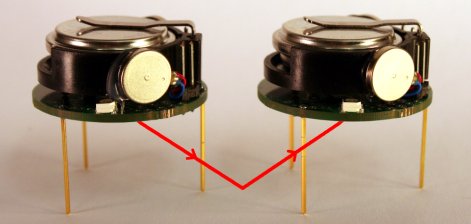
Reader, [Michael Rubenstein], sent in a project he’s been working on. Kilobot, as stated in the paper(pdf), overcomes the big problems with real world swarm robotics simulations; cost, experiment setup time, and maintenance. The robot can be communicated with wirelessly, charged in bulk, and mass programmed in under a minute. Typically, robots used for swarm research cost over a $100, so large scale experiments are left to software simulation. These, however, rarely include the real world physics, sensor error, and other modifying factors that only arise in a physical robot. Impressively enough, the kilobot comes in far under a hundred and still has many of the features of its costlier brothers. It can sense other robots, report its status, and has full differential steer (achieved, surprisingly, through bristle locomotion). There are a few cool videos of the robot in operation on the project site that are definitely worth a look.
robot1022 Articles
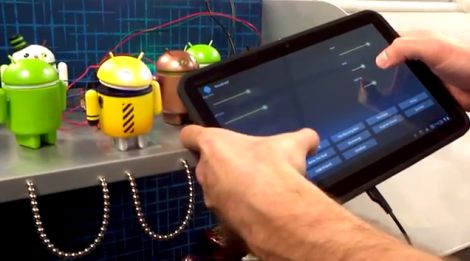
Tablet-controlled Disco Droid

We have seen a few neat Google ADK projects pop up since its announcement a few weeks back, and this one is already on the list of our favorites.
YouTube user [chrisjrelliot] has put together a great hack demonstrating the ADK’s power and how easy it can be to control devices in real time with an Android-powered device.
He hacked apart an Android figure (naturally) and fitted it with some LED eyes as well as four servos. The servos are used to rotate the head, body, and arms of his Disco Droid, all of which can be controlled via his Android-powered tablet. As you can see in the video below, he is able to control the Droid’s actions in real time with a few simple swipes of his finger. One thing we did notice is that his tablet is not connected to anything via wires, so we are assuming that there’s a Bluetooth module hidden away somewhere in the mix.
While the video is a bit short on details, [Chris] promises that source code and build plans will be published in short order.
[youtube=http://www.youtube.com/watch?v=jwvkJVUECrg&w=470]
Tiny Transforming Beer Can Robot

The next time you reach for a cold one, you might want to take a look at the can to ensure that your beer won’t suddenly sprout legs and start skittering across the table.
You might remember [Ron Tajima] from some of his previous creations, including this Roomba-based baby cradle and the PacMan Roomba mod. This time around, he has created a cool little transforming robot that fits inside a beer can.
The robot’s brains are stored just underneath the top of the beer can on a custom-built board. On one side of this board, you will find an mbed controller which is used to manage all of the robot’s functions, and on the other side, four batteries provide all of the device’s power. The robot’s three legs are controlled by six servos, allowing for movement in several different planes. The beer-bot’s movements are controlled with a Wiimote, so we’re assuming he has crammed a Bluetooth module somewhere in there as well.
[Ron] mentions that it moves a bit slowly when standing on end, but we think the robot is pretty awesome as is, and we can’t wait to see what improvements the next version might bring.
Stick around to see a video demonstration of the robot in action.
[Thanks Sascha]
Kinect-driven Cart Makes Shopping A Snap

[Luis de Matos] is working on a neat Kinect project called Wi-GO that aims, as many do, to enhance the lives of individuals with disabilities. While the Wi-GO project is geared towards disabled persons, it can be quite helpful to the elderly and pregnant women as well.
Wi-GO is a motorized shopping cart with a Kinect sensor mounted on the back. The sensor interfaces with a laptop and functions much as you would as you would expect, scanning the area in front of the cart for objects and people. Once it identifies the individual it is meant to help, the cart diligently follows behind as the person goes about their typical shopping routine. The robot keeps a safe distance to avoid collisions, but remains within reach so that it can be used to carry goods.
If you take a look a the video below, you can see Wi-GO in action. It starts off by showing how difficult it would be for an individual in a wheel chair to use a shopping cart alone, and follows up by showing how much easier things are with Wi-GO in tow.
While the project is only in prototype form at the moment, we suspect that it will only be a matter of time until you see devices like Wi-GO in your local supermarket.
Wall Climbing Robot Uses Supersonic Grippers

Watch out Spidey, there’s a new wall climber in town!
Researchers [Matthew Journee, XiaoQi Chen, James Robertson, Mark Jermy, and Mathieu Sellier] recently unveiled their wall climbing wonder bot at the 2011 IEEE International Conference on Robotics and Automation. Like most other wall climbing bots, theirs operates on the Bernoulli principle to keep it stuck to the surface, but that’s where the similarities end.
Unlike other Bernoulli-based climbers, this robot’s gripper never actually touches the surface it is climbing. The researchers were able to accomplish this feat by designing a specialized gripper which forces air through a 25 μm gap, creating a very powerful low pressure vortex. The gripper’s design compresses the air by shape alone, causing the air flow to reach speeds of Mach 3, without relying on powerful pumps or increased air volume.
The researchers state that their supersonic gripper can support about five times the weight of a conventional Bernoulli gripper, and as you can see in the video below it also has no problem climbing a wide variety of surfaces.
Window-washing Roomba, here we come!
[via Make]
Continue reading “Wall Climbing Robot Uses Supersonic Grippers”
Wireless Rover Has Two Guns…one For Each Of Ya

We never really get bored with remote-controlled rovers around here, especially when they involve reusing some old hardware as well as lasers. [Tycoon] wrote in to share his creation, which he has dubbed “Texas Ranger”.
Texas Ranger is built around an old Linksys WRT54GL router, which provides the rover’s WiFi connectivity as well as the serial interface through which everything else is controlled. The rover features a pair of PIC microcontrollers, which handle all of the servo control as well as telemetry calculations.
An onboard camera gives the operator a driver’s seat view of the action, allowing for precise control of the vehicle. Laser triangulation is used to help measure object distance, and a pair of airsoft pellet guns straddle the camera for whenever [Tycoon] feels like making his presence known. One feature we are especially fond of is the pair of Wii nunchucks which the rover uses to monitor its position. Always aware of its operating angle, it auto-adjusts the camera to compensate for uneven surfaces, guaranteeing that [Tycoon] doesn’t have to tilt his head to see straight.
Keep reading to see a quick demo video he shot of Texas Ranger in action.
Continue reading “Wireless Rover Has Two Guns…one For Each Of Ya”
Sound Localization And A Treaded Rover

[Jad] recently wrote in to share a pair of projects that have been keeping him busy as of late.
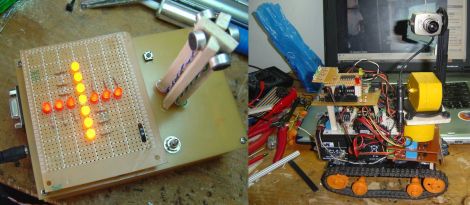
The first is a sound localization system not unlike one we showed you a few weeks ago. The difference is that his system displays the sound source via a set of LEDs rather than by motion, making it far less prone to interference by things like servo noise. His system uses four identical circuits, each of which are wired to a separate analog input on the Arduino. Each channel is adjustable, making it easy to tweak how the system responds to a particular sound.
His second project is a sizable robot built on the Motoruino platform. His contraption features several stacked control boards that handle the bots locomotion as well as camera control. It connects to his computer via a Bluetooth module that boasts a 1 mile range, allowing him to control everything from his PC. [Jad] is using the robot as a prototype for a much larger scale creation, and he says that his current focus is getting the robot to track and follow objects automatically using the on-board camera.
Continue reading to see a small preview of his bot’s progress so far.