Building A Human-Sized Pop-Pop Boat

Pop-pop boats are a neat little science teaching tool that many children end up playing with at some point or other. They’re normally sized to float around a sink or bathtub. [Steve Mould] recently got the opportunity to board a much larger example,  sized for an actual human passenger.

The boat belongs to the The AHHAA Science Center in Estonia, along with a smaller model about half the size. Both are fired by propane gas burners to give them some real heat output into the water tank, far beyond what you’d get from little tea light candles. In the case of the larger boat, it uses a series of valves to allow the tank to be filled with water while the rear thrust pipes are closed.

At the larger scale, it’s more easy to visualize the flow out of the boat’s rear outlets. It’s by no means a fast way to get around on the water, with a top speed somewhat less than walking pace. It’s also very loud. Regardless, it’s amusing to see the pop-pop engine work even when scaled up to full size.

If you’re looking for an in-depth explanation of how pop-pop boats work, [Steve Mould] has covered that previously. Video after the break.

Continue reading “Building A Human-Sized Pop-Pop Boat”

A Little Bit Of Science History Repeating Itself: Boyle’s List

In a recent blog post, [Benjamin Breen] makes an interesting case that 2023 might go down in history as the start of a scientific revolution, and that’s even if LK-99 turns out to be a dud. He points to several biomedical, quantum computing, and nuclear fusion news items this year as proof.

However, we aren’t as convinced that these things are here to stay. Sure, LK-99 was debunked pretty quickly, but we swim in press releases about new battery technologies, and new computer advances that we never hear about again. He does mention that we aren’t alone in thinking that as [Tyler Cowen] coined the phrase “Great Stagnation” to refer to the decline in disruptive tech since 1945. Still, [Benjamin] argues that people never know when they live through a scientific revolution and that the rate of science isn’t as important as the impact of it.

Continue reading “A Little Bit Of Science History Repeating Itself: Boyle’s List”

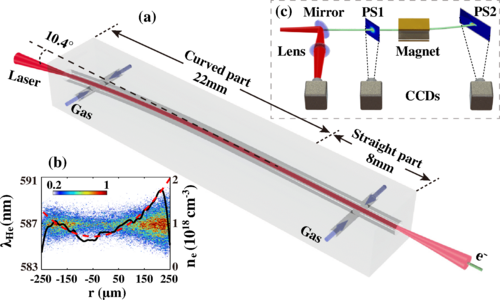
(a) Structure of the discharged capillary to produce the curved and straight plasma channel. (b) Spectrum distribution and calculated profile of the plasma density along the radial direction at the entrance of the discharged capillary. (c) Experimental setup for the measurements of laser guiding and electron acceleration. (Credit: Xinzhe Zhu et al., 2023)

Accelerating Electrons To TeV Levels Using Curved Laser Beams

There are many applications for particle accelerators, even outside research facilities, but for the longest time they have been large, cumbersome machines, not to mention very expensive to operate. Here laser wakefield accelerators (LWFAs) are a promising alternative, which uses lasers to create accelerated particles along the wake in a plasma field. One of the major struggles has been with reinjecting the thus accelerated particles into another stage of a multi-stage accelerator, which would be required to obtain energies closer to one TeV. In this area researchers have now demonstrated a way around this, by using curved channels for the laser beams (paywalled paper) which inject the laser beam into the continuous cavity. Continue reading “Accelerating Electrons To TeV Levels Using Curved Laser Beams”

Miners Vs NASA: It’s A Nevada Showdown

Mining projects are approved or disapproved based on all kinds of reasons. There are economic concerns, logistical matters, and environmental considerations to be made. Mining operations can be highly polluting, or they can have outsized effects on a given area by sheer virtue of the material they remove or the byproducts they leave behind.

For a proposed lithium mining operation north of Las Vegas, though, an altogether stranger objection has arisen. NASA has been using the plot of land as a calibration tool, and it doesn’t want any upstart miners messing with its work. 

Continue reading “Miners Vs NASA: It’s A Nevada Showdown”

Demo Relativity For A C-Note

If you are a science fiction fan, you probably hate the theory of relativity. After all, how can the Enterprise get to a new star system every week if you can’t go faster than the speed of light? [Nick Lucid] wants to set you straight: it is real, and you can prove it to yourself for under $100.

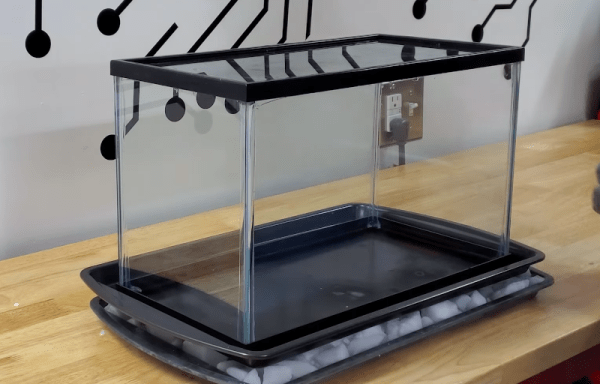
The idea uses muons created in our atmosphere by cosmic rays colliding with gasses in the atmosphere. So how do you detect muons yourself? [Nick] shows you how to do it with a fish tank, dry ice, and rubbing alcohol. If that sounds like a cloud chamber, you aren’t wrong.

A cloud chamber is undeniably cool, but how does it prove relativity? You’ll see several kinds of particles interacting with your cloud chamber, but you can tell which ones are muons by the size and motion of the streaks. The muons don’t last very long. So you’d expect very few muons to make it to the surface of the Earth. But they not only reach the surface but go deep under it, as well.

So how do you explain it? Relatively. The muon experiences its average 2.2 microseconds lifetime in what appears to us to be over 150 microseconds, even if it is moving relatively slowly for a muon. Some muons are faster or live longer, so we see a lot of them hit the Earth every minute of every day. This is due to time dilation and also explains length contraction because the muon moves at a certain speed, yet it appears to go further to us than to the muon.

Coincidentally, we recently discussed this same effect relative to using muons for underground navigation. If you want an easier way to count muons with a computer, you can build a detector for about the same price as the cloud chamber.

Continue reading “Demo Relativity For A C-Note”

What Is A Schumann Resonance And Why Am I Being Offered A 7.83Hz Oscillator?

Something that probably unites many Hackaday readers is an idle pursuit of browsing AliExpress for new pieces of tech. Perhaps it’s something akin to social media doomscrolling without the induced anger, and it’s certainly entertaining to see some of the weird and wonderful products that can be had for a few dollars and a couple of weeks wait. Every now and then something pops up that deserves a second look, and it’s one of those that has caught my attention today. Why am I being offered planar PCB coils with some electronics, described as “Schumann resonators”? What on earth is Schumann resonance, anyway? Continue reading “What Is A Schumann Resonance And Why Am I Being Offered A 7.83Hz Oscillator?”

Huygens’ Telescopes Weren’t Very Good, Now We Think We Know Why

[Christiaan Huygens] was a pretty decent mathematician and scientist by the standards of the 17th century. However, the telescopes he built were considered to be relatively poor in quality for the period. Now, as reported by Science News, we may know why. The well-known Huygens may have needed corrective glasses all along.

Much of Huygens’ astronomical work concerned Saturn.

Huygens is known for, among other things, his contribution to astronomy. He discovered Titan, the largest moon of Saturn, and also studied the planet’s rings. He achieved this despite telescopes that were described at the time as fuzzy or blurrier than they otherwise should have been.

Huygens built two-lens telescopes, and would keep a table of which lenses to combine for different magnification levels. However, his calculations don’t align well with today’s understanding of optics. As it turns out, Huygens may have been nearsighted, which would account for why his telescopes were blurry. To his vision, they may indeed have been sharp, due to the nature of his own eyes. Supporting this are contemporary accounts that suggest Huygens father was nearsighted, with the condition perhaps running in the family. According to calculations by astronomer Alexander Pietrow, Huygens may have had 20/70 vision, in which he could only read at 20 feet what a person with “normal” vision could read from 70 feet away.

It’s a theory that answers a mildly-interesting mystery from many hundreds of years ago. These days, our troubles with telescopes are altogether more complex. If only a simple pair of glasses could solve NASA’s problems!