RF Shield Turns Arduino (And PC) Into Shortwave Radio

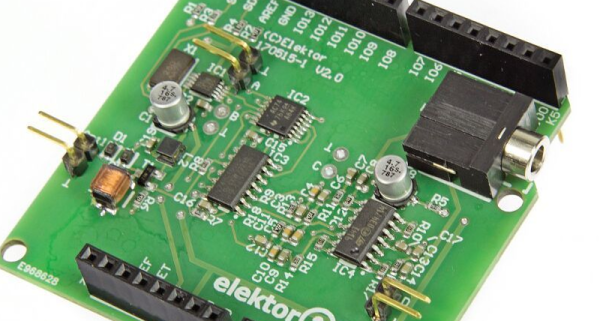
Microcontrollers tend to consume other kinds of electronics. A project you might once have done with a 555 now probably has a cheap microcontroller in it. Music synthesizers? RC controllers? Most likely, all microcontroller-based now. We always thought RF electronics would be immune to that, but the last decade or two has proven us wrong. Software-defined radio or SDR means you get the RF signal to digital as soon as possible and do everything else in software. If you want an introduction to SDR, Elektor now has an inexpensive RF shield for the Arduino. The Si5351-based board uses that oscillator IC to shift RF signals down to audio frequencies and then makes it available to the PC to do more processing.

The board is available alone or as part of a kit that includes a book. There’s also a series of Elektor articles about it. There’s also a review video from Elektor about the board in the video, below.

Continue reading “RF Shield Turns Arduino (And PC) Into Shortwave Radio”

A Mini SDR Receiver Using An Audio DSP

Software defined radio or SDR is the most exciting frontier in the field of radio, transferring as it does all signal functions from the analogue to the digital domain. Radios using SDR techniques can be surprisingly straightforward and easy to understand, and [Ray Ring]’s little SDR receiver manages to combine this with the novel use of an audio DSP rather than a computer to perform its SDR functions.

The front end is a conventional enough direct conversion design with an Si5531 clock generator providing I and Q phase-shifted local oscillator signals to a TS3A5017 analogue switch used as a mixer. An unexpected presence is an LTC6252 op-amp as an RF amplifier, but the special part comes after the I and Q baseband signals have been filtered. The SDR part of this receiver is an audio DSP, but it’s one that might not be an immediate choice. The Spin Semiconductor FV-1 is a dedicated digital reverb chip for musical effects boxes, but it comes with the feature that its internal DSP core can access custom code from an external ROM. [Ray] has written his own code for demodulation of AM, USB, and LSB signals rather than musical effects, and used the device’s left and right audio channels to process I and Q quadrature signals. The use of a single purpose chip to do something its designers never intended gives it the essence of a good hack, and we’re mightily impressed at his spotting the potential for an SDR in a musical effect. Hear it in action in the video below the break.

Meanwhile if the operation of a receiver such as this one is a mystery to you, we published a handy primer back in 2017.

Continue reading “A Mini SDR Receiver Using An Audio DSP”

LuaRadio Gives Insight Into SDR

In theory, you shouldn’t need any help to develop a software-defined radio (SDR) application. But in real life you really don’t want to roll your own code every time to read the IQ samples, perform various transformations on them, and then drive audio output. At worst, you’ll use some libraries (perhaps GNU Radio) but usually, you’ll use some higher-level construct such as GNU Radio Companion (GRC). GRC is a bit heavyweight, though, so if you’ve found it daunting before, you might check out some of the material on the LuaRadio website.

We’ve looked at LuaRadio several years ago, but it has undergone a lot of changes since then and has some excellent documentation. Like Lua itself, LuaRadio emphasizes fast scripting. It supports quite a few pieces of common hardware and nearly anything that feeds data through a soundcard.

Continue reading “LuaRadio Gives Insight Into SDR”

All Your SDR Software In A Handy Raspberry Pi Image

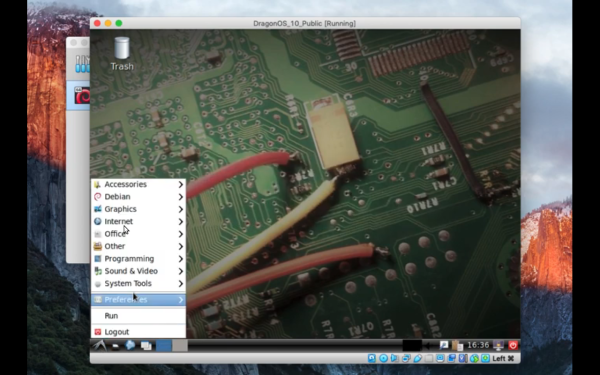
The SDR revolution has brought a bonanza of opportunities for experimentation to the radio enthusiast, but with it has come a sometimes-confusing array of software for which even installation can be a difficult prospect for an SDR novice. If you’re bamboozled by it all then help may be at hand courtesy of [Luigi Cruz], who has packaged a suite of ready-to-go popular SDR software in an OS image for the Raspberry Pi.

On board the Raspbian-based OS image are SDR Angel, Soapy Remote, GQRX, GNURadio, LimeUtil, and LimeVNA. In hardware terms the RTL-SDR is supported, along with the LimeSDR, PlutoSDR, Airspy, and Airspy HF. All are completely ready-to-go and even have desktop shortcuts, so if the CLI scares you then you can still dive in and play. More importantly it’s designed for use with SDR transmitters as well as receivers, so the barrier for full SDR operation for radio amateurs has become significantly lower too.

This year has seen the seven-year anniversary of the RTL-SDR hack that probably did most to kickstart the use of SDRs in our community. Our colleague [Tom Nardi] wrote a retrospective that’s worth a look for its overview of some SDR tricks that have evolved over that time. Meanwhile if you don’t mind restricting your outlook somewhat, it’s possible to turn the Raspberry Pi 3 into an SDR all without any extra hardware.

Software Defined Radio Gets Physical Control

Software Defined Radio (SDR) is a great technology, but there’s something so satisfying about spinning a physical knob to cruise the airwaves. Wanting to restore that tactile experience, [Tysonpower] purchased a cheap USB volume knob and set out to get it working with his software. Unfortunately, getting it up and running took a lot more work than you’re probably expecting.

Programming the knob’s STM32

After verifying that the knob worked for volume control on his computer, [Tysonpower] decided to try and pull the firmware from the device’s STM32 microcontroller. Unfortunately, this is where things got tricky. It turned out the chip had Code Protection enabled, so when it was wired up to a programmer and put into DFU mode, the firmware got wiped. Oops.

That left [Tysonpower] with no choice but to write a new firmware from scratch, which naturally required reverse engineering the device’s hardware. Step one was reading up on STM32 development and getting the toolchain working, which paved the way to getting the knob’s LED to blink. A couple more hours worth of work and some multimeter poking later, and he was able to read the knob’s movement. He describes getting USB HID working as a nightmare due to lack of documentation, but eventually he got that sorted out as well.

The end result is a firmware allows the volume knob to mimic a mouse scroll wheel, which can be used for tuning in many SDR packages. But we think the real success story is the experience [Tysonpower] gained with reverse engineering and working with the STM32 platform. After all, sometimes the journey is just as important as the end result. Continue reading “Software Defined Radio Gets Physical Control”

Keep An Eye On The Neighborhood With This Passive Radar

If your neighborhood is anything like ours, walking across the street is like taking your life in your own hands. Drivers are increasingly unconcerned by such trivialities as speed limits or staying under control, and anything goes when they need to connect Point A to Point B in the least amount of time possible. Monitoring traffic with this passive radar will not do a thing to slow drivers down, but it’s a pretty cool hack that will at least yield some insights into traffic patterns.

The principle behind active radar – the kind police use to catch speeders in every neighborhood but yours – is simple: send a microwave signal towards a moving object, measure the frequency shift in the reflected signal, and do a little math to calculate the relative velocity. A passive radar like the one described in the RTL-SDR.com article linked above is quite different. Rather than painting a target with an RF signal, it relies on signals from other transmitters, such as terrestrial TV or radio outlets in the area. Two different receivers are used, both with directional antennas. One points to the area to be monitored, while the other points directly to the transmitter. By comparing signals reflected off moving objects received by the former against the reference signal from the latter, information about the distance and velocity of objects in the target area can be obtained.

The RTL-SDR test used a pair of cheap Yagi antennas for a nearby DVB-T channel to feed their KerberosSDR four-channel coherent SDR, a device we last looked at when it was still in beta. Essentially four SDR dongles on a common board, it’s available now for $149. Using it to build a passive radar might not save the neighborhood, but it could be a lot of fun to try.

Hackaday Links Column Banner

Hackaday Links: September 29, 2019

In a sure sign that we’ve arrived in the future, news from off-world is more interesting this week than Earth news. When the InSight probe landed on Mars last year, it placed the first operating magnetometer on the Red Planet. Since then, the sensitive instrument has been logging data about the planet’s magnetic field, and now there are reports that researchers have discovered a chain of pulsations in the magnetic field. Pulsations in planetary magnetic fields aren’t all that strange; pulse trains that occur only at Martian midnight are, though. Researchers haven’t got a clue yet about what this means. We assume they’ve eliminated artifacts like something on the lander being turned on at local midnight, so when they figure it out it should be fascinating.

In more news from the future, Boston Dynamics is trolling us again. We covered the announcement early this week that they’re putting their Spot quadruped robot on sale – sort of. Turns out you need to be selected to qualify based on the application you have in mind, plus have several Ferraris full of cash to spend. While everyone was watching the adorable antics of Spot as it wandered through improbably industrial vignettes, Boston Dynamics also released this slightly terrifying video of their Atlas robot running through a gymnastics routine.  It starts with a headstand and a front roll and ends with a slipt leap and whatever the gymnastics equivalent of a figure skating axel jump is. Yes, it has a special roll cage attached to make the tumbles a bit smoother, but it’s still some remarkable stuff.

How are your RF design skills? If they’re good enough to design an RF power amp, you might want to check out this homebrew RF design challenge. Put on by NXP Semiconductors, the design must use one of their new LDMOS RF power transistors. They’ll send you samples so you can build your design, and you stand to win up to $3000 plus $1000 worth of NXP products. The contest opened back in May but is running through the middle of November, so you’d better hurry.

Speaking of RF, wouldn’t it be interesting to see a snapshot of the RF spectrum over the entire planet? ElectroSense thinks so, and they’re working on a crowdsourcing model to set up a globe-spanning network of connected RF sensors. The idea is similar to what FlightAware does for monitoring the locations of aircraft with a distributed network of ADS-B receivers. But where FlightAware only monitors a narrow slice of spectrum, ElectroSense wants it all – DC to 6 GHz. You can build a sensor from an SDR and a Raspberry Pi and start contributing to the effort, which only has a handful of sensors at the moment.

Has affordable metal 3D-printing finally arrived? For certain values of affordability, it soon will, when One Click Metal launches their new selective laser melting printer. Thomas Sanladerer did a video with the principals, and the prototype looks promising. SLM is not a new process, but patents on the core process recently ran out, so startups like One Click Metal are jumping into the market. Their printer won’t be cheap — you’ll still need to write a check with many zeroes — but with more players, the price should come down.

And finally, what’s this world coming to when a startup specializing in building giant fighting robots can’t make a go of it? MegaBots is shutting down, and while that’s certainly bad news for its founders and employees, it’s great news for anyone in the market for used battle bots. The company’s flagship bot, the 15-ton Eagle Prime, is currently up for auction on eBay. Bidding started at $1 with no reserve, but if you were looking for a steal, you’re a bit late. The high bid is currently $100,100, which is still an incredible buy considering it cost $2.5 million to build. You’ll have to pay for shipping, but you’ll have a super-destructive mecha of your own to drive around. And think how cool you’ll look rolling into some kid’s backyard birthday party. Presumably one you’ve been invited to.