
Passive Infrared (PIR) Sensor Tutorial

pirsensor

[ladyada] has a freshly-published and amazingly thorough tutorial on passive infrared (PIR) motion sensors. Most often seen in security floodlights and automatic doors, in creative hands these sensors can be put to other uses—cat flaps, camera triggers and purely artistic applications—as you’ll see in several demo projects and videos. For the curious, the tutorial provides a good amount of background theory on how PIR sensors work, along with the associated fresnel lens optics. And for those who just want to get hacking, most PIR sensors (like the one above) come in a simple-to-interface module containing all the support hardware and providing a simple digital output; the article wraps up with one such example.

Custom Flex Sensors

flex

Flex sensors, like the ones used in the Nintendo Power Glove, are generally expensive and hard to find. However, [jiovine] demonstrates that they are easy enough to make from spare parts. He sandwiched a strip of plastic from ESD bags between pieces of copper foil, and wrapped the whole thing in heat shrink tubing. The sensor is able to detect bends in either direction, unlike the original power glove sensors. His version had a nominal resistance of about 20k ohms, but by choosing a different resistive layer you could create sensors that are more or less resistive.

Related: 5-cent tilt sensor

Controllable Bristlebot

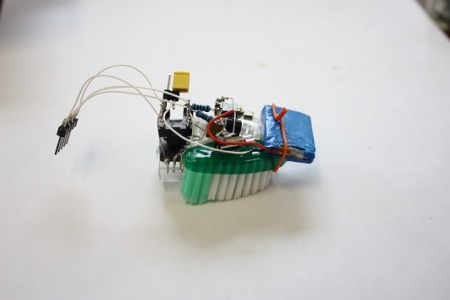
[sprite_tm], whose projects we have covered in the past, took the popular bristlebot to an extreme and created a controllable version. A bristlebot consists of a small vibrating motor mounted with a battery on the head of a toothbrush. These micro-robots buzz around randomly, and he attempted to tame them. He used a platform of twin bristlebots and added an optical sensor from a laser mouse and an ATtiny13. The optical sensor is used to determine the relative motion of the robot, so that the motors can be adjusted accordingly. He also has a video of the bot using the sensor to find a mark on the floor and stay within bounds. Although it isn’t as accurate, it acts like a traditional line-following robot.

Continue reading “Controllable Bristlebot”

TinkerKit, Physical Computing Toolkit

tinkerkit

TinkerKit is a collection of 20 different sensors and 10 actuators. It’s meant to make prototyping of physical computing devices much quicker/easier. The devices plug into a Sensor Hub Arduino shield. There is also a similar hub board that can emulate a keyboard; it translates sensor input directly to key strokes. It looks like a very ambitious project and it’s still in development. We love the idea though and think the wide variety of components will foster better final designs. The TinkerKit site covers the current component lineup and there’s a demo video embedded below.

Continue reading “TinkerKit, Physical Computing Toolkit”









