Man Proposes To Girlfriend With An Arc Reactor

arc

Thinking long and hard about how to propose to his girlfriend, [Ed] hit upon a great idea: use an arc reactor as the ring box, with enough LED lights to outshine all but their love, and servos to present the ring and tug at the heartstrings.

[Ed] set about giving his now-fiancé from his arc reactor heart by building a simple circular arrangement of adafruit RGB LED strip and an Arduino. There are two modes for this arc reactor: a light up mode that simply looks awesome, and a ‘ring mode’ that uses two servos to open the front cover and bring the engagement ring into view.

After [Ed]’s fiancé said yes, the cover in the center of the arc reactor closes for its continued use as a desk ornament. You can check out [Ed]’s proposal contraption in action after the break.

Continue reading “Man Proposes To Girlfriend With An Arc Reactor”

Tea-bagging An Arduino

tea-bagging-arduino

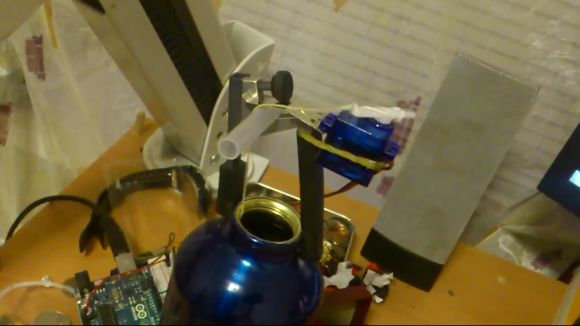
[Dmitry Narkevich] likes a strong cup of tea and his method of getting there is to oscillate the tea bag as it steeps. But why take the time to do this when you can make an Arduino brew your tea for you. As you can see, he rigged up a system to move the tea bag as it steeps in his metal bottle.

The motion is provided by a hobby servo connected to an Arduino. This makes timing the process very simple and we’d imaging it’s only a matter of time before he adds an alarm so he’ll know when it’s ready. But the real hack comes in the apparatus that connects the servo to the bottle. Since he’ll be drinking out of it the assembly needs to be easy to remove and should be able to stand up to the abuse of being clamped on and taken off a few times each day.

The base of the device is a guitar capo. This is meant to gently clamp to the finger board of a guitar using spring tension so it is already covered in rubber which gives it a firm grip on the bottle’s opening. The servo is connected to a metal part from a stapler, and the string drapes over the body of a disposable pen. Don’t miss this in action in the clip after the break.

If you don’t have a servo on hand you could try using the sled from an optical drive.

Continue reading “Tea-bagging An Arduino”

Pixar-style Lamp Project Is A Huge Animatronics Win

pixar-lamp-animated-procedurally

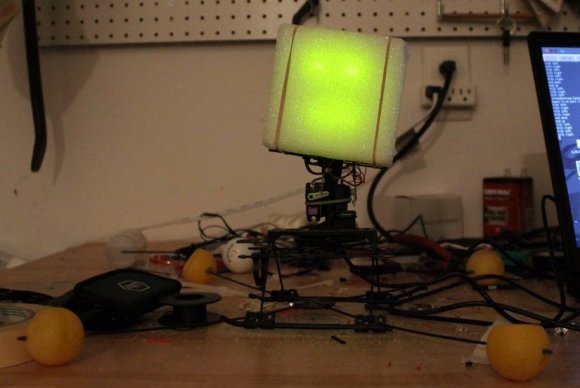
Even with the added hardware that lamp still looks relatively normal. But its behavior is more than remarkable. The lamp interacts with people in an incredibly lifelike way. This is of course inspired by the lamp from Pixar’s Luxo Jr. short film. But there’s a little bit of most useless machine added just for fun. If you try to shut it off the lamp shade is used to flip that switch on the base back on.

[Shanshan Zhou], [Adam Ben-Dror], and [Joss Doggett] developed the little robot as a class project at the Victoria University of Wellington. It uses six servo motors driven by an Arduino to give the inanimate object the ability to move as if it’s alive. There is no light in the lamp as the bulb has been replaced by a webcam. The image is monitored using OpenCV to include face tracking as one of the behaviors. All of the animations are procedural, making use of Processing to convey movement instructions to the Arduino board.

Do not miss seeing the video embedded after the break.

Continue reading “Pixar-style Lamp Project Is A Huge Animatronics Win”

$5 Toy Car Upgraded To Record The Ride In HD

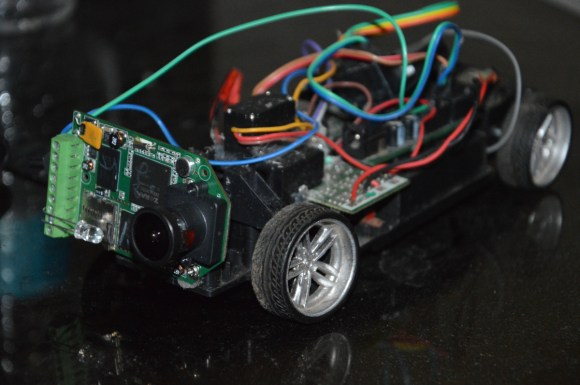
We hope [Kabir’s] driving skills are top-notch because the camera stuck to the front of this toy is a high-ticket item. It’s ironic, since the donor toy for this hacked RC car only cost about five bucks. It had been gathering dust in the dark reaches of his bedroom until he sat down and gave it a proper upgrade.

He started the project by getting rid of the stock battery and moving to a pair of Lithium Polymer cells. They give the vehicle more power and more than twice the running time between charges. A couple of springs were added to the suspension system for a smoother ride. Turning had been a problem since the original design offered no control over how far the wheels turn. You can just make out the body of the servo motor he rolled into the system to allow for more precise turning.

The most recent addition is the HackHD camera on the front of the vehicle. It records to an SD card rather than streaming the video in real-time. Check out the clip after the break to see the interesting perspective achieved by filming so low to the ground. The one thing we would add is a cage around that board which retails at around $165.

Continue reading “$5 Toy Car Upgraded To Record The Ride In HD”

Pull-string Most Useless Machine

The mechanical simplicity of this pull-string controlled most useless machine is delightful. You can see the metal gripper which is reaching up to tug on a light-fixture-style pull chain. This is how it turns itself off after you’ve pulled the string to power it up.

The device is [Alex555’s] entry in the 7400 Logic competition. We do hope that he ends up posting a schematic because we’d love to see the gritty details of how it works. After the break you can watch two doors open, allowing the arm to raise up and the gripper to grab the chain. This takes just four servo motors, which are controlled by the signal from a 555 timer and some accompanying hardware.

Apparently the chain is a fake, as the servos didn’t provide enough force to actuate that type of switch. It’s not a surprise as those pull chains do require quite a tug. An optical sensor was used to trigger the movement when your hand reaches for the chain.

Continue reading “Pull-string Most Useless Machine”

Halloween Props: Monster In A Box

This furry Halloween decoration proves to be a simple build, but it’s still quite popular with the little ones. [Chris] had a Halloween party for a group of 2-5 year olds and this monster that peeks out of a box was a huge hit. The trick really isn’t in the complexity of the build, but in the interactivity.

The enclosure is just a shoe box which has been covered in synthetic black fur. The lid was hinged on the back, and a hobby servo with a bit of an extension on the arm is used to lift the front which reveals the monster’s paper eyes. Inside you’ll find an Arduino, breadboard, and battery pack. It’s not visible above, but a distance sensor on the front of the box is monitored by the Arduino. When it detects something in front of it the servo fires up and pops open the lid. The firmware includes a timer so that the monster waits a bit before taking its next peek at the party.

A Collection Of Hands To Inspire Your Halloween Animatronics

Jump scares are a lot of fun, but if you want to hold the attention of all those trick-or-treaters we’d suggest a creepy prop. One of the best choices in that category is a ghoulishly lifelike hand. You can draw some inspiration from this roundup of robot hands which Adafruit put together.

We’ve chosen four examples for the image above but there are more to be had than just these. In the upper left there is a laser-cut acrylic hand that actually features some force sensitive resistors on the fingertips to help implement some haptic feedback. This project was inspired by the hand seen in the lower right which uses flex sensors on a glove to control the bot’s movement. If you’re looking for something more realistic the 3D printed parts on the lower left are the best bet. But if you’re looking to put something together by Halloween night the offering in the upper right is the way to go. It’s hacked together using cardboard templates to cut out plastic parts and using polymorph to form joints and brackets.