Harry Potter Location Clock Spies On Your Smart Phone

harry-potter-clock

The location clock found in the Harry Potter books makes for a really fun hack. Of course there’s no magic involved, just a set of hardware to monitor your phone’s GPS and a clock face to display it.

[Alastair Barber] finished building the clock at the end of last year as a Christmas gift. The display seen above uses an old mantelpiece clock to give it a finished look. He replace the clock face with a print out of the various locations known to the system and added a servo motor to drive the single hand. His hardware choices were based on what he already had on hand and what could be acquired cheaply. The an all-in-one package combines a Raspberry Pi board with a USB broadband modem to ensure that it has a persistent network connection (we’ve seen this done using WiFi in the past). The RPi checks a cellphone’s GPS data, compares it to a list of common places, then pushes commands to the Arduino which controls the clock hand’s servo motor. It’s a roundabout way of doing things but we imagine everything will get reused when the novelty of the gift wears off.

3d Printed Hexapod Robot

3d-printed-hexapod

This hexapod was made almost entirely via 3d printing (translated). The parts that you need to supply include a few fasteners to make connections, twelve servo motors, and a method of driving them. As you can see in the video after the break, all those parts come together into a little robot that functions quite well. The only thing that we think is missing are some grippy feet to help prevent slipping.

[Hugo] calls the project Bleuette. It is completely open source, with the cad files and source code available on his Github repository. There is additional information in the wiki page of that repo. This gives us a good look at the electronic design. He’s controlling the legs with an Arduino, but it’s all dependent on his own shield which features a PIC 18F452 to take care of the signals used to drive all of the servo motors. The board also has some peripherals to monitor the current draw and regulate the incoming power.

Continue reading “3d Printed Hexapod Robot”

Deathly Hallows Mark The Passing Of Time

deathly-hallows-clock

Whether you’re a Harry Potter fan or not we think you’ll enjoy this Deathly Hallows clock. The body is modeled after the triangle, circle, and line that make up the symbol that played a prominent role when concluding the fantasy novel series. A bit of motion and a couple handfuls of LEDs are what allow it to display the time of day.

[Yeenasty] started by building the triangular surround out of wood. In the center he added a circular veneer which was partitioned into twelve chambers. These indicate the hour and are illuminated one at a time from midnight until noon. Once all of the LEDs are switched on (as seen above) they are then extinguish one at a time from noon until midnight. [Yeenasty] mentions that this means the clock isn’t overly bright during the night-time hours.

Minutes are displayed by the wooden slat in the middle of the ring of LEDs. Here it’s showing 30 minutes after the hour because it is vertical and the bottom red LED is lit. The hand is mounted on a 180 degree servo so when it has made half of a rotation the hand backtracks 29 minutes and the LED at the other end is illuminated to continue progress around the face of the clock.

[via Reddit]

Extending The Features Of An IP Camera

adding-external-control-via-IP-camera

[Dave Astolfo] wanted to be able to let his CNC mill run by itself with the ability to monitor it remotely. The only problem with that idea is that if he checked in and saw something bad happening he needed a remote kill switch as well. He ended up killing two birds with one stone by adding extra features to an IP camera.

These Internet Protocol cameras are pretty nifty. Just plug their power cord in and they’ll connect to WiFi and start streaming video. Many of them offer features like pan and tilt, and this model even features IR LEDs for night viewing that can be switched on and off through the web interface. That’s the point at which [Dave] started his hack. He patched into the leads on the IR LEDs. They’re monitored by an ATtiny85. When he turns on the LEDs via the webpage the ATtiny85 senses it and drives a servo motor to push the ESC key on the keyboard. As you can see in the clip after the break, this will stop the milling in its tracks. We especially liked the use of LEGO Technique pieces to make the servo mount removable.

Continue reading “Extending The Features Of An IP Camera”

Arduino Using A Straight Key For Morse Code Assistance

arduino-morse-code-straight-key

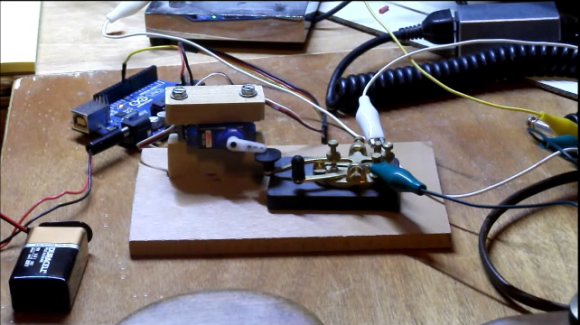
For those unfamiliar with Ham Radio, there are lots of fancy tools these days to make it easier for the radio operator. But enthusiasts still like to get back to basics, and one way to do this is to participate in Straight Key Night. This is when you pull out your traditional Morse code keyer and have a chat with others around the world. The most recent event was on New Year’s Eve. The only drag is that it sometimes takes a while to find another Ham who’s listening, and this can mean repetitively keying the letters QC SKN for long periods of time (QC invites listeners to respond, and SKN is to inform them you’re participating in Straight Key Night). Sure, a programmable keyer will do this for you, but that is against the spirit of the event. [Mike Herr] found a grey area by mechanically interfacing an Arduino with a straight key.

You can see the straight key being pressed by a hobby servo in the image above. The servo is driven by the Arduino, which will transmit the series of letters automatically. As you can see in the video after the break, once [Mike] hears back from a fellow operator he switches to a huge wooden straight key for the rest of the conversation.

Continue reading “Arduino Using A Straight Key For Morse Code Assistance”

Wave That Roman Candle Around Without Risking Your Digits

fun-with-fireworks

Some people don’t mind missing a finger or two, but we’re quite attached to all of ours. That’s why we’ve never held on to the fireworks after lighting the fuse. [Dzl] and his son wanted to be (at least somewhat) safe while still having that kind of fun. So they built this rig which lets you wave around a roman candle from a safe distance. It’s not strictly limited to one type of firework either. You can see there is a PVC barrel which will send a bottle rocket off in whichever direction the thing is pointed. As you’ve guessed, a test run is shown off in the video after the jump.

The rig is build from laser cut nylon parts. Don’t fret if you lack the equipment to automatically reproduce this. It’s not that hard to fabricate these types of parts by hand. And the motors that make it go are just hobby servos rigged for continuous rotation. [Dzl] did add external potentiometers for position feedback.

This is a tame way to celebrate the New Year, which is nice if yesterday’s project was a bit too hard-core for you.

Continue reading “Wave That Roman Candle Around Without Risking Your Digits”

PyMCU Test Project Looks Like A Minecraft Mob

pymcu-controlled-blockhead

Hackaday’s own [Jeremy Cook] has been testing out the pyMCU board and managed to put together an animated block head that looks like it could be a foe in Minecraft. That’s thanks mostly to the block of foam he’s using as a diffuser. The face of the project is a set of LEDs. These, along with the servo motors that move the neck are controlled using Python code which you can glance at after the break (there’s a video demo there too).

We first saw pyMCU early in the year. The PIC 16F1939 offers plenty of IO and acts as a USB connected bridge between your hardware and your Python scripts. Speaking of hardware, the test platform used to be an RC helicopter. [Jeremy] scrapped most of it, but kept the servo motors responsible for the pitch of the rotors. The board makes these connections easy, and the concept makes controlling them even easier. In fact, there’s only about 17 lines of code for the functions that control the servos. The rest is a simple UI built with Tkinter.

Continue reading “PyMCU Test Project Looks Like A Minecraft Mob”