Salvaged Robot Arm Makes A Big 3d Printer

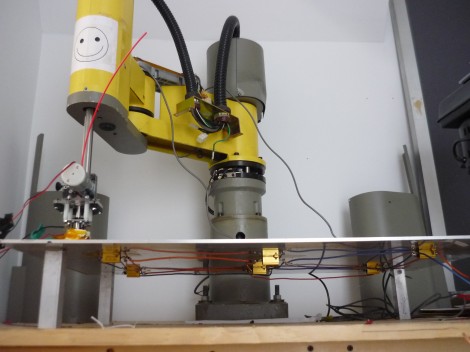
Wow, building a precision 3d printer is amazingly easy if you can get your hands on an industrial-quality robot arm. [Dane] wrote in to tell us about this huge extruder printer made from an ’80s-era SCARA robot arm. It is capable of printing objects as large as 25″x12″x6.5″.

This 190 pound beast was acquired during a lab clean out. It was mechanically intact, but missing all of the control hardware. Building controllers was a bit of a challenge since the it’s designed with servo motors and precision feedback sensors. This is different from modern 3d printers which use stepper motors and no feedback sensors. A working controller was built up one component at a time, with a heated bed added to the mix to help prevent warping with large builds. We love the Frankenstein look of the controller hardware, which was mounted hodge-podge as each new module was brought online.

You can see some printing action in the clip after the break. A Linux box takes a design and spits out control instructions to the hardware.

Continue reading “Salvaged Robot Arm Makes A Big 3d Printer”
Physical Email Box — Mail Flag And All

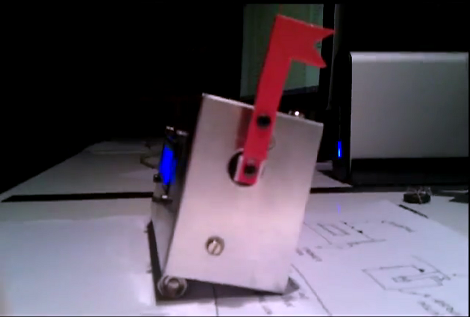
We gave you a side view because we really like the red new-mail flag. Sure it works the opposite of how USPS boxes do (where the flag tells the letter carrier there is outgoing mail to be picked up) but it’s still a fun touch. What you can’t see here is that this physical email box has a character LCD screen to read your messages and a set of buttons on the top to send back replies.

[Eraclitux’s] project puts an Arduino, LCD, a few buttons, and a servo motor inside of a metal project box. It connects to his computer and takes commands over the USB cable. The Python script is where most of the magic happens. This is a good reference project if you’re interested in using POP and SMTP packages to interface your Python scripts with an email server. You’re pretty limited on responses, with preprogrammed messages to reply “Yes”, “No”, or “Read”. But it’s journey that matters, not the destination.

Continue reading “Physical Email Box — Mail Flag And All”

There’s More Than Meets The Eye To This Robot Car

This is a robot that any Transformers enthusiast will love. Sure, the car looks just a bit boxy, but you’ll forget all about that when you see it unfold into a bipedal robot (translated). [Zak Sawa] is responsible for the creation. He pull off the build using 22 servo motors which let the car transform, and provide the somewhat awkward ability to walk. Fold it back up again and the car can drive away. In other words, here’s the Transformers toy that you always wanted; radio controled and it actually works!

This is the result of about four years of work. Apparently it’s the eighth iteration, and a note on the video after the break teases a ninth version on the way. It’s not just the robot that looks great, check out the carrying case that houses it for storage.

Continue reading “There’s More Than Meets The Eye To This Robot Car”

Converting A Manual Camera Lens To Use Motorized Zoom And Focus

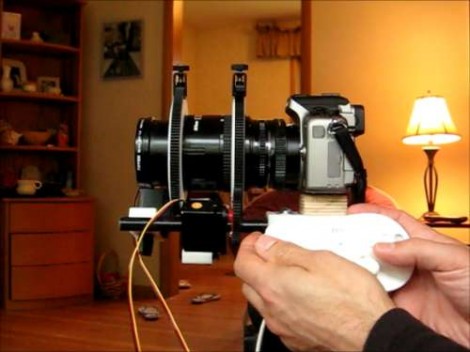
[Guy] wrote in to share this motorized camera lens project he recently finished. He really loved the zoom lens, but since both zoom and focus are manually controlled, he sometimes had trouble getting both set to the right place in time to take the shot. With modern DSLR cameras which allow video capture, he also wants to have the option of a smooth zoom that is always in focus. The solution was to add motors to the rings and control them with a Wii classic controller.

This hack really shines when it comes to the add-on hardware. He has some beautifully made rings which wrap around the focus and zoom rings on the lens. They are then held in place by a timing belt. These belts have teeth which key into the gears on a pair of servo motors. From there it’s a snap to drive the motors with an Arduino, connecting to the Wii controller with a breakout connector. You can see [Guy] showing off the build in the clip after the break.

Continue reading “Converting A Manual Camera Lens To Use Motorized Zoom And Focus”

Quick And Easy Wildlife Camera

This wildlife camera is really easy to put together. You should keep it in mind if you’re ever tying to figure out what’s eating the heads off of all of your tulips. [Revoltlab] put it together, and although there’s one fatal flaw in this particular system, the concept is quite sound.

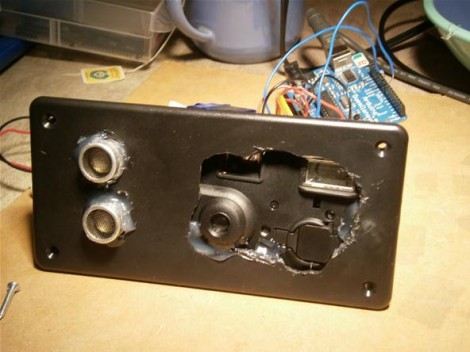
The build uses a camera, paired with an ultrasonic range finder. When something passes within the pre-set distance for the sensor, a servo motor clicks the shutter button on the camera. It’s all driven by an Arduino and powered from a 9V battery.

If you watch the video after the break you’ll discover the flaw we mentioned. This is a disposable film camera and requires winding between pictures. That hasn’t been implemented yet. But we’ve got an old digital camera with a broken LCD screen which would be perfect for the job. We’d have to do a bit more work to turn the camera on before taking the picture though.

There are a couple of possible upgrades to the idea. [Revoltlab] mentions removing the IR filter from the camera and adding an infrared flash for night-vision shots. But we would also recommend ditching the servo motor for a simple remote shutter solution as a way to avoid scaring the wildlife with the motor noise.

Continue reading “Quick And Easy Wildlife Camera”

Cardboard Hexapod Gets Around With Three Motors

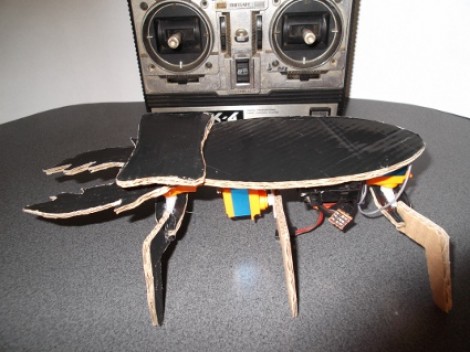
Here’s a lesson in doing a lot with very little. [Oldrobot] built this hexapod using cardboard for most of the pieces. He still had the box from his vacuum clear and it just happened to have a large black area the makes the top of the beetle look like it’s been painted.

The control board is from an old radio controlled airplane. Since RC airplanes used servos for flight control, it was a snap to hook up the three that make the bug go. One controls the set of middle legs which lift the body and change which of the propulsion legs are in contact with the ground. The other two servers move pairs of the front or back legs. It uses the same concept as this other RC controller hexapod, but much less time went into crafting the chassis and legs.

As you can see in the video after the break, the control scheme isn’t the most intuitive. But once you get a hang of which stick orientation affects each leg movement the bot ends up having fairly precise steering.

Continue reading “Cardboard Hexapod Gets Around With Three Motors”