Open Source Firmware For Hoverboards

2015 was two years ago, and to the surprise of many, we actually had hoverboards at the time. Of course, these weren’t Back to the Future-style hovering skateboards; they were crappy two-wheeled balancing scooters that suffered a few battery explosions and were eventually banned from domestic flights by some carriers. But oh boy, there were some funny Vines of these things.

While the rest of the world moved on from hoverboards, [Casainho] has been working on Open Sourcing the firmware for these interesting bits of electronics and motors. Now, his work is wrapping up and he has new firmware for electric unicycles and hoverboards.

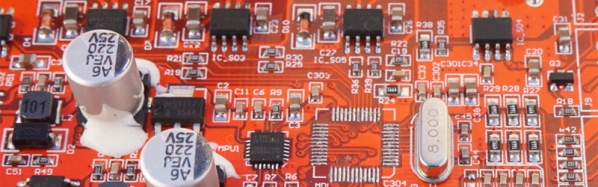
The popular and cheap electric unicycles and hoverboards that have been swimming across the Pacific from the great land of Ali Baba for the past five years are based around a single, cheap controller board. This controller board is built around the STM32F1038T6 microcontroller, and are able to control a pair of three-phase brushless motors. The teardown began on the electric unicycle forum and was completely documented in a GitHub repo.

The Open Source firmware is now mostly complete, although the necessary self-balancing function doesn’t work. We’re thinking that’s alright; with this new firmware, these electric unicycles have a crazy amount of torque and could be the basis for a few very cool builds. You can check out a video of this torque below.

If two wheels seems far too safe, exercise your inner daredevil with a 3D printed unicycle conversion for a hoverboard.
Continue reading “Open Source Firmware For Hoverboards”

Rusty ARM

You’ve probably heard that Rust is a systems programming language that has quite the following growing. It purports to be fast like C, but has features like guaranteed memory and thread safety, generics, and it prevents segmentation faults. Sounds like just the thing for an embedded system, right? [Jorge Aparicio] was frustrated because his CPU of choice, an STM32 ARM Cortex-M didn’t have native support for Rust.

Apparently, you can easily bind C functions into a Rust program but that wasn’t what he was after. So he set out to build pure Rust programs that could access the device’s hardware and he documented the effort.

Continue reading “Rusty ARM”

STM32 Analog Converter Phase Noise

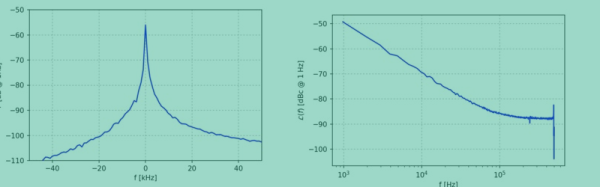
[Avian] has been using STM32 ARM processors to sample RF for a variety of applications. At first, he was receiving relatively wide TV signals. Recently, though, he’s started dealing with very narrow signals and he found that his samples had a lot of spread in the frequency domain that he didn’t expect.

What followed was some detective work that resulted in a determination that phase noise was the culprit. But why? [Avian] took some measurements and noticed that the phase noise almost exactly matched the phase noise specification for the STM32’s phase locked loop (PLL).

Unfortunately, there didn’t seem to be a good way to avoid using the PLL without major changes to the rest of the circuit. However, it was quite the learning experience and something to be aware of when counting on built-in converters for high-accuracy measurements.

One of the best things about this post is the references to more information. There’s a great explanation of phase noise, as well as a specific application note about clock jitter and analog converters.

We’ve talked about phase noise in direct digital synthesis a few times. But usually, it is pretty obvious like when you are asking a CPU to double as an RF transmitter. [Avian’s] post was a bit more of a detective story.

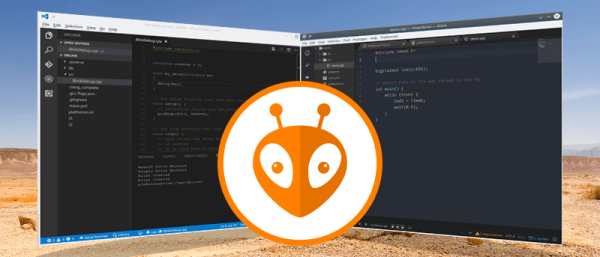
PlatformIO And Visual Studio Take Over The World

In a recent post, I talked about using the “Blue Pill” STM32 module with the Arduino IDE. I’m not a big fan of the Arduino IDE, but I will admit it is simple to use which makes it good for simple things.

I’m not a big fan of integrated development environments (IDE), in general. I’ve used plenty of them, especially when they are tightly tied to the tool I’m trying to use at the time. But when I’m not doing anything special, I tend to just write my code in emacs. Thinking about it, I suppose I really don’t mind an IDE if it has tools that actually help me. But if it is just a text editor and launches a few commands, I can do that from emacs or another editor of my choice. The chances that your favorite IDE is going to have as much editing capability and customization as emacs are close to zero. Even if you don’t like emacs, why learn another editor if there isn’t a clear benefit in doing so?

There are ways, of course, to use other tools with the Arduino and other frameworks and I decided to start looking at them. After all, how hard can it be to build Arduino code? If you want to jump straight to the punch line, you can check out the video, below.

Continue reading “PlatformIO And Visual Studio Take Over The World”

Hackaday.io User Reviews Six STM32 IDEs

One of the issues with getting started with any Arm-based project is picking a toolset. Some of us here just use the command line with our favorite editor, but we know that doesn’t suit many people–they want a modern IDE. But which one to choose? User [Wassim] faced this problem, evaluated six different options for STM32 and was kind enough to document his findings over on Hackaday.io.

Many of the tools are Windows-only and at least two of them are not totally free, but it is still a good list with some great observations. Of course, the choice of an IDE is a highly personal thing, but just having a good list is a great start.

Continue reading “Hackaday.io User Reviews Six STM32 IDEs”

Open Source Firmware For A Cheap Programmable Power Supply

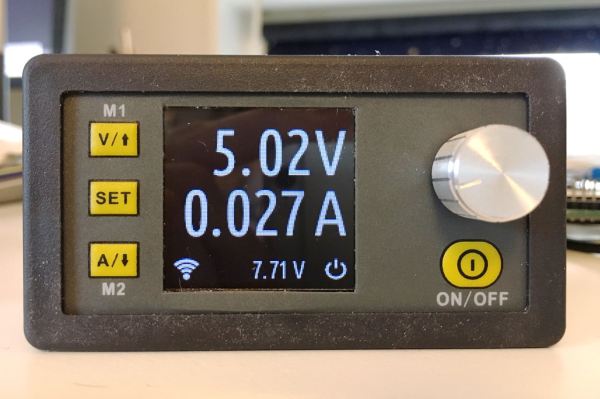
A few months ago, someone clued us in on a neat little programmable power supply from the usual Chinese retailers. The DPS5005 is a programmable power supply that takes power from a big AC to DC wall wart and turns it into a tiny bench-top power supply. You can pick one of these things up for about thirty bucks, so if you already have a sufficiently large AC to DC converter you can build a nice 250 Watt power supply on the cheap.

[Johan] picked up one of these tiny programmable power supplies. His overall impression was positive, but like so many cheap products on AliExpress, there wasn’t a whole lot of polish to the interface. Additionally, the DPS5005 lacked the ability to be controlled over a serial port or WiFi.

This programmable power supply is built around an STM32, with the programming pads exposed and labeled on the PCB. The changes [Johan] wanted to make were all in software, leading him to develop OpenDPS, a firmware replacement for the DPS5005. Continue reading “Open Source Firmware For A Cheap Programmable Power Supply”

STM32 And FPGAs In A Tiny Package

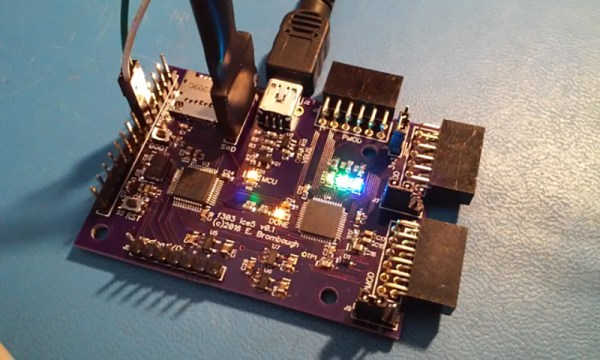
Slowly, very slowly, the time when we don’t subject embedded beginners to AVRs and PICs is coming. At a glacial pace, FPGA development platforms are becoming ever more capable and less expensive. [Eric Brombaugh] has been playing around with both ARMs and FPGAs for a while now and decided to combine these two loves into a single board that’s capable of a lot.

This board is fittingly called an STM32F303 + ice5 development board, and does exactly what it says on the tin. There’s an STM32F303 on board providing a 32-bit CPU running at 72 MHz, 48 kB of SRAM, a quarter meg of Flash, and enough peripherals to keep anyone happy. The FPGA side of this board is a Lattice iCE5 with about 3k Look Up Tables (LUTs), and one time programmable non-volatile config memory.

The connections between the ARM and FPGA include a dedicated SPI port, and enough GPIOs to implement full-duplex I2S and a USART. Like all good projects, [Eric] has shared all the files, schematics, and BOMs required to make this board your very own reality, and has provided a few links to the development toolchains. While the FPGA is from Lattice’s ice40 family, it’s not supported by the Open Source Project Icestorm toolchain. Still, it’s a very capable board for ARM and FPGA development.