Raspberry Pi Synth Gives A Softsynth Dedicated Hardware

For all the musicians out there, here’s a great use for your Raspberry Pi. All the features you would expect from a nice analog synth are implemented in a Raspberry Pi-based polysynth – dual oscillators, LFOs, and phasers – and it looks like there will be a few more features added before the Raspi synth is released.

Even though the ‘synthesis’ part of the Raspi synth already sounds wonderful, getting MIDI on the Rasberry Pi leaves much to be desired. The creator of the Raspi synth thought about using the GPIO pins as a MIDI interface, but because the GPIO pins cannot run natively at 31250 bps (the MIDI spec), the Raspberry Pi has to waste most of its CPU cycles just listening for MIDI traffic.

Right now the Raspberry Pi synth is controlled by a USB-connected MIDI interface, and as you can hear after the break, sounds wonderful. We can’t wait to hear what this synth will be able to do in a few months’ time.

Continue reading “Raspberry Pi Synth Gives A Softsynth Dedicated Hardware”

Turning An Old Keyboard Into A Work Of Art


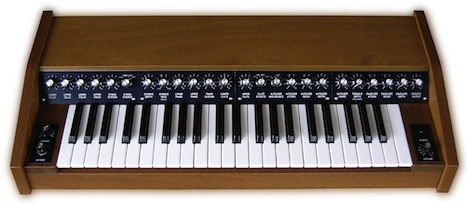
The 1970s were the glory days for analog synthesizers, and for [Stefan] listening to huge modular Moogs and ARPs resulted in a wondrous seething jealousy. In 2009, wanting to relive just a little bit of his childhood, [Stefan] picked up a PAiA Stringz’n’Things from eBay. It’s a great little keyboard, but [Stefan] his new purchase to look little classier than a tolex-covered flight case. After getting rid of the old tolex case, [Stefan] made a new enclosure and added some extra circuitry to expand the capabilities of this classic synth.

After replacing the electrolytic capacitors and fixing a voltage regulator issue, [Stefan] made a new enclosure for his keyboard out of beautifully lacquered mahogany. A new key bed stolen from an old Yamaha organ was brought in, and new control panels above the keys provide a more sensible organization than the keyboard’s previous incarnation.

The original Stringz’n’Things was laid out more like an organ than a synthesizer, a reflection of its polyphonic nature. This meant there wasn’t a very diverse tonal palette, but [Stefan] remedied that with a wave folder to generate extra harmonics, a tremolo, and an envelope generator to provide attack and decay for each note.

Now [Stefan] has a lovely polyphonic synth that has found its place on top of an old Hammond organ. As a bonus, the synth sounds really good. Not bad for an instrument generally regarded as being very limited.


Open Source Synth Sounds Awesome

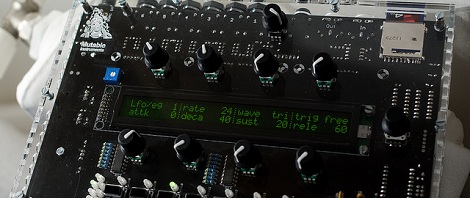
A little bird sent in a tip about a really cool MIDI synth. It’s called the Ambika, and it seems like just the thing to introduce a synth head to the world of soldering.

Compared to an entry-level synthesizer like the microKorg or its ilk, the Ambika is packed full of really cool features that just happen to sound awesome. In addition to the basic saw, square, and sine waves, there is also FM, and wavetable synthesis along with a noise generator, rudimentary voice synth, and a bitcrushed sawtooth wave voice. Really, the sound demos (available after the break) speak for themselves.

The hardware is based on the ATMega644p, a fairly high-powered 8-bit microprocessor notably used in the Sanguino. This synth supports up to 6 voices, each individual voice is contained on a separate circuit board attached to the motherboard.

Of course, the schematics/board files/firmware for the Ambika are freely available along with a pretty amazing set of technical notes. There’s no word on how much the Ambika will cost, but having it available as a kit should make it palatable if you don’t mind spending a Saturday holding an iron.

Tip ‘o the hat to an anon for sending this one in.

Continue reading “Open Source Synth Sounds Awesome”

Two Saxophone Synthesizer Builds For The Price Of One

[Bruce Land] has been sending in student projects from the electronic design course he taught at Cornell last semester. By a curious coincidence, two groups build saxophone synthesizers with the same key arrangement as a real sax.

First up is [Brian Wang]’s digital sax. There’s a small microphone in the mouthpiece and a series of buttons down the body of the sax telling the ATMega664 what note to play. The data for the saxophone synthesis was created by looking at a frequency plot of a sax, bassoon, harp, and pipe organ. [Brian] has the synthesis part down pat; there’s definitely a baritone sax in that little microcontroller.

Next up is [Suryansh] and [Chris]’s PVC pipe saxophone. It’s the same general principle as [Brian]’s project – the musician blows into the sax (we really like the kazoo mouthpiece) and a small mic picks up the sound of the wind. If the microphone output is above a certain threshold, the buttons are read and a note come out of the sax. We’re picking up a whiff of alto sax here; shame there wasn’t a duet with the two teams.

After the break you can see both saxophone projects in all their glory.

Continue reading “Two Saxophone Synthesizer Builds For The Price Of One”

Piano Box Is A Digital Synthesizer Made Of Paper

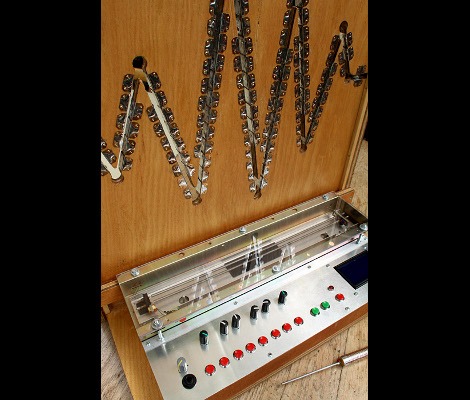
We love the look of this papercraft piano which [Catarina] built along with some friends at NYC Resistor, a hackerspace in the big apple. It starts off as a cubic black box with a white top. But just lift that top as [Catarina] does in the video after the break and three of the sides fall flat to reveal a pair of speakers and the single-octave keyboard.

The key’s don’t move when you press them. Instead, she decided to use the CapSense Arduino library to implement touch sensitive keys. Each key is made up of a plane of copper foil tape, with a strip of tape running back to the center of the box where it is interfaced with an Arduino Mega hidden there. The Tone library produces the waveforms which are played by the speakers, and a set of LEDs on the upright side of the box illuminate the keyboard diagram as you press each key. You can see that there are short white bars on that display which correspond to the black keys on the keyboard.

If you take a look at the code, you’ll see the libraries really make the code for the project simple.

Continue reading “Piano Box Is A Digital Synthesizer Made Of Paper”

Synthesize With A Hard Drive

If you’d like a pseudo-mechanical way of producing a droning synthesizer sound, [gijs] is your man. He made a small synthesizer out of nothing but an old hard drive and a few components.

Whenever a disk platter is spun manually, the spindle motor inside the drive produces a few out of phase sine waves on its connections. [gijs]’ synthesizer compares and amplifies these sine waves and sends them out to a speaker. The result is a strange droning chiptune-esque arpeggio.

The circuit for the build is soldered directly to the hard drive enclosure Manhattan style. Because the output of the spindle motor produces out of phase sine waves, [gijs] thought it would be a good idea if he could capitalize on some phase interference to alter the timbre of his synth. The entire build is mounted to a wall with hinges to one side so the speaker can be moved around. It isn’t much of a change, but we can here some wave forms cancelling each other out.

Check out the video of the build after the break. There’s also a few audio samples available on the project page.

Continue reading “Synthesize With A Hard Drive”

Digital Synth For The Non-chiptune Inclined

Chiptunes are great, and we can’t imagine a world without the Mega Man 2 soundtrack, but sometimes we all like a more 70’s style synth. This is where the Roninsynth steps in. It’s an Arduino shield that puts the basic components of a wall of synth into your pocket.

Unlike the analog oscillators of yore, the Roninsynth is based on a single dsPIC33F chip. It has all the waveforms we would expect from its big brother – sine, saw, triangle, square, and noise – and a couple modulation options.  What’s really interesting is the GUI the Roninsynth team put together. Instead of going with the knobs and buttons approach of the MIDIbox SID, the Roninsynth does everything with software. Think of it as a hardware-based softsynth.

Of course, there isn’t support for looping and phrases like what we saw yesterday, but there’s a ton of neat sounds that can be made and the capability for analog input. If you’ve ever wanted to sound like Radiohead, we can’t think of an easier way to build an Ondes Martenot.