Chumby Webserver Using Upgraded Internal Storage

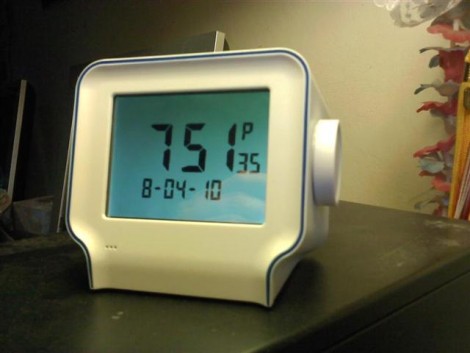
The Chumby One has an internal SD card offering a fair amount of storage. [Kenneth Finnegan’s] came with a 1 GB card that had about 500 MB left over which he filled with a collection of MP3s. But he wanted to do more and so installed a pre-compiled version of lighttpd to act as a web server. The problem is that this binary requires a thumb drive to be plugged in because it maps the storage directory to the mounted USB folder. He wasn’t happy with that so he upgraded the internal SD card and rolled his own webserver to run from the internal SD card.

The upgrade involved going from a 1 GB to an 8 GB microSD card. In order to run the webserver internally he needed to recompile lighttpd to use a different root directory. This meant setting up an ARM cross-compiler and eventually finding a new place for the start up script. The location change for the ‘lighty’ directory leaves us wondering if a symlink couldn’t have solve the problem without recompilation. But we don’t have the hardware on hand to try this out ourselves.

But if you want to give it a shot, check out [Bunnie’s] post about Chumby-based hardware. Looks like you can head out to the big-box store and have one in hand without shelling out too many clams.

Moving A Resistor For EvalBot Power When Programming

[Riley Porter] posted a picture of his EvalBot USB power hack. In the photo above we’ve put a box around D6 and D7. The development board ships with a 0 Ohm resistor in the D7 location, patching in power from the USB-B connector labeled USB DEVICE. He found that by moving that resistor to D6 he can power the board from the USB-B connector labeled ICDI.

That connector is the In-Circuit Debug Interface. TI sent us an EvalBot bundle so we pulled it out and tried it ourselves. If you plug in the ICDI it doesn’t power the board, and no USB devices register. Shorting the D6 pads changes this and the following USB device registers:

Bus 002 Device 062: ID 0403:bcd9 Future Technology Devices International, Ltd Stellaris Evaluation Board

So it looks like you need to have two USB connections or be using batteries in order to program the board via USB. The uC/OS-III hardcover book that ships with the EvalBot bundle includes board schematics. We took a look and were surprised to see that they show diodes installed on both pads. Rev A of the online schematics have been corrected, showing an omitted diode on D6 and the 0 Ohm resistor on D7. Images of both schematics are included after the break.

It would have been nice to see a selector switch installed here to give you a little more flexibility when prototyping.

Continue reading “Moving A Resistor For EvalBot Power When Programming”

Apple Studio Display Connector Ports

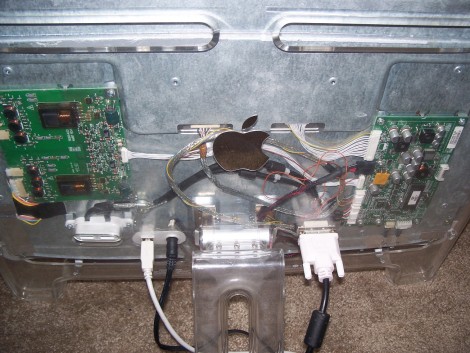
[Warrior_Rocker] pulled off his own Apple Studio Display hack by removing the cable and adding ports. As we saw in Wednesday’s post, these displays use a cable with a proprietary connector that combines DVI, USB and Power. Instead of altering the cable, [Warrior_Rocker] removed it completely. By wiring up a standard barrel jack for power, a USB type-B socket, and a DVI port, he can now use standard video, power, and USB cables to connect to the monitor.

This project was actually submitted to us on May 25th and we missed it. It’s sad that sometimes tips fall through the cracks, and we’re sorry that we missed this particularly well-executed hack. [Warrior_Rocker] wrote in asking why his project didn’t qualify after seeing the similar post on Wednesday. So please don’t take it personally if your project doesn’t get posted. If you think it fits right in here at Hackaday and haven’t heard anything after two weeks or so, consider sending to us again.

Mac SE Reborn As A Server And Mac Emulator

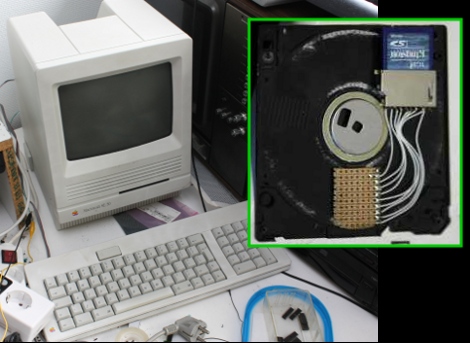
[Sprite_TM] cooked up an amazing hack by resurrecting a Mac SE using a Dockstar and ARM processor. The retro hardware had a bad mainboard thanks to the corrosive properties of a failed backup-battery. He had been wanting to do something with the Seagate Dockstar and decided it would find a nice home in the Mac. But what fun is a dead machine housing a headless server? To add to the fun he included an ARM processor running a Mac emulator, along with all the bits to make the screen, keyboard, and peripherals work. When the Mac is off the Dockstar still runs as a server.

But one of the best parts is the floppy drive. It still takes floppies, but there’s no magnetic media inside of them anymore. Instead, he’s added an SD card slot and some protoboard in the space for the read head. The drive itself has had the read head transplanted for some pogo pins (hey, we saw those earlier today). When you insert the floppy, the pogo-pins raise up and contact the protoboard, connecting the SD card to a Teensy microcontroller.

There’s so much going on with this project we just can’t cover it all here. Things like a chemical cleaning to return the original color of the classic case, and building a converter so that the peripherals are USB compatible are just some of the pleasures awaiting you in [Sprite_TM’s] post. He’s also filmed a demo video that we’ve embedded after the break.

Continue reading “Mac SE Reborn As A Server And Mac Emulator”

This Is A Peer-to-peer Filesharing Network

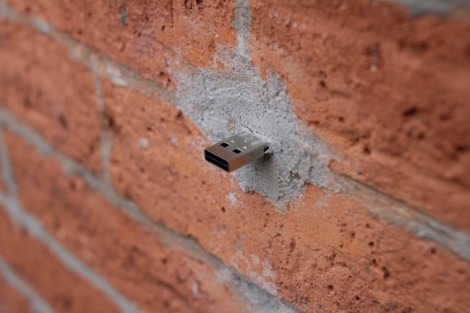
[Aram Bartholl] is building his own filesharing network that screws those fat cats who want to control your freedom. He’s added file cache devices throughout NYC (five so far but more to come) that are anonymous and free to use. Upload what you want, download what you want. They’re completely offline which means monitoring who’s doing what gets a lot harder and quite possibly requires a warrant from a Judge (we’re obviously not legal experts, your mileage may vary).

As for the slew of comments that are sure to point out the dangers of malicious USB device; We think everyone knows they’re taking on some risk when connecting to a USB plug protruding from a brick wall.

[Thanks Neckbeard]

IM-ME USB Dongle Hacking

This circuit board is from the USB dongle of a Girl Tech IM-ME. [Joby Taffey] took it apart and poked around to learn its secrets. These dongles come along with the pink pager that has become a popular low-cost hacking platform. But we haven’t seen much done with the dongle itself up until now.

[Joby] used the OpenBench Logic Sniffer to gain some insight on what’s going on here. The board has two chips on it, a Cypress CY7C63803 USB microcontroller which talks to the computer over USB and also communicates over SPI with a Chipcon CC1110 SoC radio. It looks like reprogramming the Cypress chip is a no-go, so he went to work on the CC1110. The inter-chip communications data that he acquired by sniffing the SPI lines gave him all he needed to reimplement the protocol using his own firmware. As a proof of concept he to reflashed the CC1110 and can now send and receive arbitrary commands from the dongle. There’s a tiny video after the break showing a script on the computer turning the dongle’s LED on and off.

Continue reading “IM-ME USB Dongle Hacking”

Using An Arduino Or Seeeduino For Its FTDI Chip

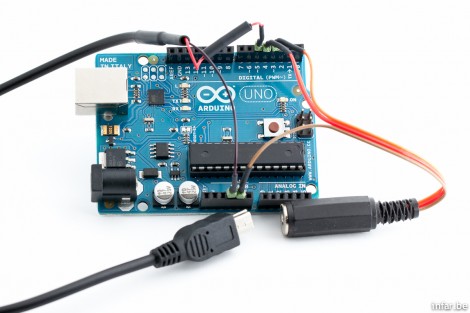
We think of the Arduino as a rapid prototyping tool but we never thought of it as an FTDI breakout board before. [Ihsan Kehribar] wrote a quick post to show how it’s done. You’ll find an FTDI chip on Arduino boards that have a USB connector. It’s used to handle the USB communications on one side, and TTL serial communications on the other. The serial pins from the chip are mapped to the UART on the AVR chip, and in turn they appear on the pin headers for easy connections. Just load up a really simple sketch(available from Ihsan’s post) to make sure the processor doesn’t get in the way and you’ve got yourself an FTDI breakout board. If you happen to have a Seeeduino there’s even more functionality as the board has a selector switch that allows you to choose between 5V and 3.3V levels.

This doesn’t hold true to the newest generation of Arduino, as those board have replaced the FTDI chip with an ATmega8U2. That’s basically and ATmega8 with native USB handling… fancy.

[Thanks Marcus]