Wireless Water Heater Monitor Uses Whatever Was Lying Around

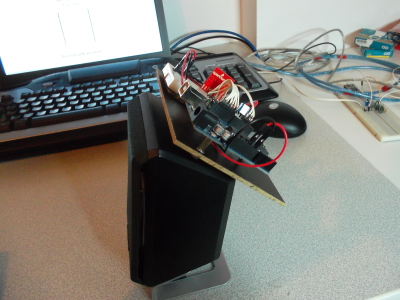
[Chris] set out to build a monitoring system for his water heater. It doesn’t Tweet or send SMS messages. It simply lights up an LED when the water heater is active. The one thing that complicates the setup is that he didn’t want to pull any wire from the garage into the house. What you see above is the wireless setup he used to accomplish this goal.

This is an electric water heater, so [Chris] patched into the 230V heating element feed. When the water heater is idle this connection is cut off. He used a transformer to step the voltage down to 17V and rectified it before feeding a 7805 power regulator. The rest of the transmitter circuit consists of a 555 timer driving the coil seen on the left. It is made out of telephone wire, with each of the four conductors inside connected together to multiply the number of windings. The box of breakfast sausages hosts the receiver coil. His hardware takes the induced current from that coil and amplifies it, feeding the signal to the base of a transistor responsible for switching the status LED. This works through the 6″ thick garage wall, although he did have to use a battery on the receiving end as his wall wart was injecting way too much noise into the system to work.

Making A Nostalgic Apple Mouse Wireless

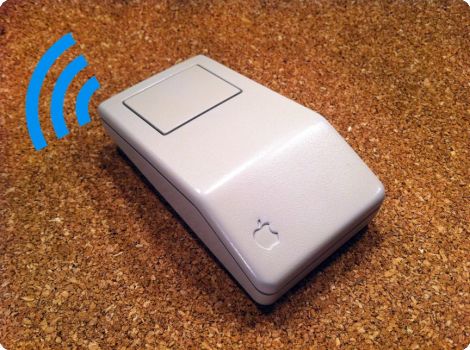
If you’ve got an old mouse sitting around that has that perfect retro look why not start using it again? We’d bet there’s just enough room in there to turn the input device wireless.

The hack does away with everything but the case. The guts from a brand new wireless laser mouse are used as replacements. For the most part this is a simple process of making room for the new board and laying it in place. It involves cutting off a few plastic case nubs, enlarging the hole on the bottom so that the laser has a clear line of sight to the desktop, and hot gluing the thing in place. The button cover had a bit of plastic glued in place so that it lines up correctly with the replacement mouse’s switch.

The only thing that didn’t work out well is the battery situation. The AA cell that the mouse needs was too big for the retrofit so it was swapped with an AAA. These have a lower capacity which means more frequent replacement.

[via Make]

Wireless Stereo Add-on Turns On Receiver And Pipes In Some Music

[PC486] wanted to add Bluetooth to a simple shelf stereo system. But if you’re going to go wireless, why not develop an all-in-one solution. His adapter turns on the stereo and feeds it audio all from a smart phone.

This is his roommate’s hardware so cracking it open and grabbing an iron wasn’t really an option. He needed a way to control the system without any permanent alterations. Since the unit has IR remote control capabilities that’s the most obvious way to go. But the original remote is long gone so he had to hit the Internet. Luckily the remote control codes are in the LIRC repository. He grabbed a small microcontroller, an ATtiny25, and wired up an IR led to send commands to the unit.

Next he examined the Bluetooth audio receiver board he planned to used in the project. It’s got an LED that lights up when connected to another Bluetooth device. The microcontroller knows when to turn the stereo on and when to shut it off again by monitoring that LED with a pin interrupt. Check out the final results in the clip after the break.

Continue reading “Wireless Stereo Add-on Turns On Receiver And Pipes In Some Music”

10bitworks Shows Us How To Light Up A Synchronized Swarm Of LED Jellyfish

10bitworks-led-tshirts

[Jeremy Zunker] from 10bitworks recently wrote in to share a cool build the group put together for the Luminaria 2012 festival which took place in March of this year. As you might have guessed, the fest is home to a wide array of light-themed projects, so the team at 10bitworks thought long and hard to come up with a design which would help them stand out from the other 79 featured artists.

At the core of their project is a t-shirt which features a deep-sea diver surrounded by swarm of jellyfish. Each of the jellyfish is backlit by an LED module, allowing the group to create intricate light patterns on the shirt.

10bitworks brought 8 shirts to the show, each fitted with a small control pack that contained a set of batteries and a Jeenode wireless board. A ninth Jeenode and a large antenna were used as the master control unit, sending signals to each of the t-shirts in order to synchronize the light display.

The final result turned out very nicely as you can see in the video below, where [Jeremy] walks through all of the project’s finer details.

Continue reading “10bitworks Shows Us How To Light Up A Synchronized Swarm Of LED Jellyfish”

More Small Radio Modules For Your Wireless Needs

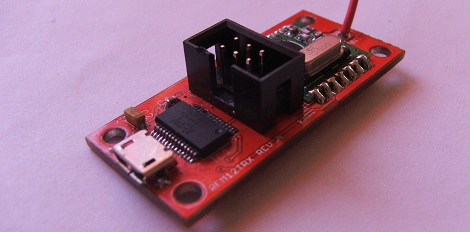
In the never-ending pursuit of cheap wireless communication for your microcontroller projects, [kiu] came up with a small board that allows for serial communication via a 433MHz radio link.

[kiu]’s transceiver uses an RFM12 wireless module available online for just a few dollars. Alongside this module is an ATMega8 and a USB to serial FTDI chip. When [kiu] plugs this board into his computer, he’s able to run a terminal, connect to this board, and receive and transmit hex values at 115,200 bps from another one of these boards.

According to [kiu]’s BOM, 10 boards only cost him 180 Euros, or about $225 USD. Considering off-the-shelf solutions such as an XBee could easily cost twice as much, we’re thinking [kiu] did a very nice job here.

[kiu] put all the board files, schematics, and code up on his GitHub, ready for your perusal. A very cool build, and very useful for a high altitude balloon, rocket, or wireless sensor build.

Very Inexpensive RF Module Tutorial

Let’s say you need a way to make a project wireless, but don’t have the scratch for a ZigBee or its ilk. You could use IR, but that has a limited range and can only work within a line of sight of the receiver. [Camilo] sent in a project (Spanish, translation) to connect two devices via a wireless serial connection. As a small bonus, his wireless setup is cheap enough to create a wireless network of dozens of sensors.

[Camilo] used the TLP434A transmitter/receiver combination to get his wireless project off the ground. These small devices only cost about $5, but being so inexpensive means the hardware designer needs to whip up their own communications protocol.

For a microcontroller, [Camilo] chose a Freescale MC9S08QC, a pleasant refrain from the AVR or PIC we normally see. After making a small board for his transmitter, [Camilo] had a very small remote control, able to send button presses or other data to a remote receiver.

After the break, you can see a short demo video [Camilo] posted of his wireless transmitter turning on an LED attached to his receiver. Unfortunately, this video was filmed with a potato, but all the schematics and code is on his web site for your perusal.

Continue reading “Very Inexpensive RF Module Tutorial”

A Perpetually Powered Wireless Outpost

For [Justin], the topic of remotely powering electronics in the field comes up often. So often in fact he decided to put up a tutorial for powering electronics from solar power and batteries, as well as sending and retrieving data with the help of a cellular connection.

The electronics [Justin] chose for his remote wireless project include an AT&T 3G connection to the Internet provided by a Beaglebone, BeagleTouch display, and BeagleJuice battery pack. Of course an Arduino had to make it into this project, so a few light sensors were wired into a few Arduino Unos and connected to the Beaglebone.

After finding a few deep cycle boat batteries, [Justin] wired up a pair of solar panels that put out about 200 mA in full sun. This equates to about 2700 mAh a day, about 300 mAh more than his Beaglebone/Arduino/3G connection/WiFi setup needs per day.

As for what [Justin] can do with his wireless outpost, it makes setting up remote sensors for agriculture a breeze, and could easily be used to automagically send pictures from a game camera straight to a web page. Pretty neat, and very useful if you need to wire up sensors in the field to the Internet.

Continue reading “A Perpetually Powered Wireless Outpost”