Solar power has been around for a long time now. Once upon a time, it was mostly the preserve of research projects and large-scale municipal installations. Eventually, as the technology grew ever cheaper, rooftop solar came along, and cashed-up homeowners rushed to throw panels on their homes to slash their power bills and even make money in some cases.
Those in apartments or rented accommodations had largely been left out of the solar revolution. That was, until the advent of balcony solar. Popular in Germany, but little known in the rest of the world, the concept has brought home power generation to a larger market than ever.
Way, way back in the days when men wore beards and wide-lapelled suits in exotic colors, only NASA had access to photovoltaics and ‘solar’ meant solar thermal. In those days of appropriate technology, it was thought that the ultimate in thermal mass was a phase-change material– a salt or wax that in melting and re-freezing could hold far more heat than plain rock or water, which were more often used. Well, now that it’s the 21st century, we’ve got something even better. As Ars Technica reports about a recent paper in Science Magazine, Molecular Solar Thermal (MOST) energy storage can blow that old stuff right out of the water.
Molecular energy storage? That’s where the sunburn comes in. A sunburn occurs because proteins in your skin are denatured– kinked, twisted, and knocked out of shape– by ultraviolet light. The researchers realized that those kinky proteins are pretty energetic: like a spring, they’re storing energy in their distorted structure. Even better, certain chemicals, like the pyrimidone in the study, don’t ‘relax’ the way a phase change material does. It’s not a matter of warming up and giving up the energy stored in the molecular structure when cooling down– the energy needs coaxed out, in this case by an acidic solution.
That poses problems for a closed-loop system, since you’d be continuously diluting the pyrimidone with heat-releasing acid and neutralizing base. On the other hand, 1.65 MJ/kg of energy storage is nothing to sneeze at, especially when you’re collecting it with nothing more technically advanced than a fluid running through clear tubing. Conveniently enough, researchers found a way to make this stuff liquid at room temperature.
Comparing the heat in this MOST storage material to electrical potential in a battery is a case of apples and oranges, but in terms of pure energy density the pyrimidone cooked up for the paper is in the same range as Li-Ion batteries. There is some self-discharge, in that the altered “dewar” state of the pyrimidone decays naturally, but with a half-life of upto 481 days, you could imagine storing up a tankful UV-altered pyrimidone all year round to provide your winter’s heat.
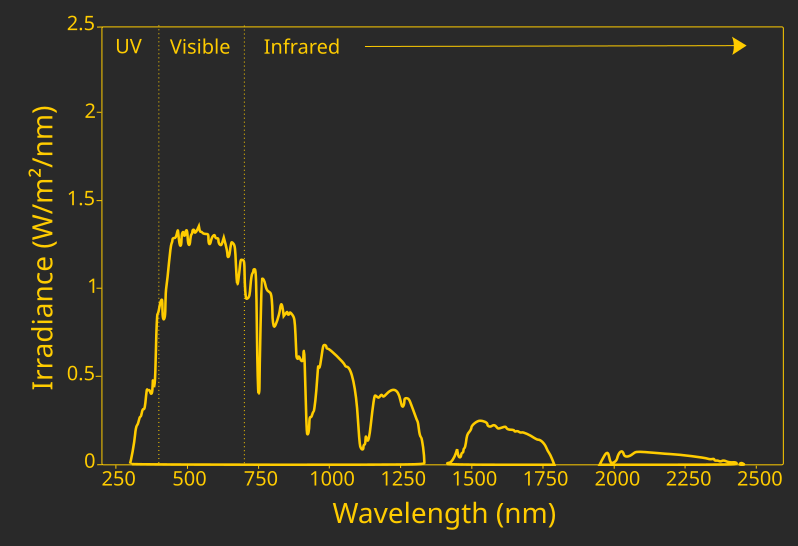
There’s not much power making it to surface in the UV, but lower energy photons cannot effect the transition.
It’s not perfect. Right now you get about 20 “charge cycles” before the molecules break down, but then, if you’re using this for seasonal load-spreading, a two-decade service life is nothing to shake a stick at. It’s only collecting energy from the UV range of the spectrum, which is a tiny fraction of the energy from our sun. The quantum efficiency of the molecule is rather poor as well– it takes a lot of photons to get a dewar transition.
With solar photovaltaics being as cheap as they are, thermal builds are few and far between– even solar water heaters are powered by PV these days. Of course if you’re somewhere that doesn’t get much sun, you could always go for wind power instead.
Thanks to [zit] for the tip! If you’ve seen a bright idea in the wild, or have one yourself, our tips line is open rain or shine.
Every Boy Scout or Girl Guide probably had the experience of building a simple solar oven: an insulated box, some aluminum foil, and plastic wrap, and voila! On warm, sunny, summer days, you can bake. On cloudy days, well, you need another plan. The redoubtable [Kris De Decker] and [Marie Verdeil] provide one, with this solar-electric oven over on LowTechMagazine.
Now, you might be wondering: what’s special here? Can’t I just plug a full electric range-oven into the inverter hooked to my Powerwall? Well, yes, Moneybags, you could — if you had a large enough solar setup to offset the storage and inverter losses, that is. But if you only have a few panels, you need to make every watt count. Indeed, this build was inspired by [Kris]’ earlier attempt to power his apartment with solar panels on his balcony. His electric oven is one of the things that stymied him at that time. (Not because cooking took too much energy, but because it took too much power for his tiny battery to supply at once.)
The fact that there exist in our world flat rocks that make lightning when you point them at the sun is one of the most unappreciated bits of wizardry in this modern age. As hackers, we love all this of techno-wizardry–but some of us abhor paying full price for it. Like cars, one way to get a great discount is to buy used. [Backyard Solar Project] helped a friend analyze some 14-year-old panels to see just how they’d held up over the years, and it was actually better than we might have expected.
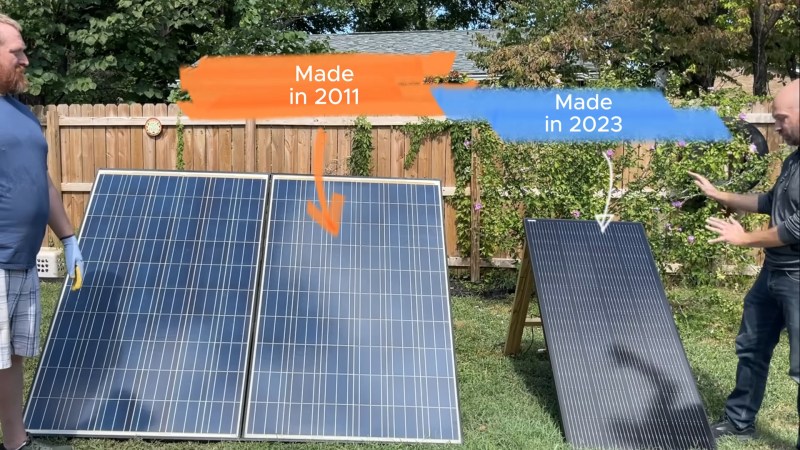
The big polycrystalline panels were rated at 235 W when new, and they got 6 of them for the low, low price of “get this junk off my property”. Big panels are a bit of a pain to move, but that’s still a great deal. Especially considering that after cleaning they averaged 180 W, a capacity factor of 77%. Before cleaning 14 years worth of accumulated grime cost about eight watts, on average, an argument for cleaning your panels. Under the same lighting conditions, the modern panel (rated to 200 W) was giving 82% of rated output.
That implies that after 14 years, the panels are still at about 94% of their original factory output, assuming the factory wasn’t being overoptimistic about the numbers to begin with. Still, assuming you can trust the marketing, a half a percent power drop per year isn’t too bad. It’s also believable, since the US National Renewably Energy Laboratory (yes, they have one) has done tests that put that better than the average of 0.75 %/yr. Of course the average American solar panel lives in a hotter climate than [Backyard Solar Project], which helps explain the slower degradation.
Now, we’re not your Dad or your accountant, so we’re not going to tell you if used solar panels are worth the effort. On the one hand, they still work, but on the other hand, the density is quite a bit lower. Just look at that sleek, modern 200 W panel next to the old 235 W unit. If you’re area-limited, you might want to spring for new, or at least the more energy-dense monocrystalline panels that have become standard the last 5 years or so, which aren’t likely to be given away just yet. On the gripping hand, free is free, and most of us are much more constrained by budget than by area. If nothing else, you might have a fence to stick old panels against; the vertical orientation is surprisingly effective at higher latitudes.
If you’re mounting solar panels, everybody knows the drill, right? Point them south, angled according to latitude. It’s easy. In a video which demonstrates that [Everyday Dave] is truly out standing in his field, we hear a different story. [Dave] has a year’s worth of data in his Solar Panel Showdown that suggests there are good reasons to mount your panels vertically.
Specifically, [Dave] is using bifacial solar panels– panels that have cells on both sides. In his preferred orientation, one side faces South, while the other faces North. [Dave] is in the Northern Hemisphere, so those of you Down Under would have to do the opposite, pointing one face North and the other South.
Since [Dave] is far from the equator, the N/S vertical orientation beats the pants off of East-West facing panels, especially in winter. What’s interesting is how much better the bifacial panels do compared to the “standard” tilted orientation. While peak power in the summer is much better with the tilted bifacial panels (indeed, even the tilted single-sided panels), in winter the vertical N/S panels blow them out of the water. (Especially when snow gets involved. Vertical panels don’t need sweeping!)
A new kind of ‘camera’ is poking at the invisible world of the human body – and it’s made from the same weird crystals that once shook up solar energy. Researchers at Northwestern University and Soochow University have built the first perovskite-based gamma-ray detector that actually works for nuclear medicine imaging, like SPECT scans. This hack is unusual because it takes a once-experimental lab material and shows it can replace multimillion-dollar detectors in real-world hospitals.
Current medical scanners rely on CZT or NaI detectors. CZT is pricey and cracks like ice on a frozen lake. NaI is cheaper, but fuzzy – like photographing a cat through steamed-up glass. Perovskites, however, are easier to grow, cheaper to process, and now proven to detect single photons with record-breaking precision. The team pixelated their crystal like a smartphone camera sensor and pulled crisp 3D images out of faint radiation traces. The payoff: sharper scans, lower radiation doses, and tech that could spread beyond rich clinics.
Perovskite was once typecast as a ‘solar cell wonder,’ but now it’s mutating into a disruptive medical eye. A hack in the truest sense: re-purposing physics for life-saving clarity.
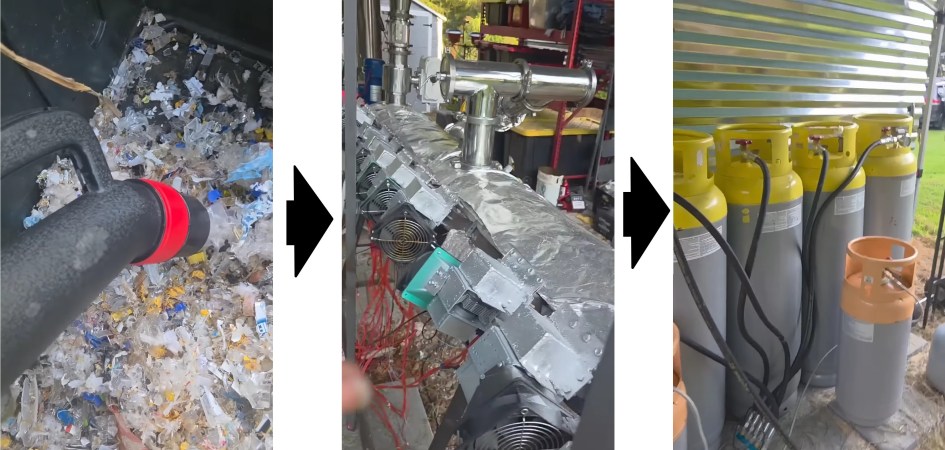
[naturejab] shows off his solar powered pyrolysis machine which can convert scrap plastic into fuel. According to the video, this is the world’s most complex hand-made pyrolysis reactor ever made. We will give him some wiggle room there around “complex” and “hand-made”, because whatever else you have to say about it this machine is incredibly cool!
As you may know pyrolysis is a process wherein heat is applied to organic material in an inert environment (such as a vacuum) which causes the separation of its covalent bonds thereby causing it to decompose. In this case we decompose scrap plastic into what it was made from: natural gas and petroleum.
His facility is one hundred percent solar powered. The battery is a 100 kWh Komodo commercial power tank. He has in the order of twenty solar power panels laying in the grass behind the facility giving him eight or nine kilowatts. The first step in using the machine, after turning it on, is to load scrap plastic into it; this is done by means of a vacuum pump attached to a large flexible tube. The plastic gets pumped through the top chamber into the bottom chamber, which contains blades that help move the plastic through it. The two chambers are isolated by a valve — operating it allows either chamber to be pumped down to vacuum independently.
Once the plastic is in the main vacuum chamber, the eight active magnetrons — the same type of device you’d find in your typical microwave oven — begin to break down the plastic. As there’s no air in the vacuum chamber, the plastic won’t catch fire when it gets hot. Instead it melts, returning to petroleum and natural gas vapor which it was made from. Eventually the resultant vapor flows through a dephlegmator cooling into crude oil and natural gas which are stored separately for later use and further processing.