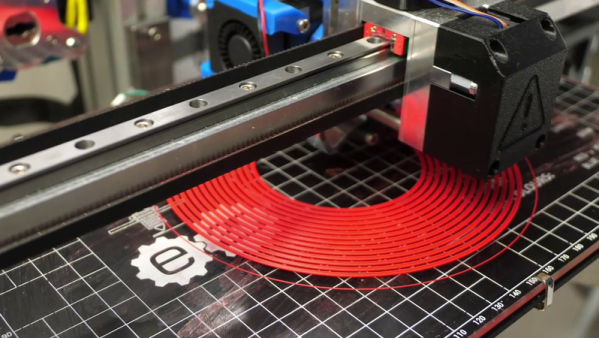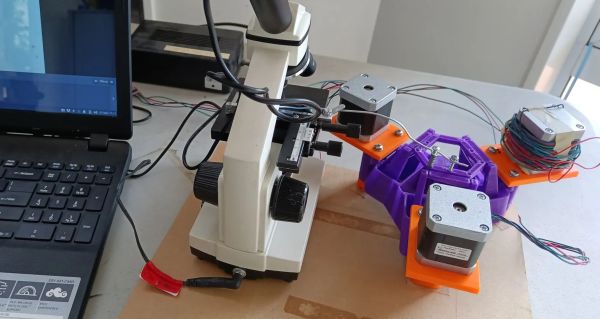
Optical encoders are nothing new; they can be found in everything from mice to printers. They’re great for allowing DC motors to know their exact position and even current direction. If this is sounding like old hat, it’s because we’ve shown you rotational versions before.
[Chris] uses the same concept, but produced a linear optical encoder instead of rotational. His setup is much like whats used in non stepper-motor CNC and RepRap mills, allowing ordinary DC motors to know their position within a plane. It’s a quick tutorial, but we liked the detail and it reminded us we need to finish that DC motor based mill thats still a pile of parts in the closet. Check out a video of [Chris'] in action after the break. Read the rest of this entry »
We aren’t exactly sure how or even why you would need to RepRap in space, but we guess their team needed something to do while designing and printing their next version. They figure that if they can print completely upside down in -1G and then upside up in 1G, that 0G hopefully wont be a problem; hopefully being the keyword.
Even if it isn’t true space printing, the concept opens several new doors. Instead of having risky rocket or shuttle launches when the secondary air oscillator on the IIS is struck by an asteroid, print a new one. Or perhaps, the ocean floor research facilities’ external hull is punctured by an asteroid, print a new one. Or the HaD office chair breaks because [Mike] was hit by an asteroid, print a new one.
[Chris] liked Cartesian RepRap idea so much that he decided to design his master’s diploma project around it. Though it uses most of the same parts as the RepRap (even the PCBs), [Chris] has adapted it so it does milling rather than 3D printing. Most of the parts (such as the stepper motors) were harvested from old inkjet printers and typewriters. The thee-axis CNC machine can already etch and carve styrofoam at an impressively high resolution. To deal with all of the debris that comes with milling, a vacuum attachment (shown attached) was created. [Chris] is considering adapting it so it can work with wood and aluminum as well. Best of all, it uses standard G-code files, just like the RepRap. A publication by [Chris] on the project is also available through his website. No plans to release a kit have been announced yet, but we’ll wait and see. If any commenter knows of an open source CNC milling machine available as a kit, feel free to post a link to it below.
Generation 2.0 of RepRap, the self replicating 3d printer, is approaching realization. Code named “Mendel”, the new design will be wedge shaped rather than a box which offers a few benefits. The overall design is smaller than the original RepRap but the printable area is larger. This means more functionality with less building material. With each new generation of this project the assembly gets easier and total parts price drops making the RepRap available to a much wider audience.
The RepRap project has been working on bringing 3D printing to the masses by creating a extrusion printer that can also make the majority of its own parts. For the most part, these print ABS or HDPE plastics which are strong and recyclable. In order to create these replicating printers, similar machines called RepStraps are built out of either laser-cut parts or machined elements. They are functionally equivalent to RepRap printers, but are not made of printed parts. [nophead] documented his RepStrap, HydraRaptor, that is based off a milling machine. He had already printed a set of RepRap parts, and he documented printing a second set. The machine worked for about 100 hours over the course of 2 weeks, printing about 1.5 kg of parts. He made a few adjustments, such as replacing ABS bearings with HDPE to reduce friction. The parts are for Factor e Farm so they can get started with 3D printing.
Is this the beginning of a new trend? We’ve seen case modding in computers for a while now, but are we going to start seeing extreme case modding for our CNC machines? This is Kali. Kali eats plastic and pukes parts. Nice.
Purple Crayon is a new entry into the home fabricating arena. Shown above, with it’s makers [Konrad] and [Aaron], it’s set to compete with RepRap and Cupcake. It looks to be bigger than Cupcake, but smaller than the reprap. There aren’t many details available on their site, but we’re sure there will be soon. They do state that it should retail for less than $1,000.
[Rhys Jones] has been working with the RepRap team to develop a way to print circuit boards. The machine first prints the plastic substrate with channels for the metal to be deposited into. They adapted their pinch wheel feeder to work with solid core solder (flux creates a mess). The extruded solder’s specific heat isn’t hot enough to melt the plastic. They made a video (embedded below) of their test piece: an optical endstop. The team has also been experimenting with decoupling the feed mechanism from the extruder.
RepRap has released a new driver board for their stepper motors. They’ve honed the design to be easier to assemble and cheaper. We’re sure all of that is wonderful, but what really got our attention was the video. In the video, which you can see after the break, they run a test file through it to make it “sing” happy birthday. Is this something that everybody does and we’re just now catching on? Why all the musical stepper motors today?
The CupCake CNC Kit is the flagship product of MakerBot industries, a joint venture between [Bre Pettis] and [Zach Hoeken]. At $750, it comes with all the motors, belts, body pieces, bearings, belts, and other pieces to assemble it. You could be printing your own 3d objects in a matter of hours with this. 3D printers with only slightly larger capacities can run thousands of dollars. The only advantage to some of the commercial products might be resolution. They don’t give much as far as technical data as the unit isn’t available yet. They should start Shipping before April 15th, so they can’t be far off. This could possibly be a competitor for the RepRap. Since RepRap doesn’t offer a complete kit, we’ll have to speculate. We’ve seen estimates from $500 to $1000 to build one.