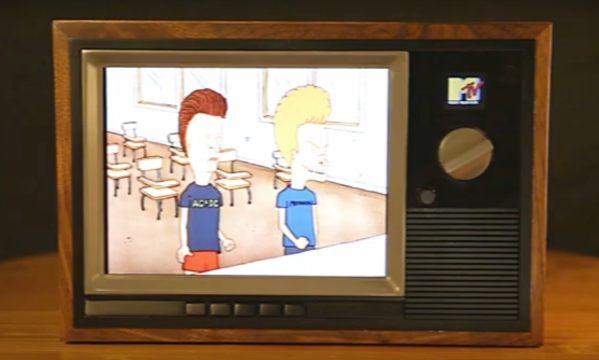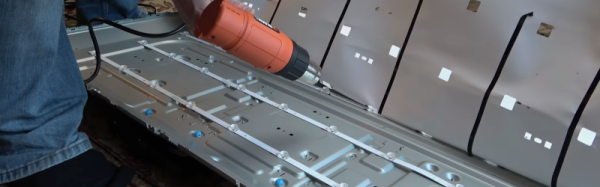
After letting it sit around for about 3 years, [Blake] decided it was time to fix his broken 15″ television. A little trouble shooting showed the problem was with the inverter. The backlight would come on for a few seconds, off for a few seconds, then repeat. By freeing the Magnavox 15MF400T from its metal case he got it working again, but couldn’t find the source of the short. His solution: build a new case out of non-conductive material. Voilà! We have the 15″ LEGO monitor.
We’re not sure why [Roteno] prefers to have his TV and cable boxes not face him when he’s sitting on the couch, but to each their own. You may already see many problems with this setup: discoloration from LCD viewing angle, difficulty playing Wii, oh and most importantly – not being able to change the channel with his IR remote. [Roteno] was lucky enough, however, to have an IR remote input on the back of his cable box. All it took was a 3.5mm jack and a spare IR receiver and he was back in business. Sure it’s not as technical as some of our cable or IR hacks and we would like to see someone try this who doesn’t have as easily accessible IR input on the back of their cable box. But either way, here’s one more step to never having to leave that couch.
[Erdem] is leading up the efforts to reverse engineer Samsung TV firmware with a project called SamyGo. Official Samsung firmware uses the Linux kernel, making it a familiar system to work with for many developers. So far they’ve implemented NFS and SAMBA for sharing files over the network, improved playback from USB devices, and unlocked the ability to use non-Samsung WiFi dongles.
In order to make changes to the system, you need to enable a telnet connection on the device. The SamyGo team accomplished this by changing an official version of the firmware in a hex editor to start the telnet daemon at boot time. This altered firmware is then flashed using Samsung’s built in upgrade system. Once telnet is enabled, non-official firmware can be manually flashed.
We’d love to see this project expand to other TV Brands in the future. In fact, we were looking for something like this back in June when we realized that our Sony Bravia runs a Linux kernel and can be updated via USB drive. Be careful if you want to try this out. We can only imagine the fallout after telling your significant other that you bricked a high-priced LCD.
The folks over at Hulu Labs have been busy it seems, as they have just released a version of their desktop client for Linux. Windows and OSX versions of the desktop client have been out for some time now, but Linux has been left in the dark. Functionality wise, it operates and plays videos identically to its counterparts. The Linux version can also be controlled via an IR remote. We certainly are excited to add this to our entertainment systems. The release is a bit of a surprise, but a welcome change to the usual treatment of Linux, and it’s nice to see the mainstream start to recognize it. Plus, this is just more ammunition for getting rid of those monthly cable/satellite subscriptions.
TV-B-Gone: antisocial nuisance or harmless prank? Whatever your feelings, there’s no denying this device has become a staple of the DIY hacking crowd, as evidenced by the countless derivativessincehatched. This latest mutation crushes them all.
[manekinen] from the Polish electronics blog Elektroda (“Electrode”) wasn’t satisfied with high-power TV-B-Gone designs using multiple 5mm infrared LEDs, so he created his own using a single one-Watt monster. The device is concealed in an ordinary flashlight casing, making it somewhat inconspicuous. A custom PCB containing an ultra-minimalist version of the TV-B-Gone circuitry sits just behind the reflector. The choice of reflectors determined maximum distance vs. coverage…they opted for distance. Specific figures aren’t given, but we estimate this thing could shut off televisions on Mars.
The original article (Polish or Google-ized English) includes construction photos and an archive (.rar) of project files including Eagle schematics and C source code.
Would it be totally irresponsible to mention there’s now a 3-Watt version of this LED? We’re just sayin’.
Reader [GRitchie] wrote in with an interesting find in his new TV set: with just some minor soldering it was possible to tap into an unencrypted hi-def video stream.
HDCP (High-bandwidth Digital Content Protection), used by Blu-Ray players and cable or satellite receivers, normally ensures a DRM-protected link between the device and a compatible display. Any properly-licensed device that forwards HDCP content (such as an HDMI switch box) is expected to provide encrypted output; those that don’t may get blacklisted by the system and become expensive paperweights. It’s something of an annoyance for users who feel this oversteps fair use applications such as time-shifting.
[GRitchie] found that his new TV with “InstaPort” Fast HDMI Switching didn’t perform this re-encryption step between the set’s internal switcher and the next stage in decoding. Soldering just eight wires directly from the switching chip’s output to an HDMI cable provided an unencrypted output that could then be received by a PC for later replay.
What’s not clear at this point is whether the capability is peculiar to just this one make and model, or applies to anything with the new Fast HDMI Switching. If the latter, it will be interesting to see how this plays out…nearly all of the major HDTV manufacturers are evaluating InstaPort for new sets, which would make any attempt at HDCP blacklisting awkward, to say the least.
With the transition to digital TV, the FCC has abandoned the old analog format. Luckily, you can take advantage of this and set up your own analog TV station. The FCC has a tool on their site to see what channels are open in your area to broadcast in. To broadcast, you need a TV transmitter, but cheap short-range models can be found on eBay or made at home [pdf]. Once you have a transmitter, you can pump in a video source, either your own content or videos from youtube. One group, OMGimontv is showcasing popular youtube clips on channel 14 in New York. On their site, users can vote for what clips they want to see. Although this isn’t as simple as making a radio station, it still has a lot of potential.
The Music visualizer is actually a second build based on an earlier design[Thanks Roger]. The build was influenced by Zyra’s How to make an oscilloscope out of a television. The hack is quite simple, patch the output of an amplifier into the vertical deflection coils of the CRT. This is a good use for that old TV you may have laying around but don’t want to recycle it just yet. While on the subject we had covered the Mac SE/30 audio visualizer in 2006. For those looking for something a little more hard core, here is a bit about Homemade cathode ray tubes.
The TV-B-Gone has proven to be a dangerous and versatile gadget. At Interactive Matter, they created an even smaller version with more sneaking potential. Called the µTVBG, it packs an entire TV-B-Gone in a 1.4 x 2.5 cm footprint and even has room for a programming header. He found some high-powered surface-mount IR LEDs that would match the original TV-B-Gone’s power. To drive the board, they used a CR1220 button battery on the bottom of the board. The whole thing is smaller than your thumb and should be easier to hide next time you wreak havoc.
[Jeri] put together an absolutely massive Etch A Sketch for The FatMan and Circuit Girl show. She had removed the DLP chip from an HD rear projection TV and decided to repurpose the 52inch screen. The movement mechanism uses pulleys from screen doors with nylon lines. The two sets of lines are fed in a criss cross pattern so that the parallel lines move in the same direction. The lines move tent poles in the x and y which controls the movements of the golf tee stylus. It’s driven by two high torque motors from $9 Harbor Freight 18V drills. They tried several different powders, but ended up using aluminum powder from an original Etch A Sketch because it sticks to everything. It will eventually be hooked up for IRC bot control once they get a large enough h-bridge.