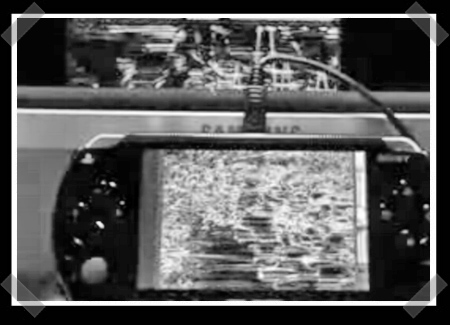
Use A PSP As An Extended Display

Follow along with this project and you could use your PSP as a display for your computer. The software, available for download on the site, gives you a 960×544 display. The data is compressed, sent to the PSP, then decompressed for display. Though that sounds clunky, the video after the break shows it working pretty smoothly with some Winamp visualization. Only 32 bit Windows XP or older is supported currently.

Continue reading “Use A PSP As An Extended Display”

Parts: MicroSD Memory Card Holders

SD cards add cheap persistent memory to your project, but the holder takes a lot of board space. A smaller option is the microSD flash format. MicroSD cards are compatible with regular SD cards, and most come with a free adapter. We looked at four holders for our mini web server. Which should you choose? Read about our experience below. Continue reading “Parts: MicroSD Memory Card Holders”

“Killer Zombie Drone” Is Awesome And Recycled

Usually, when someone mentions military drones, we think of something much smaller and less intimidating than this monster. This is an Airforce Phantom II, retrofitted to be a computer controlled killing machine. Able to carry 18,000 pounds of stuff that goes boom, a single computer can control up to 6 of these in formation.

Sounds scary doesn’t it?  Actually, though these are capable of being offensive, they are mainly used for target practice. These are decommissioned units that have been fixed up and modified to be radio controlled.

[via BotJunkie]

AVR ATtiny25 USB Hit Counter

[Bob] has a USB page hit counter that uses an ATtiny25 to run a MAX7219 which drives eight 7-segment displays. It is easy to implement USB on an AVR using just firmware, eliminating the need for any USB to RS232 conversion. The host software is written in Delphi and sits in the Windows tray. The code examples seem simple enough to expand upon into your own display programs.

Sanguino ATmega644P Board

The RepRap project, which is a printer that can make components using rapid prototyping technology, and it is designed so that it can eventually self replicate. Has released a new breakout board for the Sanguino that provides access to all the pins as screw terminals. The Sanguino is an Arduino compatible board based on the ATmega644P chip. You can populate the full board with all the components and have a fully functional single board. You could populate only the screw terminals and plug your Sanguino, and use it as a breakout board as well. The board design is released on Google Code.

ArduPilot Pro Autonomous Drone

We wrote about [Chris Anderson] before when he released the Arduino based autopilot. He has since crashed his first Predator UAV, due to an underpowered motor and poor control of the v-tail only steering. He has since released a pro version of the autopilot controller, and is modifying this UAV Predator drone kit to work with it. One ATMega168 processor handles flying and the other handles GPS navigation, but because they work together, it results in a fully autonomous drone. He also has a BlimpDuino version we have covered before.

Blinkenlights’ Stereoscope Goes Live In Toronto

We’re happy to present this guest post from History Hacker’s [Bre Pettis]. Today [Bre] catches up with the Blinkenlights team, who turn entire buildings into displays. Their current project is Stereoscope which goes live in Toronto, Canada today.

Earlier this week, I posted about the beginnings of the blinkenlights project. It started in 2001 in Berlin, but now Seven years later, in May 2008, blinkenlights is back. The City of Toronto asked the blinkenlights team if they would be interested in joining another Nuit Blanche (as they did in Paris in 2002). Short on time and with a lot of ambition, they decided to redesign and push the envelope on the project to make it wireless for The Toronto City Hall since there would be 960 windows split up in two towers. In the above photo, you can see Stereoscope in all its glory. Continue reading “Blinkenlights’ Stereoscope Goes Live In Toronto”