How To Crack A Master Lock

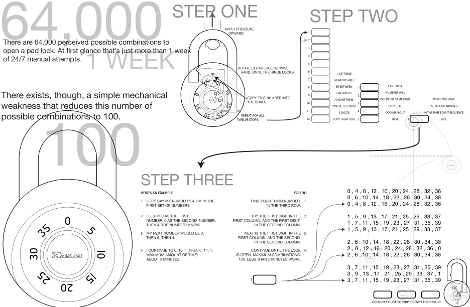
Long, long ago we covered a method to crack a Master lock in about 30 minutes or less. Here’s a revival of the same method but now the instructions to retrieve the combination are in info-graphic format created by [Mark Edward Campos].

If you didn’t get to try this the first time around, here’s how it works: A combination of a physical vulnerability, math, and brute force is used. First, the final number of the code can be obtained by pulling up on the latch while the dial is rotated. Because of the way the lock is built the correct number can be extrapolated using this trick. Secondly, a table of all possible first and second number combinations has been calculated for you.  Third, it’s your job to brute force the correct table of possibilities which includes only about one hundred combinations.

We’re not really into felony theft and hopefully you’re not either. But, we have a nasty habit of needing to use a combination lock that’s been in a drawer for a few years and having no idea of what the correct code might be.

Update: We’ve had a lot of comments about shimming as a better method. For your enjoyment we’ve embedded a video after the break that details how to shim a Master lock using a beer can. Just remember: friends don’t let friends drink and shim.

Continue reading “How To Crack A Master Lock”

There I Fixed It: A Blog About Hacking, Poorly.

austinb-ipodmuffler

Thereifixedit.com is a site filled with dubious innovations. Some of them are cool, some of them are clever, and most of them are terrifying. Anyone who has ever stood in front of a broken household appliance with a roll of duct tape, one screw driver with a bit chipped off the flat part, and determination will laugh themselves silly browsing through this site. Maybe some of the ghetto hacks we covered before should be in this list.

[Thanks for the link Dad]

Doom On A Picture Key Chain

[vimeo http://vimeo.com/6878807%5D

Alright, so Doom isn’t actually running on the key chain itself, but rather a BifferBoard: a small 150MHz x86 containing ethernet, serial, and even USB with only one watt of power consumption! The project is to show how easy it is to program the BifferBoard and getting it talking to other hackable items – such as the picture key chain for a display. Doom does appear a bit slow, but [Biff] figures its do to how haphazardly it grabs keyboard input over SSH.

Thermoelectric Solar Power

Thermo_Electric_Solar_Power

[Colin] has put together an instructable for a solar power generator that uses the thermoelectric effect instead of the photovoltaic (PV) effect. We have seen Peltier devices used in cooling cans, solder paste, backs, and hacked hard drives. This is the first hack we have seen where a Peltier device is used to generate electricity from heat, essentially running the device backwards. The thermoelectric effect is the same principle that is used to generate electricity in radioisotope thermoelectric generators used in deep space probes such as Cassini. What applications can you come up with to use the thermoelectric effect as a power source?

Vocoding With A Piano

This really cool project allows a grand piano to “speak”.  We don’t know any details about its construction but we had to share. The keys are being hit by solenoids in a manner to replicate human speech.  Click through to the video, it’s worth it. You may have to allow the popup to see the video, and it is in german, but the piano is clearly speaking english. We want one to keep around the office. It could read our emails to us.

(Edit from 2015: The link went bad, but it can be found elsewhere on YouTube.)

[via matrixsynth]

Pocket Multimeter Review

three_pocket_multimeters

Reader [Mikey Sklar] told us about a review he wrote covering 3 different models of pocket multimeters. We’re sure that you’ve had the same experiences we have being the go-to-guy or got-to-gal  for all things electrical. For our sort, having a multimeter on hand at all times has become an expectation.

[Mikey] looks at a model from ebay, Harbor Freight, and Radio Shack. Not surprisingly, the ebay offering doesn’t rate too well but does get the job done. We were surprised to read that he picked up the Cen-Tech model for about $10 at Harbor Freight. Although it may no longer be sold there (we haven’t checked) [Mikey] seems pretty happy with it so we’ll be on the lookout during our next tool-buying trip. We’re unfamiliar with the tiny Radio Shack 22-820 but we’ve always been happy with our larger 22-811. The 22-820 allows the probes to be folded up inside of the case cover for a truly pocketable package.

You can never have too many meters at your disposal and we’ll have to keep this article in mind the next time we’re shopping for another. Never used a multimeter before? Take a look at the tutorial [Mikey] linked to over at ladyada.

Jump Start Your Car With Sega Parts

sega_jump_start

[Jenn’s] family is a single-car household. Because of this, it’s a little more difficult to get a jump start when the headlights run down the battery. Not wanting to ask the neighbors for help, her husband [Richard] decided to come up with his own solution.

Rummaging through the parts on hand, [Richard] went with his old friend Sonic the Hedgehog. He used two 12-volt, 1 amp Sega Genesis power adapters in parallel hooked up to a 12 volt, 3 amp  power supply. The end result is a 12-volt 5 amp source hooked to the car’s electrical system and used to get their road machine started.

We have enjoyed some of [Richard’s] offerings in the past, such as Super Nintoaster and the Super Genintari but this is a bit less… eloquent. A few questions do come to mind. First of all, is this the best way to use parts of your 20-year-old gaming system?  How many amps does your average car starter pull down?  And finally, what kind of issues are we looking at with the lead acid battery under these conditions?  Weigh in on the conversation in the comments.