Photographing Splashing Droplets

[youtube=http://www.youtube.com/watch?v=oyL9R4-h5cQ&w=470]

When doing those cool liquid droplet splash pictures, you need to time not only the camera, but the droplets themselves. This project takes you through how to build the system to time the droplets and work with camera axe to get the right pictures. PCB files and schematics are available. As you can see, the results are quite nice.

JooJoo Turns Out To Be Legit, Gets Torn Down.

The JooJoo exists. With all of the recent media coverage of the iPad, we’ve had a chance to hear some interesting discussion and heated debates. Usually the more tech savy and the hackers are most upset about the “closedness” of the hardware and software. We have heard of many alternatives, but usually they’ve been pretty clunky. The JooJoo(originally “crunch pad”) by Fusion Garage gets mentioned, but we’ve been avoiding it since the company had been having so many set backs, we doubted it would actually exist. Well, it does. The shipped the first ones at the same time as the iPad.

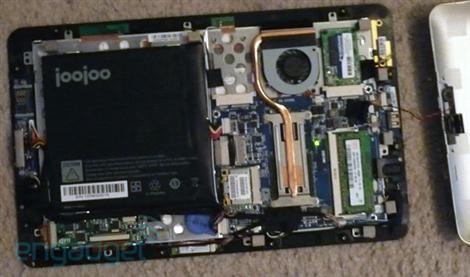
What is so special about it? well, heres what you’ll find when you open it up (yeah, with screws).

  • a RAM slot, 1 GB provided
  • 2x mini pcie slots
  • 1x ssd slot
  • a 3g sim slot
  • Nvidia’s new ion graphics chip
  • An atom n270 processor

With 4 Gb of storage, bluetooth, wifi, a camera, external USB ports, a screen boasting 1366×768 resolution, and a slick interface which supports flash, we can’t help but get excited. It costs $499. We think this could be a fantastic hacking platform. We aren’t going to just run out and buy one yet, but if it takes off, we expect to see people hacking these like crazy. Too bad they couldn’t have gotten a little more press to compete with the iPad.

IPad Teardown

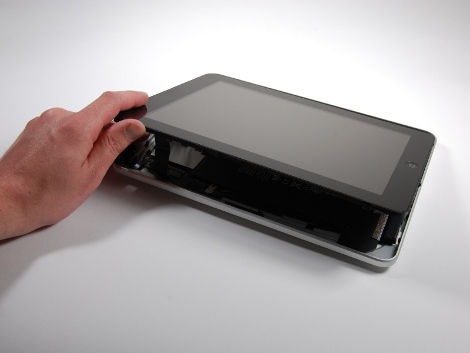
Its been quite a while since we’ve featured something from iFixit. But when we saw they had torn apart the next greatest Apple product, the iPadreleased today, and how everyone on our team loves it, we thought why not also let our user base enjoy the destruction informative teardown as well.

In both the original and the FCC teardown, we see some awesome features and tricks Apple implemented. Most notably the two separate 3.75V lithium polymer cells, not soldered to the motherboard, allowing users to easily replace the battery if need be. However, in the opposite respect, more components than ever are being epoxied to the board, making the iPad much more rugged.

We’re left wondering, with everyone able to see the beautiful insides, does it change anyone’s mind on getting an iPad? Or would you rather make your own?

Touch Screen For Graphing Calculator

[youtube=http://www.youtube.com/watch?v=pyWIJFLbJZ0]

[Owen] got down and dirty by adding a touchscreen to his TI-84 graphing calculator. The dirty part is the z80 assembly code he wrote to use the linkport as a UART (assembly always makes us feel queasy). Once that was working he implemented some commands using an Arduino and then hooked up an Nintendo DS touch screen. Now he’s got this proof of concept video where he draws on the screen, that input is interpreted by the Arduino, commands are sent through the UART, and the calculator program draws on the screen. Adding a touch screen to something is a lot more impressive when you have to go to these lengths to get it working. Nice job!

HDD Power Tools: The Sander

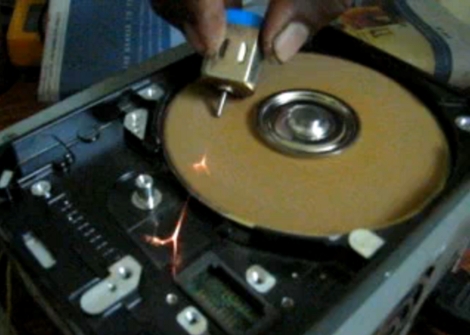
At first we thought this looked hastily thrown together and quite possible useless. Then we watched the video, embedded after the break, and realized it is quite a handy bench sander. [Mhkabir] opened up an older hard drive, removed the read head, and added a piece of carefully cut sand paper. When you hook it up to your bench supply you’ve got a small sander ready to use.  We can’t wait to try it on some small PCB edges. Now that we’ve seen a sander and a chop saw, we wonder what’s next?

Continue reading “HDD Power Tools: The Sander”

Clock Sans-microcontroller

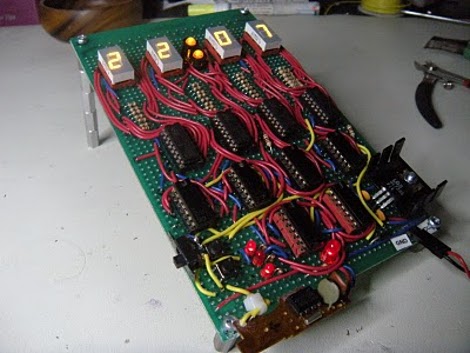
This clock requires no microcontroller. It’s actually a digital logic counter that functions as a timepiece. [BlackCow] used six decade counters to track seconds, minutes, and hours. The output is displayed on four 7-segment digits using BCD-7-segment decoders that you can learn about in our binary encoded decimal post. The actual timekeeping is done by a quartz clock circuit he pulled from a Mickey Mouse clock. This would be a perfect circuit to build in a digital logic simulator, just follow the schematic and learn as you go.

AVR Synth/sequencer

[youtube=http://www.youtube.com/watch?v=yHmhdiQ8Xko]

[kernelcode] has built this pretty slick looking sequencer/groovebox and shared the process with the world. At its heart you’ll find an AVR atmega168 along with a hand full of buttons and blue LEDs. He says the total cost was somewhere around £15-20, so that’s somewhere under $40 for the American readers. There are tons of great pics of the build and it looks like he’ll be uploading source code soon as well.

[via hackerfoundry.com]