UV EPROM Eraser In A Toolbox

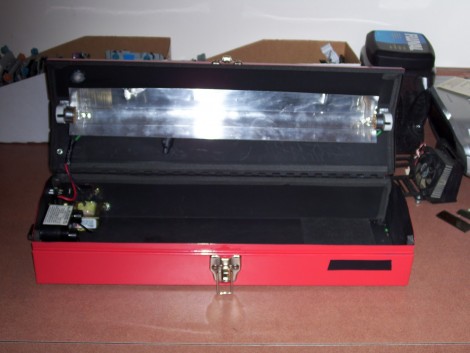
[Devon Croy] belongs to a hackerspace that works hard to keep hardware from going to the landfill. He found they were in possession of over a hundred Erasable Programmable Read Only Memory chips (EPROM). Not to be confused with EEPROM, which are electronically erasable, these EPROM chips require a strong source of UV light to blank the old data before they can be written again.

Instead of buying a tool to erase two or three chips at a time he built his own bulk EPROM eraser from an old metal toolbox. He used parts from a fluorescent black light and acquired a new bulb that generates light in the UVC spectrum, the band which works as an eraser for the chips. After bolting the parts into the case he added a spring-loaded timer knob and a safety switch that kills the power when the case is opened, similar to the UV exposure box we looked at yesterday.

Of course, if you don’t need a bulk eraser you could shop some garage sales for a UV pacifier cleaner which can also erase EPROM chips.

90 TB Drive Array For Home Storage Needs

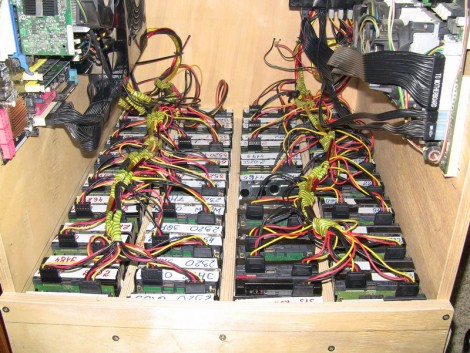
Why store it in the cloud when you could have a 90 Terabyte hard drive (translated) array in your house? The drives are mostly Western Digital Caviar Green EARS 2TB models which are known for energy efficiency and quiet operation. It’s a little unclear as to whether this is using one or two motherboards, but the drives are connected using PCI RAID5 and RAID5+0 controller cards. There’s a total of 40 cooling fans built into the case, half on the bottom and the rest on the top. They move air up through the case, with plans to add a dust filter in the future. Heck, with that type of air movement you could throw on a standard furnace filter. Apparently it is quiet enough to talk in “almost a whisper” while next to the plywood monolith. But we’re a bit skeptical of that claim.

It’s not quite as fancy looking as the 67 TB storage from last year… but it does look pretty easy to build at home.

[Thanks Henrique via EnglishRussia]

Crash Space Takes On The Machine

It’s that time again, time to take on the machine with the Hackerspace, Crash Space (and part two)! The team of Californians set out and successfully turned the front of their building into a musical instrument, similar to [David Byrne’s] Playing the Building. When a pedestrian walks by they set off distance sensors, which in turn actuate mallets that strike particular objects to produce a tone. We were pleasantly surprised at how interactive the installation was, even if it didn’t sound that great. But will it be enough to beat out the previous two teams? And how will it do up against Artisans Asylum’s not what you’re thinking Breakfast Machine next time?

[thanks Deven]

AVR DDS Signal Generator Improvements

[Vassilis Papanikolaou] took a good thing and made it better with some design upgrades to this AVR based signal generator. We looked at version 1.0 of this tool back in 2006 and since then it saw an upgrade to 2.0. But [Vassilis] wanted to take things one step further, with a compact single-sided PCB. What you see above is the beautiful result of his work; a professionally made board that is compact, uses through-hole components, and has zero wire jumpers.

If you want to build one for yourself there’s a great parts list as well as board artwork and schematic. The system uses an ATmega16 so you’ll need a way to program one. There’s also just a bit of firmware tweaking to remap the control buttons to match the updated hardware layout.

Building A UV Exposure Box

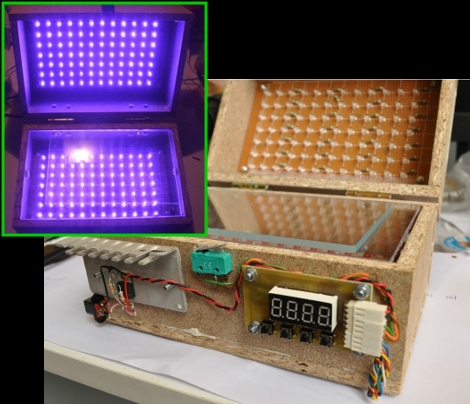
There are two methods of using etchant resist when making circuit boards. We use the toner transfer method that requires ironing on laser toner to the copper, but you can also use chemical resist that reacts to ultraviolet light. [Bogdan] decided to start doing more of the latter so he built a UV exposure box to make the process easier.

It is possible to use flourescent light bulbs for this, but he decided to use UV LEDs, a method we’ve also seen before. But there’s always room to innovate, and [Bogdan] built-in a couple of nice features that are new to us. Because the UV light can be bad for your eyes, he included a set of red visible-light LEDs on the bottom half of the box that are used to align two layers of exposure mask when making double-sided boards. There’s also a switch that automatically shuts off the UV light when the box is opened. And as the coup-de-grace, he added a programmable timer to regulate the exposure, using his newly created box when etching the PCB for it.

Waterproof DIY Momentary-push Switch

[Patman2700] has a nice scope for his paintball gun that uses a red dot instead of cross-hairs. The problem is that he kept forgetting to turn it off which ended up running the batteries down frequently. His solution to the problem was to get rid of the toggle switch used to turn it on and replace it will a home-made momentary push button switch. Now he presses the switch to aim and doesn’t waste juice when he’s running around, trying not to get pelted with paint.

Since this is used outside he wanted it to be water-tight. The switch is built using materials we’ve seen in previous diy switches; adhesive-backed copper sheets for conductors, foam to keep them separated until pressed, and plastic as a support. Copper is applied to the plastic base, with a ring of foam separating the base from the second layer of copper. When squeezed, the two layers of copper come in contact to complete the circuit. To make it work a bit better [Patman2700] added a dab of solder in the center of the bottom copper layer so there is less distance between conductors, and used extra foam to build up a bump in the center of the assembly for a better ‘button’ feel. The whole thing is encased in shrink-wrap with the seams sealed with super glue to keep moisture at bay.

Rodent-based Power Generation

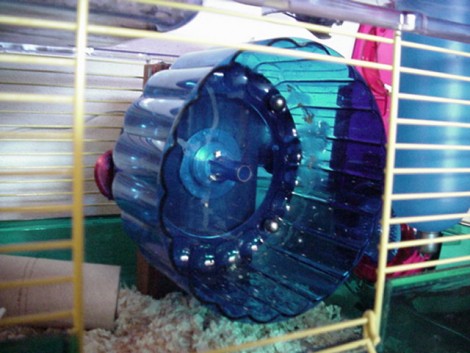
Your hamster lives to good life, with food delivery and a maid service that cleans up after him. [DanF] helped to brighten up this hamster’s life even more by improving its exercise equipment and giving it a small night-light as well. This project adds a low RPM alternator to the hamster wheel.

The first part of the process was to reduce energy lost to friction by fitting the wheel with a bearing. From there a ring of permanent magnets was added which will pass by a stationary coil and induce a current. It works, but unfortunately there’s not enough power generated to charge a battery. That means the light is only on when the hamster is running. But maybe you can figure out a way to use a super-capacitor like we saw in that exercise bike hack.

One nice finishing touch to the setup is a bicycle computer to track how much time was sent on the wheel, and the distance traveled.

[Thanks Dizzy]