Ez430 Home Automation

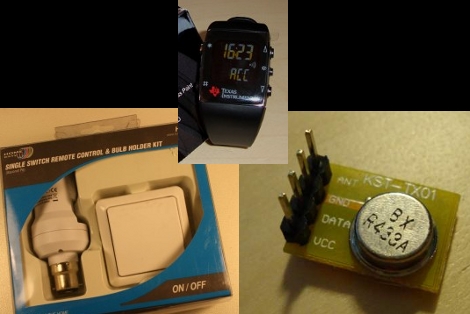
[Oliver] has been doing some work to use his TI ez430 Chronos wristwatch for some home automation. He’s working with a RF controllable lightbulb adapter which operates in the 433 MHz band. A dirt-cheap breadboard-friendly transmitter is available from Seeed Studios and he uses this in conjunction with a computer and an Arduino. Before the trolls get to their thing, YES, this is incredible overkill. But remember that he’s prototyping. We hope that if he intends to actually use this setup he’ll migrate to something like an ATtiny2313 running V-USB. Better yet, you should be able to tap into the watch’s companion receiver and cut the computer out completely.

If you’re easily amused you’ll appreciate the video of a light turning on and off after the break. If you’re a little harder to please then take a look at Oliver’s methods of using Python processing for the watch’s data.

Ok, now we’ve seen this watch turning on lights and unlocking doors. What else ‘ya got?

Built-in Hex Editor Unlocks Plasma TV Features

[Nick] tipped us off about a guide to unlock extra features on Panasonic televisions. The hack works on the G10 models of plasma TVs and uses the service menu to gain access to the EEPROM memory. With a few quick steps you can change some data with a built in hex editor, unlocking several new settings menus, or bricking your entertainment centerpiece. We’ve seen some Samsung TV hacking in the past and hope that with increased processing power in today’s models we’ll someday see consumer TVs available with open-source firmware so that we can integrate of our favorite entertainment software.

‘Mod In The USA’ N900 PUSH Competition

Just when you think you’ve heard all you can about the N900 PUSH competition, we have some more news for you.

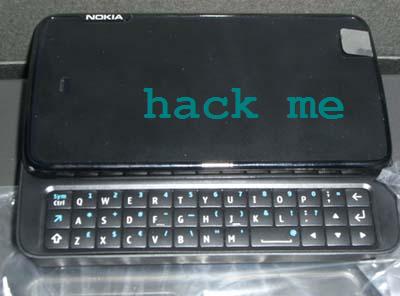
The original PUSH competition was only for UK members, but now Nokia has introduced the ‘Mod in the USA‘ N900 PUSH competition. Similar to the original, anyone (within region) can submit a cool mod, hack, useful creation that would use the N900. Winners will be selected, and thats when the differences start.

There will be a $10,000 for 1st prize, and smaller prizes for 2nd and 3rd. Plus a trip to Vegas to showcase the 3 winning hacks at CTIA 2010 as well as funding, N900s and support to build the mods.

Don’t have an idea but still want to try? They have a discussion group to get the juices flowing, or you could always discuss in our comments.

[Update: The original PUSH competition was actually world wide. Thanks Matt and Ricardo]

FAT Support For Any Microcontroller

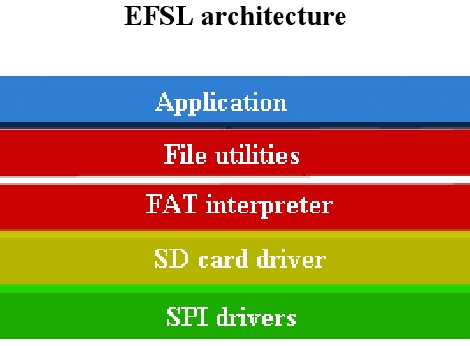
[Rahul Sapre] sent us a guide to porting EFSL to any microcontroller (PDF). The Embedded Filesystems Library adds FAT support to C compiled microcontrollers. It is targeted at the AVR line of chips but can be adapted to any architecture that works with a C compiler. [Rahul’s] guide will take you through the process of adapting the latest stable 0.2.8 version to new hardware by using a PIC uC as the working example. The non-stable development branch of EFSL is working toward multiple-platform support so consider lending a hand if this interests you.

Hackaday Links: February 7, 2010

Bot gives head to passersby

This free range robot was spotted at this year’s Kinetica Art Fair. You can place your hand above it and it will stop and pour you a beer. That’s if you consider 7/8 of a glass of head ‘a beer’.

Photo booth adds fun – consumes floor space

Face it, photo booths are fun, and if they’re free a lot of people will use them. This particular booth was built in some guy’s apartment, adding the fun but eating up floor space. But this would be a great build for your next group gathering, just like the Crushtoberfest. [via DVICE]

More human through-hole design

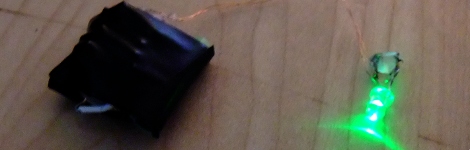
[Fridgehead] stuck and 5mm LED in his earlobe and then used a microcontroller to make it pulse. He’s got quite a mop and that’s where he hides the black controller pack. The next version should be RGB and the smallest surface mount packages he can solder. At least this isn’t disgusting like the LED nipple ring.

Chandelier your wife will never let you install

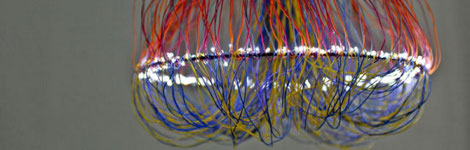
This 300 LED chandelier uses epoxy coated wires draped around the light ring to resemble a more traditional crystal light fixture. It’ll still be a hard sell if you want to hang this over the dinner table. [via Gizmodo]

A touch of copper

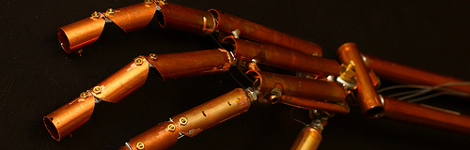
[Zombie84] built a prototype of a robot arm out of copper pipe. There’s not much info here, but you can see some wires in the wrist that appear to function as tendons. This reminds us of the characters from 9.

Putting On A Show In The Rain

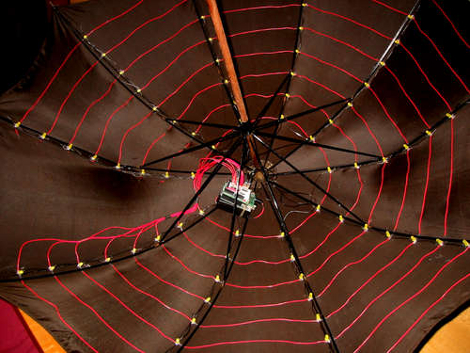
Let’s face it, walking around in the rain sucks. [Matth3w] is trying to add a little whimsy to an unpleasant experience by adding an LED matrix to his umbrella. The array contains 80 LEDs that are individually addressable. This is a mutiplexed array that relies on a MIC2981 source driver for the eight rows (or rings in this case), with the ten columns handled by the Arduino. The effect is quite nice as you can see in the video after the break. Now that he’s proven this works, you might want to etch your own PCB in order to get rid of the Arduino board and prototyping shield, making it easier to waterproof the control circuitry. This would make a nice addition to your illuminated umbrella stock.

Continue reading “Putting On A Show In The Rain”

Performance Oddities

[Mario the Magician] wrote in to let us know that he makes Hackaday a priority every morning with his coffee. Well, so do we. He also included a link to his homepage when submitting this revelation. The juicy details that are as much of a fix as the caffeine in the coffee are missing from his posts. But the hacks are solid.

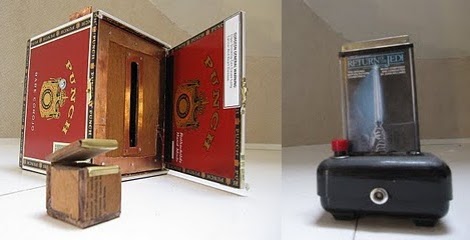
Magicians are hackers. If you could go out and buy the props, the concept are unlikely to impress anyone. [Mario] demonstrates his Nickel Box and a Jedi Mind Trick he built. The Nickel Box is a mechanical contraption that somehow transports a coin from one part of a cigar box to a tiny little enclosure on top of it. The Jedi Mind Trick uses a microcontroller and an old Star Wars soundtrack cassette tape box to put on a light and sound show while it recovers your chosen card from a shuffled deck. Great demonstrations, but no word on what’s going on inside.

[Mario’s] also has a collection of… performance oddities. His talking television takes an audio input and displays a 1950’s-esque oscilloscope effect on an old TV. He’s attempting to stop his heart, or burn the house down, or both with a flyback transformer lightning box. And his drawing automaton, well, you’ll just have to see it.

We believe in electrons, not magic (even though some say there are no electrons). So we want to know how those magic props are built. Like any good magician, [Mario] probably won’t reveal his secrets. If you’ve got the goods this your chance. Write a post detailing your magical prop builds and send them our way. If it’s well done we’ll feature it here on Hackaday.