Wireless Painting

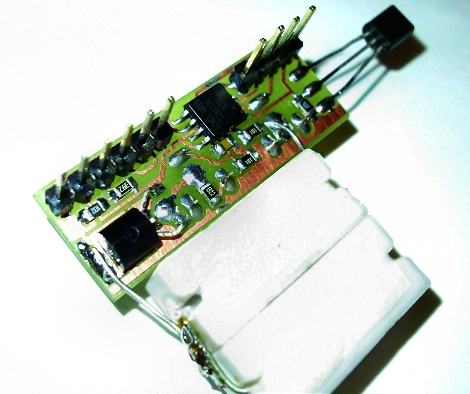
[Tom Shannon] uses science as part of his art. One of his methods when painting is to use this radio controlled paint pendulum. He gave an interview at his studio, which we’ve embedded after the break, and goes into detail about this device. It has six different reservoirs that hold the paint colors. Each gravity-fed canister connects to a central nozzle with flexible tubing. The hand held control box has a slider for each color that moves a servo pinching each supply tube. This ingenuity keeps him creating even though Parkinson’s Disease has started to manifest itself with tremors in his hands.

It’s hard to make out the paintings seen above, but the ones on display in the video are pretty amazing. He mentions that anything can be loaded into the hoppers, including tomato sauce. Is anyone else thinking about large scale pizza constuction? This also reminds us of the mechanical bartenders we’ve seen in the past. Continue reading “Wireless Painting”
TPM Crytography Cracked

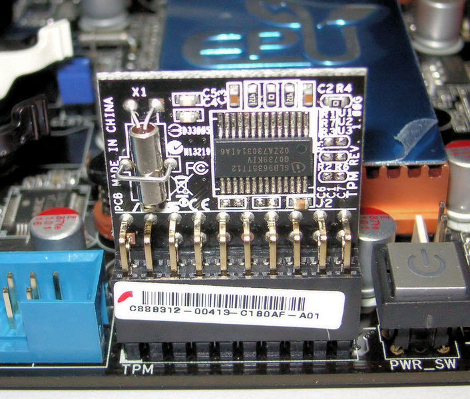
Trusted Platform Module based cryptography protects your secrets as well as your government’s secrets.  Well, it used to. [Christopher Tarnovsky] figured out how to defeat the hardware by spying on its communications. This requires physical access so it’s not quite as bad as it sounds, but this does reach beyond TPM to many of the security chips made by Infineon.  This includes peripheral security chips for Xbox 360 and some chips used in cell phones and satellite TV.

[Christopher] revealed his hack during his presentation at Black Hat 2010. The method is wicked-hard, involving removal of the chip’s case and top layer, then tapping into a data bus to get at unencrypted data. The chip still has some tricks up its sleeve and includes firmware traps that keep a look out for this type of attack, shutting down if it’s detected. Infineon commented that they knew this was possible but regard it as a low threat due to the high skill level necessary for success.

[Thanks Greg]

Old-time Music Player Is Brand New

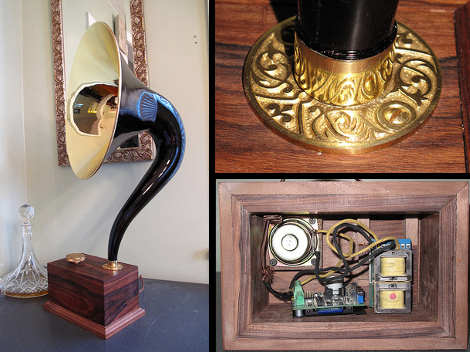
This looks like a home entertainment center of yore but something’s not quite right. Where is the turntable used to play the music? It turns out that this Danforth Standard Digitrola is digital and doesn’t rely upon wax for an input. [Jonathan Danforth] built it as a show piece and it exhibits fine craftsmanship. A sound driver uses the brass horn and the acoustical chamber to put out what sounds like a fine quality end product.  Hear it playing some Daft Punk in the video after the break. The music comes from an MP3 board inside that has a 50W amplifier and reads the music from an SD card. The only control available to the listener is the brass knob which controls the volume.

Continue reading “Old-time Music Player Is Brand New”

Porta Touch: Portable Multitouch

[youtube=http://www.youtube.com/watch?v=lHpZ5tM7sN8]

We just found this great portable multitouch rig called the portatouch. Made by a user at the NUI group website named [portatouch], this system uses a stripped down LCD as the display with IR LEDs edge lighting a touch surface in front of it. A camera mounted below the LCD picks up the reflections of the LEDs and converts it to touch points. While the implementation isn’t anything new, the package is really great. If you want to learn how to set up the technical side of it all, head over to the NUI group website and you’ll find all you want. We would love to see a more detailed breakdown of his rig though. The portability and quick construction are fantastic and seem like they could be reproduced without a ton of custom work.

‘tiny’ Power Supply Monitor

[Manekinen] built a power supply monitor based around an AVR ATtiny13. Voltage and amperage are displayed on a 16×2 LCD character display (we’re not sure what the third number is… samples per second?). This is no small feat considering that the tiny13 is an 8-pin chip. He makes it happen by using the pins for both LCD control and ADC input. To make this happen the HD44780 compliant display is used in 4-bit mode. Check out the video after the break and hit up the non-translated page if you want to download the source code and PCB artwork. A note of warning, he’s using the RESET pin for I/O which means once you burn the fuses you’ll need a programmer that has High Voltage Serial Programming capabilities if you want to reprogram the chip. Continue reading “‘tiny’ Power Supply Monitor”

Modded C64 Eye Candy

“Everyone needs a hobby,” they tell us. For the blogger mysteriously identified only as “R,” that hobby would be an almost fanatical nostalgia for the Commodore 64 computer.

At first we thought this was a fan community site, but apparently it’s all the work of a single person. [R] has tweaked, extended, repackaged and resurfaced this 1980’s icon in nearly every imaginable way. They tend to gloss over the technical aspects of these mods, but that’s okay – the C64 is such an exhaustively documented system now that the site dwells mainly on the aesthetics and meaning of these reborn devices.

The 64 has made an indelible impression on electronic music, and the machines are still sought after by collectors, composers and circuit-benders. [R] pays homage by housing these vintage systems in styles reminiscent of even vintage-er synthesizers. Any one of these would warrant a post here, yet there’s a whole collection to browse. Check it out!

[via Retro Thing]

GuruPlug, The Next Generation Of SheevaPlug

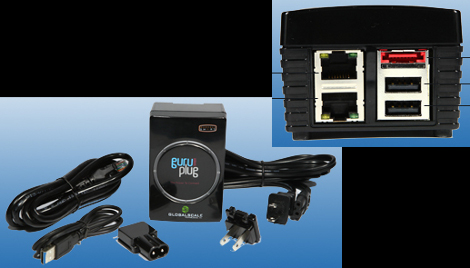
Meet GuruPlug, an all-in-one server that is now available for pre-order. This is the next generation of the popular SheevaPlug that features some added goodies. The base model sells for the same $99 and appears to have the same specs as the original but for $30 more, the GuruPlug Server PLUS moves to 2 Gigabit Ethernet ports, one eSATA connector, and built-in WiFi and Bluetooth. All of this for $129 and it only pulls 5 watts? Wow.

Update: Thanks to [Foerdi] and to [Phil Burgess] for the pointing out that the hardware diagram on the features page shows WiFi and Bluetooth for both models.

[Thanks Chris]