Fowl Accommodations Provided By Mathematics

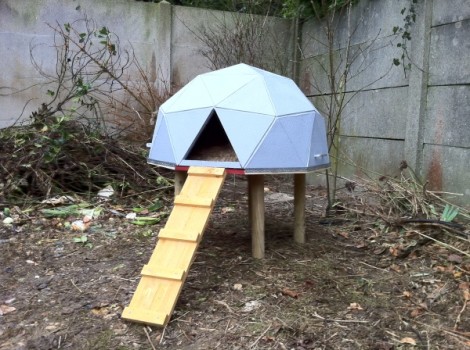
[Anthony’s] chickens happily return to roost each night thanks to the spacious house he built for them. Sadly the geodesic dome never became the home of the future despite what the people were promised. But using a bit of unorthodox joinery you can create enclosures for your chickens or other animals in need of shelter.

The construction begins with 30 isosceles triangles and nine equilateral triangles which he cut from solid wood on a chop saw. To join the pieces he used metal banding and screws, which hold the edges close together but allow them to flex. This solved the problem of precision mitres at the edge of each wood piece. Once the dome was fully assembled he filled the joints with caulk and finished it with rubber roofing compound.

Our only question is: how’s he going to automate the door of the coop?
Laptop LCD Reused In Beagleboard Project

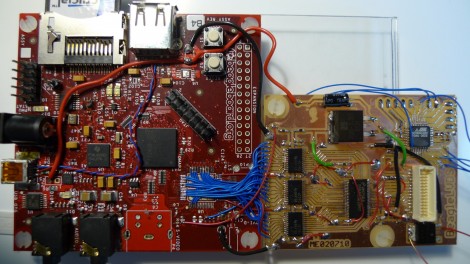
This daughterboard lets [Matt Evans] drive a laptop LCD using a Beagleboard. Apparently the Beagleboard gained a VGA header when it moved to revision C but [Matt’s] working with revision B4 which is why he had to do all of that ninja soldering with the blue wires. The driver board itself is a thing of beauty, hosting a DS90C363 LVDS serialiser as well as some buffer chips that handle level conversion for it. He’s also included an ATmega48 so that he has some options for future improvements.

The LCD is mounted in a custom acrylic case, with Beagleboard and driver board taped to the back of it. There’s RS232 and a USB hub which opens up the possibility of using a WiFi dongle for communications. So far he doesn’t have much functionality other than displaying images on the screen but there is some talk about using a touchpad for control. We’d love to see a touchscreen overlay, transforming the build into a proper ARM-based tablet.

A Charlieplex Display And A Board Layout Tip

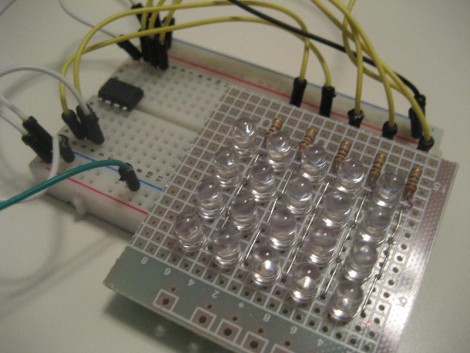
[Ben] is getting himself up to speed with microcontrollers. He jumped into the deep end by taking on this Charlieplex LED matrix build. As you can see after the break, he not only made the display work, but coded Conway’s game of life to run on the ATtiny85 that drives the device. What you see above is the prototype version that [Ben] used to make sure he had the hardware just right. He’s seeing the project through to a manufactured board and this is where the layout tip comes from. In order to make sure he had enough space for all of his components he printed out the board artwork, taped it to some Styrofoam, and then inserted all of the through-hole parts. Now he can be sure that physically the design works, we’ll keep our fingers crossed that everything is also kosher electrically.

Continue reading “A Charlieplex Display And A Board Layout Tip”

Sniffing RF Hardware Communication Packets

[Travis Goodspeed] put together a proof of concept hack that sniffs wireless keyboard data packets. He’s using the Next HOPE badge that he designed as the hardware platform for these tests. It has an nRF24L01+ radio on-board which can easily communicate with 2.4 GHz devices.

The real trick comes in getting that radio to listen for all traffic, then to narrow that traffic down to just the device from which you want data. He covers the protocol that is used, and his method of getting around MAC address verification on the hardware. In the end he can listen to all keyboard data without the target’s knowledge, and believes that it is possible to inject data using just the hardware on the badge.

Hamster Powered Strandbeest

hamster_strandbeest

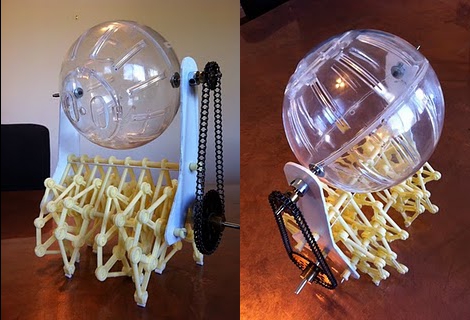
Gakken magazine featured a miniature wind-powered Strandbeest recently, converting it to run on everything from rubber bands to solar power. [Crabfu] thought it would be worthwhile to hack the Strandbeest kit that shipped with the magazine as well, so he started to brainstorm.  Well-known for his steam powered hacks previously featured here, he did originally consider adding a steam plant to the walker.  In the end, he scrapped that idea due to concerns about heat and weight.  Thinking about it further he settled on something he considered ridiculous, even stupid: A hamster powered Strandbeest.

[Crabfu] added a few components including a hamster ball and a simple chain drive from a Meccano building set before testing the device with a toy train as the power source.  Once he was certain that he had the proper gear ratio set, in went a friend’s hamster.  The device worked wonderfully, much to the delight of his nieces, as you can see in the video on his site.

Rotary Wall Plug From Scrap

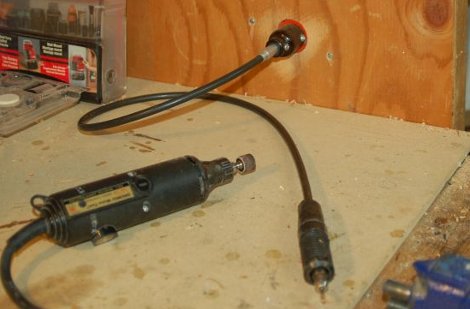
Rotary tools such as a Dremel are useful to have around for all sorts of tasks in a workshop, including cutting, polishing, and grinding. [Konstantin] sent us in his home made wall mount rotary tool based off of parts from a blender and an old bench top jigsaw. Unlike a Dremel where the motor is in the hand held part of the tool, this setup hides the blender motor (which provides the power) behind a wall panel, and is controlled via the blender’s speed settings buttons. We could see this configuration allowing for more delicate work due to the reduction of weight in hand, as well as the added bonus of a near impossibility of losing this tool. Overall an excellent re-purposing of leftover parts, be sure to check out [Konstantin]’s blog for more build info and photos.

DIY Clapper

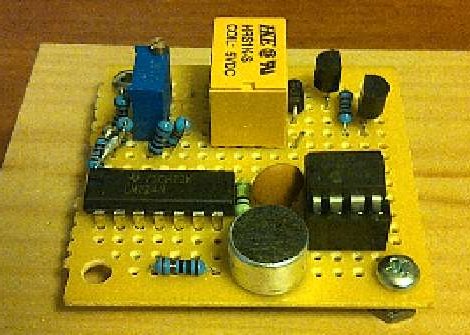
[Patrick’s] latest Instructable walks us though making a clap clap on / clap clap off type of switching circuit, similar in use to that sometimes popular commercial product seen on TV. He does this by using a standard electret microphone, half of an LM324 op amp, a voltage comparator and a PIC micro controller.

The operation of the device is as simple as its wiring, the microphone picks up sound and produces a signal, that signal is stripped of its DC component and fed into the op amp, after 2 stages of amplification the signal passes though a voltage comparator, and if the sound was loud enough a timer is triggered on the pic. Two claps within the specified amount of time, the micro then switches on a relay which can toggle your outside appliance (keeping the load in mind).

On the last page [Patrick] also gives a rough outline of how to make a single clap on / off variant using a 555 timer and some flip flops. Join us for a quick video after the break, and be sure to check this one out.

Continue reading “DIY Clapper”