All About Eve

Most programming languages today look fairly similar. There’s small differences, of course (Python using spaces, Ruby and Perl have some odd-looking constructs). In the 1960s and 1970s, though, a lot of programming languages were pretty cryptic. Algol, APL, and LISP are great examples of unusual looking programming languages. Even FORTRAN and PL/1 were hard to read. RPG and COBOL were attempts to make programming more accessible, although you could argue that neither of them took over the world. Most programming languages today have more similarity to FORTRAN than either of those two languages.

A new programming language, Eve, claims to be based on years of research in programming from a human perspective instead of from the computer’s. The result is a language that works by pattern matching instead of the usual flow of control. It is also made to live inside of Markdown documents that can serve as documentation. You can see a video about Eve, below.

Neither of these are totally new ideas. SNOBOL, AWK, and Prolog all have some pattern-matching involved. [Donald Knuth] was promoting literate programming back in the 1980s. However, Eve understands modern constructs like web browsers.


Continue reading “All About Eve”

Turn That Old Tablet Into A Sub-$100 Linux Laptop

Tiny laptops have always been devices that promise so much, yet fail somehow to deliver. From the Atari Portfolio palmtops through to the recent crop of netbooks they have been either eye-wateringly expensive if they are any good, or so compromised by their size constraints as to be next-to-useless. We’ve seen DOS, EPOC, Windows, WinCE, Palm OS, Linux distros and more in tiny form factors over the years, yet few have made a significant mark.

The prospect of a “proper” computer in your hand isn’t something to abandon just yet though. We are now reaching the point at which the previous generation of higher-end Android tablets are both acceptably powerful and sufficiently numerous as to be available at a very reasonable price. Perhaps these can provide the tiny laptop seeker with a basis for something useful. [NODE] certainly thinks so, because he’s produced a nice little Ubuntu laptop using a second-hand Nexus 7 tablet and a Bluetooth keyboard case. Android is replaced with an Ubuntu image, and a cardboard cut-out display bezel is held in place with magnetic strips. A step-by-step guide has been put up to help others interested in following the same path.

This is not the most amazing of hardware hacks, in that it involves mostly off-the-shelf items and a piece of software. However it’s worth a look because it does provide a route to a very acceptable little Linux laptop for an extremely reasonable price. One concern is that the Ubuntu version seems not to be a recent one, however we’re sure readers will point at any newer distribution builds in the comments. If you fancy a look at the finished laptop he’s posted a video which we’ve included below the break.

Continue reading “Turn That Old Tablet Into A Sub-$100 Linux Laptop”

See If You Can Reverse Engineer This Scrap Metal Battery

We got quite a few tips in about a paper from Vanderbilt about a cool scrap metal battery they’ve been playing with. They made some pretty bold claims and when we fed the numbers in they pretty much say they’ve got a battery you can make at home, that can hold half as much as a lead acid, can be made out of scraps in a cave (even if you’re not Tony Stark), charge super fast,and can cycle 5,000 times without appreciable capacity loss.  Needless to say that’s super cool.

Of course, science research is as broken as ever and the paper was hidden behind a paywall. Through mysterious powers such as the library and bothering people we were able to get past this cunning defense and read the paper. Unfortunately the paper reads more like a brag track than a useful experimental guide on how to build the dang battery. It’s also possible that our copy was missing some pages. Anyway, we want to do science!

Anyway, here’s what we know. The battery is based on an ancient battery called the Baghdad Battery. The ancient battery supposedly used iron and copper with a mystery electrolyte. The scrap battery, however, is made from scrap iron and scrap brass. The iron makes sense, but why brass? Well, brass has copper in it, and you can still get at it chemically even if it’s alloyed.

To that end, the next step was to throw some oxygen atoms in with those pesky Fe and Cu ones. The goal is to get a redox reaction going. If you do it right you can achieve pseudocapacitance. To to this the researchers used “common household chemicals and voltages” to anodize the iron and copper inside the brass. The press photo have them holding a gallon of muratic acid, if that helps. We don’t know, but if they can jam a few oxygen atoms in there then so can we!

After that it’s all about sitting the electrodes in a bath of potassium hydroxide. We guess you can scrape the inside of an AA for that. Anyway, the paper’s light on process but the battery seems really cool. They’re not pursuing this research for commercialization, instead going the OSHW route. They hope to get to the point where anyone can just grind up a bunch of scrap steel and brass, maybe throw it in a birdcage, anodize it, and get a super long life battery for grid use for less than a lead acid. If any of you manage to build one of these drop us a tip!


Hackenings: Retro Gaming And Computing

[Strages] contacted us via IRC on the #Hackerspaces channel to let us know that Makers Local 256, his hackerspace in Huntsville Alabama, is having their annual Retro Gaming and Computing Night this week: November 12th from 4pm to 11pm.

Nothing makes us feel old like seeing Starcraft tossed in with the "retro" games category, but if they set up a LAN for three-way Zerg-Terran-Protoss action, we’ll abide. If you’re anywhere near Huntsville, you should head on down and show off your hard-earned skills.

Hackenings

"Hackenings" is our weekly roundup of what’s going on in hackerspaces around the world. If you’ve got an event that you’d like to see on these pages, write to tips@hackaday.com with [Hackenings] in the subject line, and awesome images or graphics if you’ve got ’em. And tune in again next Saturday to see what’s going on in (y)our world.

Slow Dance Appears To Make Time Run In Slow Motion

Rendering something in slow-motion is an often-used technique that attempts to add some ‘wow’ or ‘cool’ factor. Seeing something out in the world move in slow motion is marginally rarer — rarer still if it’s in your own home. But do it right and that kind of novelty turns a lot of heads. Enough to go 8x on a Kickstarter goal.

Slow Dance, a picture frame ringed with strobe lights, generates the surreal effect of turning small, everyday objects into languid kinetic sculptures. It’s an intriguing example of kinetic art done in a novel way.

[Jeff Lieberman], a veteran of high-speed photography, takes advantage of ‘persistence of vision’ by synchronizing the vibrations of an object — say, a feather — with a strobe light blinking 80 times per second. An electromagnet inside the frame is used to vibrate the objects, while the strobe lights are housed inside the thick frame.

Continue reading “Slow Dance Appears To Make Time Run In Slow Motion”

Hackit: Laser Cut Your Own Jigsaw Puzzle

If you have a laser printer, you’ve got your Christmas presents sorted out. At least if your family likes jigsaw puzzles. The idea is very simple, laminate a photograph onto some laser-cuttable board, and then run the laser over the outline of the pieces. Bam! Instant puzzle.

The trick is generating the puzzle outline, and of course there’s an online application for that. It’s got options that let you customize the piece count and shapes, and then download the result as an SVG image.

Unfortunately, it’s closed-source and makes the pieces a little bit too uniform for our liking — many of the pieces have exactly the same shape as each other. Are you up to the challenge of writing a better one? We’d love to see it, because the idea of a simple puzzle overlay for laser cutters is too good. Help us get started with some brainstorming in the comments below. How do you go about generating meaningfully unique jigsaw edges algorithmically?

Once you’ve got the puzzle cut out, you can seal up the surface nicely, toss it in a box, and then you’ve got a personalized present. To put it together, we suggest an accompanying DIY pick-and-place tool. (And kudos to [Kristina] for the best headline of 2015 on that one!)

Thanks to Hackaday alum [George Graves] for the tip!

Personal Compass Points To Your Spawn Point

A conventional compass points north (well, to magnetic north, anyway). [Videoschmideo]  wanted to make a compass that pointed somewhere specific. In particular, the compass — a wedding gift — was to point to a park where the newlywed couple got engaged. Like waking up in a fresh new Minecraft world, this is their spawn point and now they can always find their way back from the wilderness.

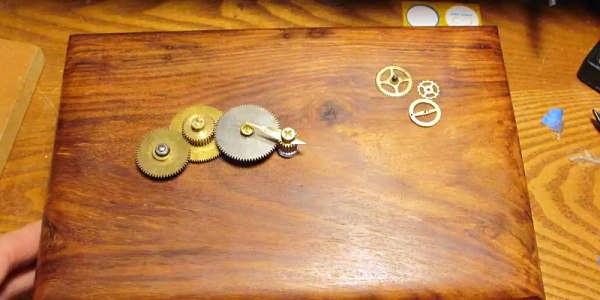
The device uses an Arduino, a GPS module, a compass, and a servo motor. Being a wedding gift, it also needs to meet certain aesthetic sensibilities. The device is in an attractive wooden box and uses stylish brass gears. The gears allow the servo motor to turn more than 360 degrees (and the software limits the rotation to 360 degrees). You can see a video of the device in operation, below.

Continue reading “Personal Compass Points To Your Spawn Point”