The 2019 Geneva International Motor Show has a number of “concept” vehicles. These are vehicles that usually include some cool feature that isn’t really practical — at least today. For example, in the past, concept cars have had adjustable color interior lighting, plug-in hybrid engines, and power windows — all things that would eventually become commonly available. However, today’s advances in computer-generated graphics have meant you can show things you can’t begin to build. Case in point: Goodyear has a video touting the Aero — a solid car tire that doubles as a propeller for your garden variety flying car.
To us, the thing looks more like a science fiction movie trailer than anything remotely practical. Four relatively small wheels with no central hub can flip and provide enough lift to propel a sizeable vehicle skyward. Even more interesting, is to transition modes from ground to flight, the vehicle balances on two wheels while using only two as propellers to generate lift.
Editors Elliot Williams and Mike Szczys catch up on the past week in hackerdom. It seems as if we’re in a golden age of machine building as an incredible rocker-bogie rover is built to transport a child and mechanical simplicity automates the wet cat food dispensing process. We marvel at the ability to use G-code to decorate eggs (them being curvy in more than one direction and all). The we contemplate the ability to build and start a motor which will continue to run long after your own life ends. And perhaps it’s time to add more layers to your PCB design playbook.
Take a look at the links below if you want to follow along, and as always, tell us what you think about this episode in the comments!
Take a look at the links below if you want to follow along, and as always, tell us what you think about this episode in the comments!
As you might expect from one of our most illustrious alumni, [Caleb Kraft] is a rather creative fellow. Over the years he’s created some absolutely phenomenal projects using CNC routers, 3D printers, laser cutters, and all the other cool toys the modern hacker has access to. But for his latest project, a celebration of the full Moon, he challenged himself to go low-tech. The Moon is something that anyone on Earth can look up and enjoy, so it seemed only fitting that this project should be as accessible to others as possible.
[Caleb] started this project by looking for high-resolution images of the Moon, which was easy enough. He was even able to find sign shops that were more than happy to print a giant version for him. Unfortunately, the prices he was quoted were equally gargantuan. To really be something that anyone could do, this project needed to not only be easy, but as affordable as possible. But where do you get a giant picture of the Moon for cheap?
He eventually found a source for Moon shower curtains (we told you he was creative), which fit the bill perfectly. [Caleb] says they aren’t nearly as detailed as the original images he found, but unless you’ve got your face pressed up against it you’ll never notice anyway. To make the round frame, he used PEX tubing from the hardware store and simply stapled the curtain directly to the soft plastic. The hardest part of the whole project is arguably getting the curtain flat and taut on the PEX ring.
Technically you could stop now and have a pretty slick piece of art to hang on your wall, but [Caleb] took the idea a bit farther and put a strip of RGB LEDs along the inside of the ring. The shower curtain material does a decent enough job of diffusing the light of the LEDs to make it look pretty good, though there’s certainly some room for improvement if you want to get a more even effect over the entire surface. While you’re at it, you might as well add in some additional electronics so the lighting matches the current phase of the real-life Moon.
On the other hand, if you’re willing to settle for a far more diminutive version of Luna and don’t mind using those highfalutin hacker tools that [Caleb] decided to avoid for the good of mankind, we’ve got a project you might be interested in.
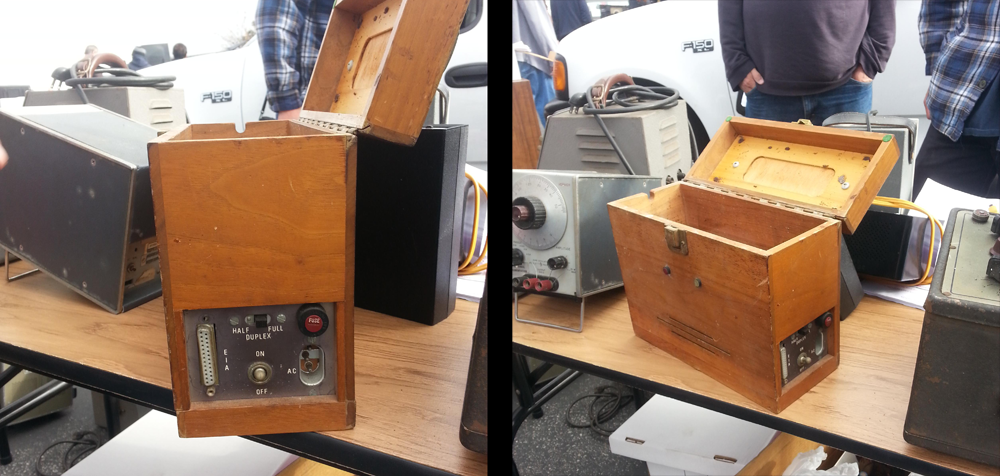
A few years ago, I was out at the W6TRW swap meet at the parking lot of Northrop Grumman in Redondo Beach, California. Tucked away between TVs shaped like polar bears and an infinite variety of cell phone chargers and wall warts was a small wooden box. There was a latch, a wooden handle, and on the side a DB-25 port. There was a switch for half duplex and full duplex. I knew what this was. This was a modem. A wooden modem. Specifically, a Livermore Data Systems acoustically coupled modem from 1965 or thereabouts.
The Livermore Data Systems Modem, where I found it. It cost me $20
The probability of knowing what an acoustically coupled modem looks like is inversely proportional to knowing what Fortnite is, so for anyone reading this who has no idea what I’m talking about, I’ll spell it out. Before there was WiFi and Ethernet and cable modems and fiber everywhere, you connected to the Internet and BBSes via phone lines. A modem turns digital data, in this case a serial connection, into analog data or sound. Oh yeah, we had phone lines, too. The phone lines and the phones in your house were owned by AT&T. Yes, you rented a phone from the phone company.
90s kids might remember plugging in a US Robotics modem into your computer, then plugging an RJ-11 jack into the modem. When this wooden modem was built, that would have been illegal. Starting with the communications act of 1934, it was illegal to attach anything to the phone in your house. This changed in 1956 with Hush-A-Phone Corp v. United States, which ruled you could mechanically attach something to a phone’s headset. (In Hush-A-Phone’s case, it was a small box that fit over a candlestick phone to give you more privacy.)
The right to attach something to AT&T’s equipment changed again in 1968 with Carterphone decision that allowed anyone to connect something electronically to AT&T’s network. This opened the door for plugging an RJ-11 phone jack directly into your computer, but it wasn’t until 1978 that the tariffs, specifications, and certifications were worked out. The acoustically coupled modem was the solution to sending data through the phone lines from 1956 until 1978. It was a hack of the legal system.
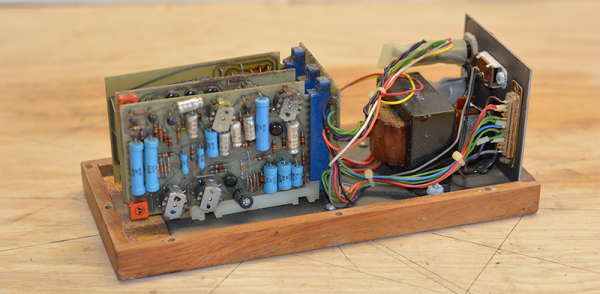
This leaves an ancient modem like the one sitting on my desk in an odd position in history. It was designed, marketed and sold before the Carterphone decision, and thus could not connect directly to AT&T’s network. It was engineered before many of the integrated chips we take for granted were rendered in silicon. The first version of this modem was introduced only a year or so after the Bell 103 modem, the first commercially available modem, and is an excellent example of what can be done with thirteen or so transistors. It’s time for the teardown, so let’s dig in.
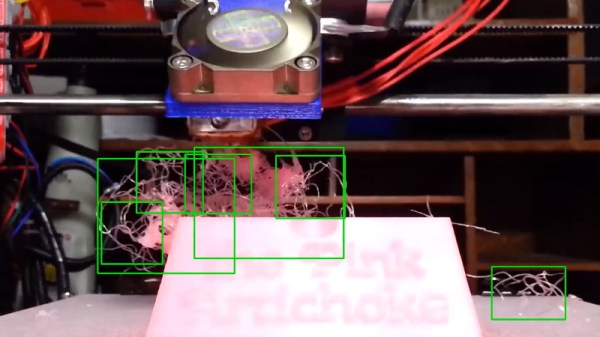
Among 3D printer owners, “spaghetti” is the common term for the tangled mess of stringy plastic that’s often the result of a failed print. Fear of their print bed turning into a hot plate of PLA spaghetti is enough to keep many users from leaving their machines operating overnight or while they’re out of the house. Accordingly, we’ve seen a number of methods that allow the human operator to watch their print remotely to make sure everything is progressing smoothly.
But unless you plan on keeping your eyes on your phone the entire time you’re out of the house, there’s still a chance some PETG pasta might sneak its way out. Enter the Spaghetti Detective, an open source project that lets machine learning take over when you can’t sit watching the printer all day. Their system plugs into Octoprint to monitor your print in real-time and pause it if it starts looking particularly stringy. The concept is still under development, but judging by the gallery of results submitted by users, the system seems to have a knack for identifying non-edible noodles.
Once the software comes out of beta it looks like the team is going to try to monetize it by providing hosting and monitoring services for a monthly fee, but as it’s an open source project, you’re also able to run the software on your own machine. Though the documentation notes that the lowly Raspberry Pi doesn’t have quite what it takes to handle the image recognition routines, so you’ll need a proper computer if you want to self-host the service. Could be a good use for that old laptop you’ve got kicking around the lab.
As demonstrated in the video after the break, the system’s “spaghetti confidence” is shown with a simple to understand gauge: green is a good-looking print, and red means the detective is getting a sniff of the stringy stuff. If your print dips into the red too much, Octoprint is commanded to pause the print. The user can then look at the last image from the printer and decide to either cancel the print entirely, or resume if the Spaghetti Detective got a little overzealous.
A while ago, [Skippy] bought a cheap knock-off of the Apple USB mains charger from an AliExpress seller, for the British low, low price of 89p. Normally we’d give you a dollar conversion, but since that’s coincidentally the price of the basic McDonalds hambuger in the UK we’ll go with the hamburger as a unit of conversion. And as any self-respecting hacker would, he subjected it to a teardown and gave it a few tests.
Surprisingly though its pins were a little long it was just within the BS1363 pin spacing specification, probably due to its external dimensions copying the Apple original. The emissions test he performed might surprise readers, as it gave the little device its first pass. Radiated RF emissions were well below the test threshold, a welcome sight for anyone who has had to test a device. Sadly the same could not be said for conducted emissions, and it was happily spraying RF to all and sundry from its connections.
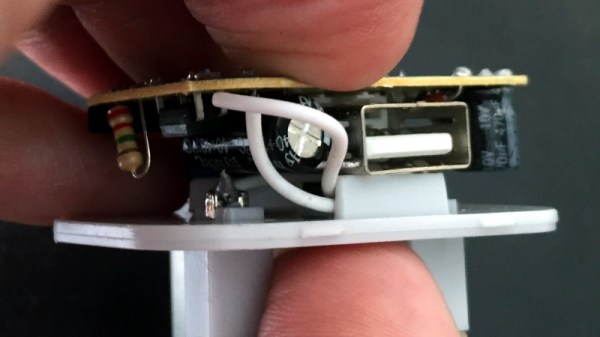
Taking a look inside revealed the usual litany of frightening safety fails. There was no insulation between the mains pins and the circuit board, and a secondary capacitor was even touching one of the pins. Meanwhile another capacitor connecting both sides of the circuit was not of the required Y rating. These and a raft of others make the device illegal for sale in Europe without further tests, but to give some numbers to it all he subjected it to a screen test applying 600 VAC common mode to its pins and checking for leakage current through the device. This it failed, and indeed it did not recover from the test.
So in this case, the price of a hamburger definitely does not get you an Apple, nor even does it get you an equivalent. But of course, you knew that, because we’ve talked about fake Apple chargers and power supplies many times before.
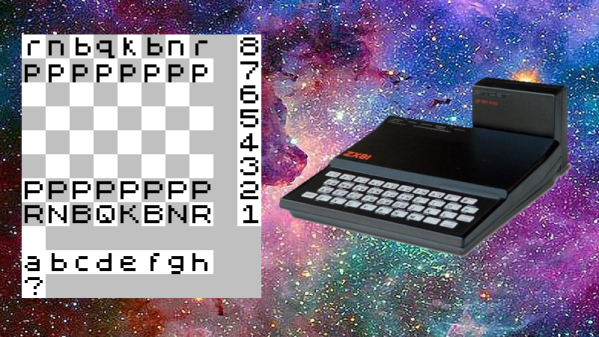
When programming for modern platforms, the restraints are different to those of 30 years ago. Back in the dawn of the microcomputer age, storage and RAM were measured in kilobytes. It simply wasn’t possible to store large amounts of graphical data, and even code had to be pared back at times. [reeabgo] found out some of these limitations first hand, when coding a tiny chess program for the Sinclair ZX81.
[reeabgo]’s project goes by the name ChesSkelet, and is truly tiny. Measuring in at just 377 bytes in its smallest version, the entire program takes up less space than this very article describing it. To achieve these feat requires certain sacrifices, of course. The tiniest edition contains no graphics whatsoever, representing the game state with simple characters and featuring no adornments whatsoever. The full-fat version comes in at 477 bytes and adds quite a lot of functionality. There’s a proper checkerboard, along with move legality checks and pawn promotion.
Unfortunately, advanced chess play isn’t quite possible – castling is not implemented, and the AI doesn’t yet handle check situations properly. Despite this, it’s a solid approximation of the real game, all packed into an impressively small space.