Ramen Lamp Has Us Feeling Hungry

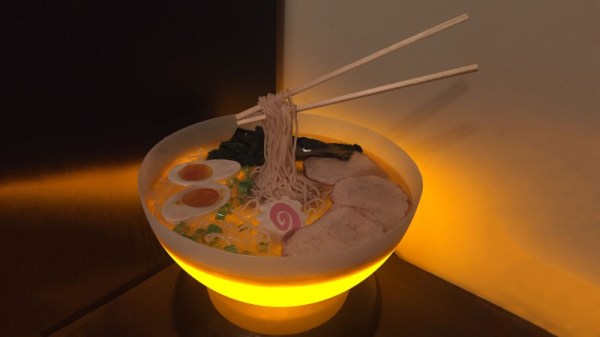
Ramen comes in many forms, and whether you’re eating the 10 cent instant packets during the school year, or dining out at a fancy noodle bar, it’s a tasty meal either way. [ramenkingandi] has long been in love with the classic Japanese fare, and decided to create a homage to the dish – in lamp form.

The lamp build begins, somewhat unsurprisingly, with a lamp – but not how you’d think. A Walmart floor lamp is harvested for its lampshade, which approximates the dimensions of a typical ramen bowl. It’s then fitted with warm yellow LEDs to give it a pleasing glow. Polymer clay is used to create fake ramen ingredients – including noodles, pork, and choy sum. Jewelery wire is used to suspend the chopsticks in mid-air, before resin is poured into the bowl and the ingredients arranged on top. For a final touch, the bowl is painted with an artistic stripe to hide the electronics inside, and the lamp is complete.

It’s a great example of fake Japanese food, which is actually a huge industry in that part of the world. We’d love to have this lamp on display in our own home, fully expecting ramen consumption to increase considerably over time.

Lamps are a common feature around these parts – and some of them have even learned to leap. 

Hands-On: GreatFET Is An Embedded Tool That Does It All

There’s a new embedded hacking tool on the scene that gives you an interactive Python interface for a speedy chip on a board with oodles of GPIO, the ability to masquerade as different USB devices, and a legacy of tricks up its sleeve. This is the GreatFET, the successor to the much loved GoodFET.

I first heard this board was close to launch almost a year ago and asked for an early look. When shipping began at the end of April, they sent me one. Let’s dig in for a hands-on review of the GreatFET from Great Scott Gadgets.

Continue reading “Hands-On: GreatFET Is An Embedded Tool That Does It All”

The Arduboy Gets A Crank Mod

You’ve seen VR headsets and wearable video game controllers and flight yokes and every other type and kind of video game controller, but a crank? Yes, the Arduboy now has a crank modification in tribute to (or blatant ripoff of) the PlayDate, a video game console created by Panic and Teenage Engineering.

The basis for this build is the Arduboy, a miniature game system the size of a credit card. This game console features candy-like buttons, compatibility with the Arduino IDE, and a community that has produced dozens of games already. Where there’s software developers there’s inevitably a few hardware engineers waiting in the wings, and this is no exception. [bateske] created a crank mod for the Arduboy that gives this miniature, toy-like game console a crank. Ready to write a bass fishing simulator? This is your shot.

The hardware for this build consists of a 360° rotary encoder for the internals of the device. For the handle, [bateske] found an interesting ‘premium grinder for herbs and spices’ on Amazon. Shockingly, this crank handle just sort of works with the rotary encoder.

As for games, this is a brand new user interface for the Arduboy game console, so of course there are some interesting possibilities. There’s a fishing simulator that’s more interesting than real fishing and something like Flappy Bird only instead of flapping it’s bouncing over bottomless pits. You can check out this crank console out below.

Continue reading “The Arduboy Gets A Crank Mod”

Building A Googie-Style Sign With The Help Of CNC

The Googie style was a major architectural trend of the post-war period in the United States. It remains popular to throwback to this style, and [Wesley Treat] got the job to create a sign in this vein for a local trailer motel (Youtube link, embedded below).

CNC tools make just about any job easier, and this one is no exception. The smooth curves of the sign were carved out of several sections of PVC sheet, and stacked up to form the body of the sign. These were then sanded, coated in putty, and given a lick of  paint. Steps like these could likely be skipped in the interest of saving time, especially given that few will see those parts once the sign is installed. However, [Wesley] takes pride in his work, and the final piece is all the better for it. It’s also important for the piece to impress the client, not just the public.

The front of the sign is also produced in PVC sheet, and given a coat of paint with brush techniques used to create a faux-wood finish. Vinyl is then applied to the textual and graphical elements in order to create a colored backlit effect. The sign is lit with off-the-shelf LED strips, and the whole assembly is weather sealed to protect it from the elements.

The final product is a beautiful piece, harking back to the classic Googie aesthetic and serving as a testament to [Wesley]’s skills. It’s a great example of how easy it is to create great work with the right tools and the proper attention to detail. It also goes to show how great LEDs are for signage, whether you’re at the beach or the lab. Video after the break.

Continue reading “Building A Googie-Style Sign With The Help Of CNC”

The Backbone Of VHF Amateur Radio May Be Under Threat

A story that has been on the burner for a few weeks concerns a proposal that will be advanced to the ITU World Radiocommunication Conference 2023. It originates with French spectrum regulators and is reported to be at the behest of the Paris-based multinational defence contractor Thales. The sting in its tail is the proposed relegation of amateur radio to secondary status of the widely used two-meter band (144 MHz) to permit its usage by aircraft. The machinations of global spectrum regulation politics do not often provide stories for Hackaday readers, but this one should be of concern beyond the narrow bounds of amateur radio.

Most parts of the radio spectrum are shared between more than one user, and there is usually a primary occupant and a secondary one whose usage is dependent upon not interfering with other users. If you’ve used 435 MHz radio modems you will have encountered this, that’s a band shared with both radio amateurs and others including government users. While some countries have wider band limits, the two-meter band between 144 MHz and 146 MHz is allocated with primary status to radio amateurs worldwide, and it is this status that is placed under threat. The latest ARRL news is that there has been little opposition at the pan-European regulator CEPT level, which appears to be causing concern among the amateur radio community.

Why should this bother you? If you are a radio amateur it should be a grave concern that a band which has provided the “glue” for so many vital services over many decades might come under threat, and if you are not a radio amateur it should concern you that a commercial defence contractor in one country can so easily set in motion the degradation of a globally open resource governed by international treaties penned in your grandparents’ time. Amateur radio is a different regulatory being from the licence-free spectrum that we now depend upon for so many things, but the principle of it being a free resource to all its users remains the same. If you have an interest in retaining the spectrum you use wherever on the dial it may lie, we suggest you support your national amateur radio organisation in opposing this measure.

AI Recognizes And Locks Out Murder Cats

Anyone with a cat knows that the little purring ball of fluff in your lap is one tiny step away from turning into a bloodthirsty serial killer. Give kitty half a chance and something small and defenseless is going to meet a slow, painful end. And your little killer is as likely as not to show off its handiwork by bringing home its victim – “Look what I did for you, human! Are you not proud?”

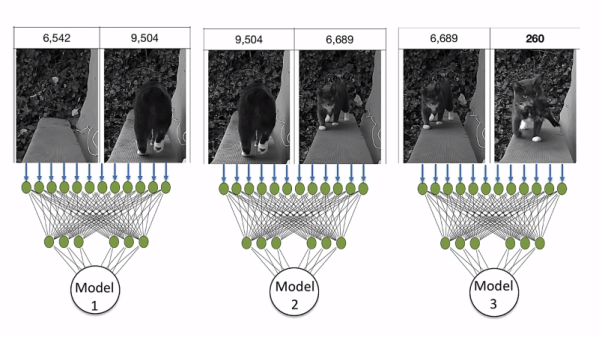
As useful as a murder-cat can be, dragging the bodies home for you to deal with can be – inconvenient. To thwart his adorable serial killer [Metric], Amazon engineer [Ben Hamm] turned to an AI system to lock his prey-laden cat out of the house. [Metric] comes and goes as he pleases through a cat flap, which thanks to a solenoid and an Arduino is now lockable. The decision to block entrance to [Metric] is based on an Amazon AWS DeepLens AI camera, which watches the approach to the cat flap. [Ben] trained three models: one to determine if [Metric] was in the scene, one to determine whether he’s coming or going, and one to see if he’s alone or accompanied by a lifeless friend, in which case he’s locked out for 15 minutes and an automatic donation is made to the Audubon Society – that last bit is pure genius. The video below is a brief but hilarious summary of the project for an audience in Seattle that really seems quite amused by the whole thing.

So your cat isn’t quite the murder fiend that [Metric] is? An RFID-based cat door might suit your needs better.

Continue reading “AI Recognizes And Locks Out Murder Cats”

Building A Geodesic Dome Greenhouse

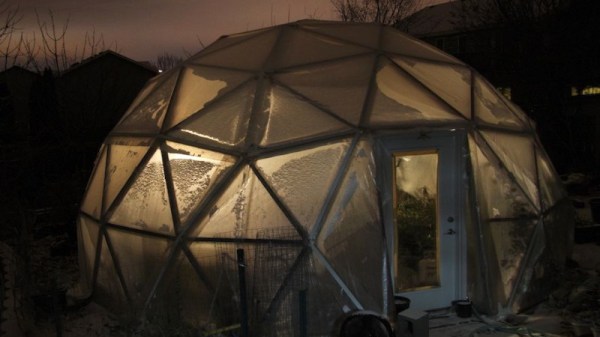
Greenhouses are a great way to improve conditions for your plants, and are an absolute necessity for any serious gardening in colder climates. When the time came for [gentleworks] to build a new greenhouse, rather than going with a conventional design, they decided to go with a geodesic dome instead.

The greenhouse uses a few techniques that will be unfamiliar to those used to run-of-the-mill carpentry. The individual cedar struts meet at a series of hubs, constructed out of short lengths of Schedule 80 PVC pipe. The struts are attached to the pipe with steel straps, screwed into place. This doesn’t give the strongest of holds, but as most of the loads on the struts are compressive in nature, it works well in practice. Plastic sheeting is used as a covering to help let in plenty of light while keeping the cold out. The greenhouse is also heated, and can maintain a 40 deg F temperature differential with 14,000 BTUs.

It’s a build that has us wanting to throw up a dome or two in our own backyard. We’ve seen other geodesic structures before; if you’re working on one yourself, be sure to drop us a line.