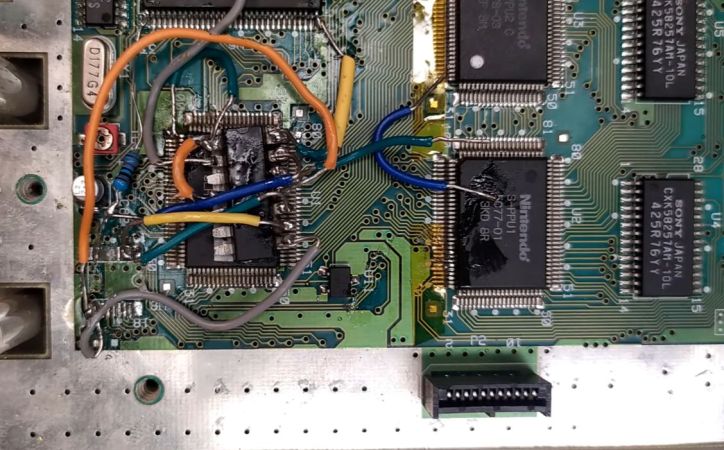
Not what you want to see when testing that ‘repaired’ SNES. (Credit: Skawo, YouTube)
The good part about older game consoles like the Super Nintendo is that they have rather rudimentary region locks, but unfortunately this also gives some people the idea that installing something like the SuperCIC mod chip to make a SNES region-free is easy. The patient that arrived on [Skawo]’s surgery table was one such victim, with the patient requiring immediate surgery to remove the botched installation before assessing the damage.
Here the good news was that the patient features the revision B CPU, making it a good console to rescue. The bad news was that the pads of the old CIC chip had been ripped up, there was a solder bridge on S-PPU1 between two pins and both the installed wiring and soldering were atrocious, requiring plenty of touch-ups.
With the CIC pads already a loss, finishing the SuperCIC mod seemed like a good plan, also since this would make for a nice region-free console. This mod involves a PIC16F630 with special firmware that works with the corresponding CIC IC in each cartridge, while also switching between 50/60 Hz mode to fit the cartridge’s region. After an initial test with PAL and NTSC cartridges everything seemed all right. Then [Skawo] ran the SuperNES Burn-In test from its cartridge, which gave dire news.
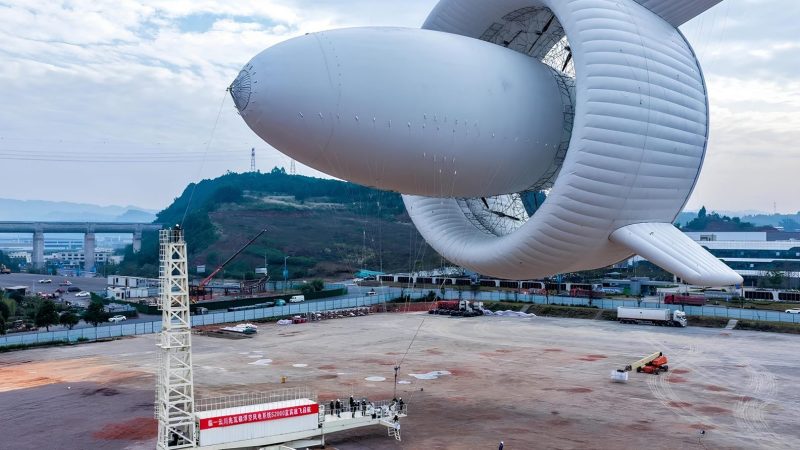
2000 m above ground level (AGL), winds are stronger and much, much more consistent than they are at surface. Even if the Earth were a perfect sphere, there’d be a sluggish boundry layer at the surface, but since it’s got all these interesting bumps and bits and bobs, it’s not just sluggish but horribly turbulent, too. Getting above that, as much as possible, is why wind turbines are on big towers. Rather than build really big tower, Beijing Lanyi Yunchuan Energy Technology Co. has gone for a more ambitious approach: an aerostat to take power from the steady winds found at high altitude. Ambitiously called the Stratosphere Airborne Wind Energy System (SAWES), the megawatt-scale prototype has recently begun feeding into the grid in Yibin, Sichuan Province.
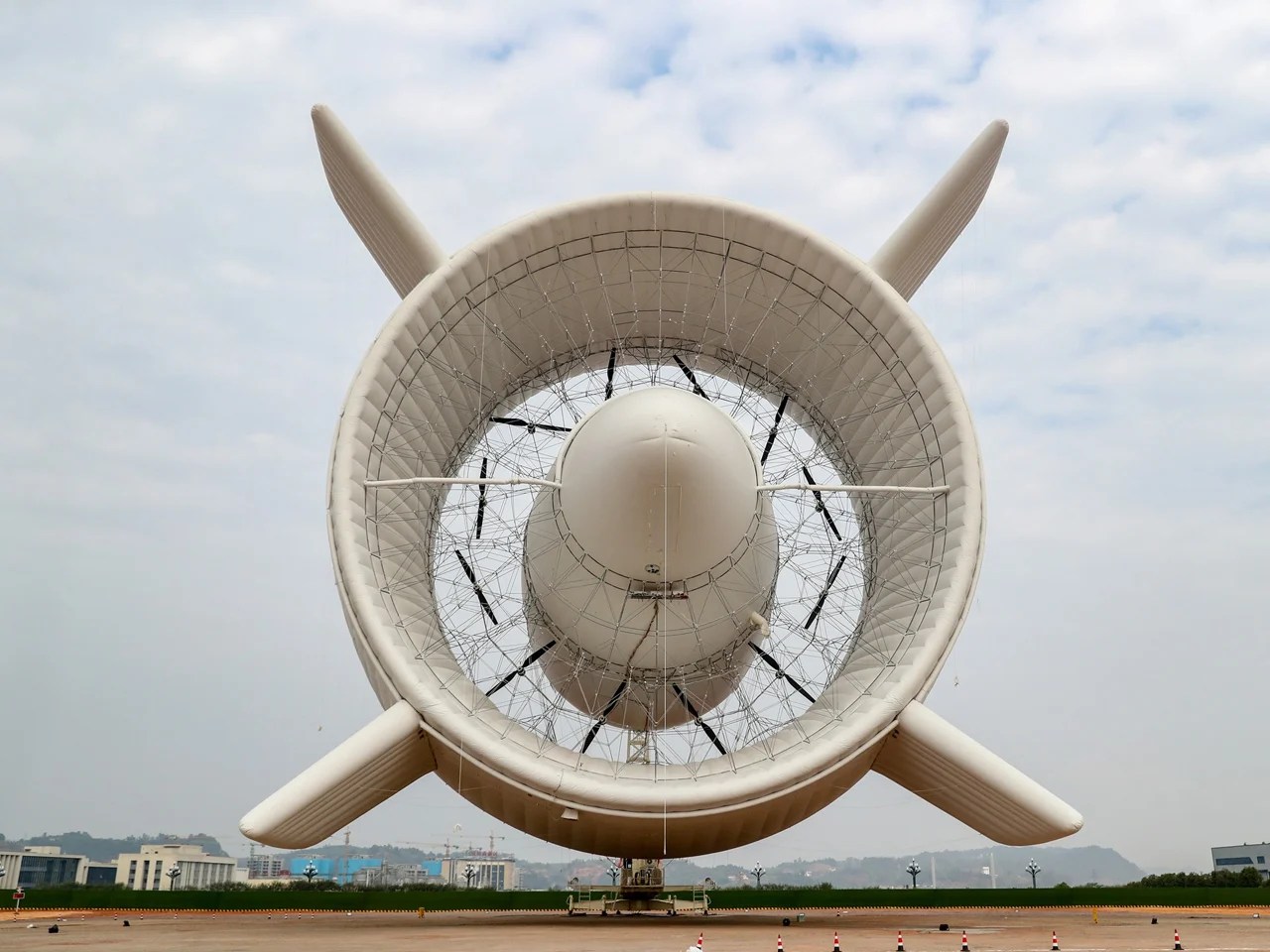
The name might be a bit ambitious, since its 2000 m test flight is only one tenth of the way to the stratosphere, but Yibin isn’t a bad choice for testing: as it is well inland, the S2000 prototype won’t have to contend with typhoons or other ocean storms. The prototype is arguably as ambitious as the name: its 12 flying turbines have a peak capacity of three megawatts. True, there are larger turbines in wind farms right now, but at 60 m in length and 40 m in diameter, the S2000 has a lot of room to grow before hitting any kind of limit or even record for aerostats. We’re particularly interested in the double-hull construction– it would seem the ring of the outer gas bag would do a good job funneling and accelerating air into those turbines, but we’d love to see some wind tunnel testing or even CFD renderings of what’s going on in there.
A rear view shows the 12 turbines inside the double hull. It should guide air into the gap, but we wonder how much turbulence the trusses in there are making.
During its first test flight in January 2026, the system generated generated 385 kilowatt-hours of electricity over the course of 30 minutes. That means it averaged about 25% capacity for the test, which is a good safe start. Doubtless the engineers have a full suite of test flights planned to demonstrate the endurance and power production capabilities of this prototype. Longer flights at higher capacity may have already happened by the time you read this.
Flying wind turbines isn’t a new idea by any means; a few years ago we featured this homemade kite generator, and the pros have been in on it too. Using helium instead represents an interesting design choice–on the plus side, its probably easier to control, and obviously allowing large structures, but the downside is the added cost of the gas. It will be interesting to see how it develops.
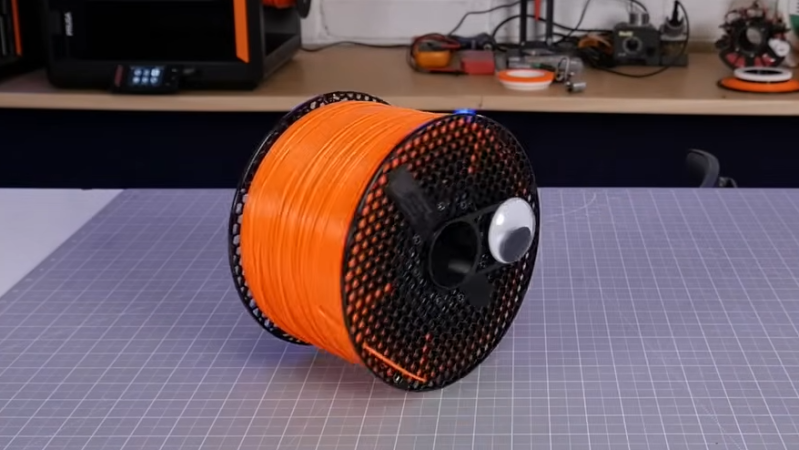
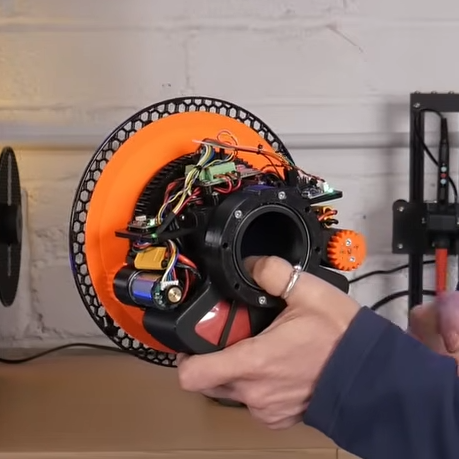
[Matt Denton]’s SpoolBot is a surprisingly agile remote-controlled robot that doesn’t just repurpose filament spool leftovers. It looks exactly like a 2 kg spool of filament; that’s real filament wound around the outside of the drum. In fact, Spoolie the SpoolBot looks so much like the real thing that [Matt] designed a googly-eye add-on, because the robot is so easily misplaced.
The robot’s mass rotates around a central hub in order to move forward or back.
SpoolBot works by rotating its mass around the central hub, which causes it to roll forward or back. Steering is accomplished by tank-style turning of the independent spool ends. While conceptually simple, quite a bit of work is necessary to ensure SpoolBot rolls true, and doesn’t loop itself around inside the shell during maneuvers. Doing that means sensors, and software work.
To that end, a couple of rotary encoders complement the gearmotors and an IMU takes care of overall positional sensing while an ESP32 runs the show. The power supply uses NiMH battery packs, in part for their added weight. Since SpoolBot works by shifting its internal mass, heavier batteries are more effective.
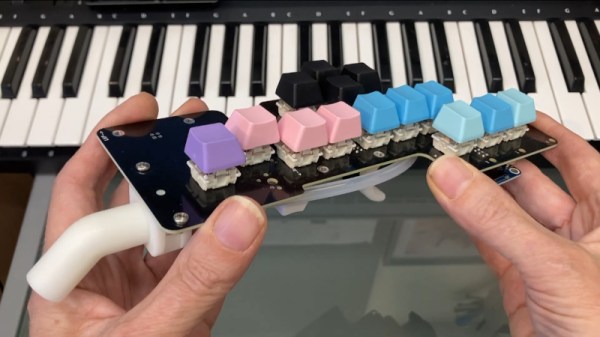
The receiver is a standard RC PWM receiver which means any RC transmitter can be used, but [Matt] shows off a slick one-handed model that not only works well with SpoolBot but tucks neatly into the middle of the spool for storage. Just in case SpoolBot was not hard enough to spot among other filament rolls, we imagine.
The googly-eye add-on solves that, however. They clip to the central hub and so always show “forward” for the robot. They do add quite a bit of personality, as well as a visual indication of the internals’ position relative to the outside.
The GitHub repository and Printables page have all the design files, and the video (embedded just below) shows every piece of the internals.
The kind of hardware available nowadays makes self-balancing devices much more practical and accessible than they ever have been. Really, SpoolBot has quite a lot in common with other self-balancing robots and self-balancing electric vehicles (which are really just larger, ridable self-balancing robots) so there’s plenty of room for experimentation no matter one’s budget or skill level.
The project consists of a small board full of old-school ICs that can be used to drive WS2812Bs in a simplistic manner. A 74HC14 Schmitt trigger oscillator provides the necessary beat for this tune, generating an 800 kHz clock to keep everything in time and provide the longer pulse trains that represent logic one to a WS2812B. A phase-shifted AND gate generates the shorter pulses necessary to indicate logic zero. Meanwhile, a binary counter cycles through 24 bits (8 per R, G, and B) to handle color. Pressing each one of the three push-buttons allows each color channel to be activated or deactivated as desired. It can make the strip red, green, or blue, or combine the channels if you press multiple buttons at once. That’s all the control you get—it would take a bit more logic to enable variable levels of each channel. Certainly within the realms of possibility, though.
We’ve featured some other nifty tricks for driving WS2812Bs in unconventional ways, like using DMA hardware or even I2S audio outputs. If you’ve got your own tricks, don’t hesitate to notify the tipsline.
The Haxophone is an open source MIDI saxophone project that has achieved some popularity. It’s caught the attention of [Shieladixon] not because she is a saxophonist but because she plays the recorder and is dissatisfied with existing MIDI recorder peripherals. She’s set about modifying the device to produce the Haxocorder, a better MIDI recorder.
The video below the break is the third of a series, of which part one and part two deal with the Haxophone and the shortcomings of her existing recorder peripheral. She’s replacing the Pi Zero of the Haxophone with a Pi Pico in a Zero form factor, and simplifying its design significantly to remove unnecessary features. The result is a versatile instrument capable at a touch of becoming the full range of recorders, which she demonstrates with some nifty duet work.
The upstream Haxophone project can be found here if you are interested, and we hope she follows this up with a release of her mods to make the Haxocorder. Meanwhile if you feel you might have seen her work before, she’s the brains behind the MIDISID.
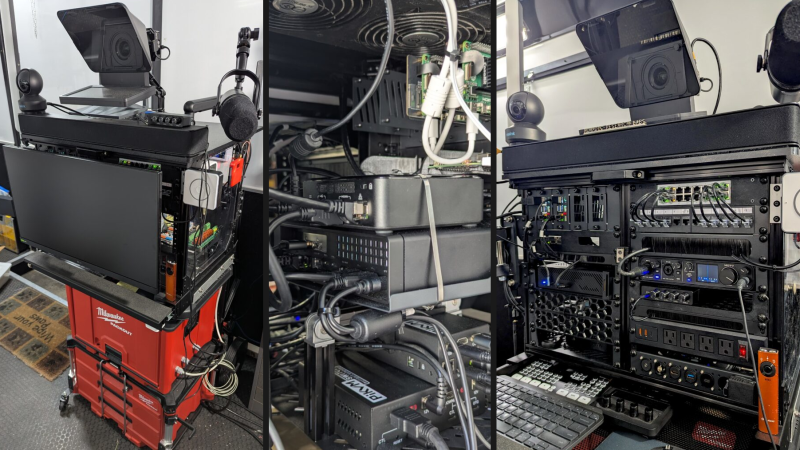
[Steven K. Roberts] is the original digital nomad, having designed and built mobile computing for his own use since the 80s. His latest project is Bionode, a portable computing lab built into a hand truck that can accommodate a wide spectrum of needs for a person on the go.
Far more than just a portable computer with wheels and a handle, Bionode is an integrated collection of systems with power management, a sensor suite, multiple computers, NAS for storage, networking, video production tools, and even the ability to be solar charged. [Steven] also uses a laptop, and Bionode complements it by being everything else.
If one truly wishes to be mobile and modular as well as effective, then size and weight begins to be just as important as usability. Everything in Bionode has a purpose, and it currently contains a PC with GPU for local AI and machine learning work, a NAS with 14 TB of storage, an Ubuntu machine, a Raspberry Pi 5 running Home Assistant, another Raspberry Pi 5 for development work, a Raspberry Pi 3 for running his 3D printer, and a Raspberry Pi 4 for SDR (software-defined radio) work. A smart KVM means a single keyboard, mouse, and display can be shared among machines as needed and additional hardware in a thoughtful layout makes audio and video projects workable. Everything is integrated with sensors and Home Assistant with local AI monitoring, which [Steven] likes to think of as the unit’s nervous system.
Bionode is therefore more than just a collection of computers crammed into a hand truck; it’s a carefully-selected array of hardware that provides whatever [Steven] needs.
Give it a look if you want to see what such a system looks like when it’s been designed and assembled by someone who’s “been there, done that” when it comes to mobile computing. Bionode would complement something like a mobile workshop quite nicely; something [Steven] has also done before.
In theory having a single device that combines the features of multiple dedicated devices is a great idea, saving a lot of space, time and money. However, in reality it mostly means that these features now conflict with each other, force us to deal with more complex devices that don’t last nearly as long, and become veritable vampires for your precious attention.
Whereas in the olden days a phone was just used for phone calls, now it’s also a video and photo camera, multimedia computer, pager, and more, but at any point an incoming phone call can interrupt what you are doing. There’s also always the temptation of doom scrolling on one of the infinite ‘social media’ apps. Even appliances like televisions and refrigerators are like that now, adding ‘smarts’ that also vie for your attention, whether it’s with advertisements, notifications, or worse.
Meanwhile trying to simply do some writing work on your PC is a battle against easy distractions, leading people to flee to the digital equivalent of typewriters out of sheer desperation. Similarly, we increasingly see ‘dumb’ phones, and other single-task devices making a comeback, both as commercial options and as DIY projects by the community.
Are we seeing the end of the ‘everything device’ and the return to a more simple time?