Simple Devices Protecting Our Water System

We are all used to turning on the faucet and having clean, drinkable water on demand. But think about what happens afterwards in your home: that water is used to wash dishes or water lawns and many other uses that render it undrinkable. What stops this nasty water from flowing back into your pipes and out of your kitchen faucet? A backflow preventer. This simple, but vital, part of your plumbing turns your water pipes into one-way systems that give out clean, drinkable water. This isn’t just about making your water taste nice: backflow preventers protect your water supply from things like brain-eating amoeba and E Coli that could kill.

Continue reading “Simple Devices Protecting Our Water System”

Hackaday Dictionary: The Global Positioning System (GPS)

One of the fundamental technologies of modern gadgets is the Global Positioning System (GPS). Using signals from satellites orbiting the earth, a GPS receiver can pin down its location with remarkable accuracy: the latest generation of Civilian Navigation Signals (CNAV) sent by the US GPS system has an accuracy of less than half a meter (about 3 feet). These signals also contain the time, accurate to within milliseconds, which makes it perfect for off-line dataloggers and systems that require very accurate timing. That’s a powerful combination that has made GPS one of the main technologies behind the mobile revolution, because it lets gadgets know where (and when) they are.

Continue reading “Hackaday Dictionary: The Global Positioning System (GPS)”

IndieGoGo Project Offers DNA Editing For The Home

CRISPR is the new darling of the genetics world, because it allows you to easily edit DNA. It is far more effective than previous techniques, being both precise and relatively easy to use. According to this IndieGoGo project, it is coming to your home lab soon. Genetic researchers love Clustered Regularly Interspaced Short Palindromic Repeats (CRISPR) because it allows you to very precisely edit a DNA strand. Using a protein called CAS9, CRISPR can find a very specific sequence in a DNA sequence and cut it. It occurs naturally in cells as part of the immune system: by finding and remembering parts of virus DNA, a cell can recognize and attack it when infected. For the genetics researcher, this allows them to insert new DNA sequences at specific points in the genes of any living cell.

Continue reading “IndieGoGo Project Offers DNA Editing For The Home”

Fail Of The Week: OpenMV Kickstarter Project Hits Manufacturing Snag

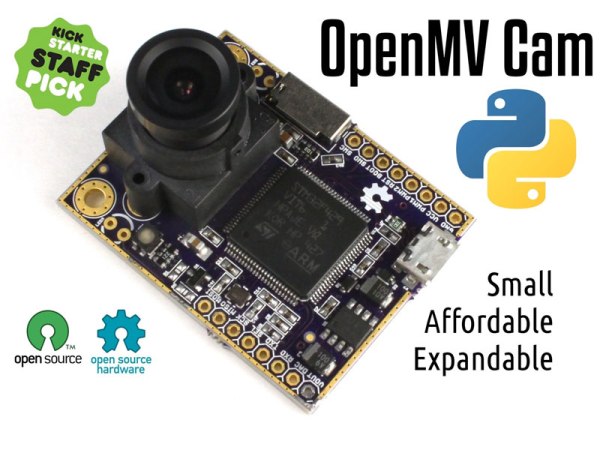
Making stuff is hard, especially when you are making lots of stuff. The OpenMV Cam project knows this, because it has hit a problem while putting together their cheap machine vision module. The problem is with the BGA solder balls that connect the image sensor to the main board.

openmv-thumbWe’ve covered this intriguing project before: the aim is to build a small, cheap module that can run image processing algorithms to easily give robots sight. The sensor is a Ball Grid Array (BGA) package, which means there are a grid of small solder balls on the back that form the electrical connections. It seems that some of these solder balls are oxidized, preventing them from melting and fusing properly with the board. This is called a head-in-pillow defect, because the ball behaves like your head when you lie down in bed. Your head squishes the pillow, but doesn’t merge into it. There are 38 balls on the OV26040 image sensor and even a single bad link means a failure.

The makers of the project have tried a number of solutions, but it seems that they may have to remake the ball links on the back of each sensor. That’s an expensive process: they say it will cost $7 for each, more than the actual sensor cost initially.

A few people have been posting suggestions in the comments for the project, including using solvents and changing the way the sensors are processed before mounting. We’d like to see them overcome this hurdle. Anybody have any suggestions to quickly and cost effectively move the manufacturing process forward?

Continue reading “Fail Of The Week: OpenMV Kickstarter Project Hits Manufacturing Snag”

Automatic Cat Feeder Dispenses Noms, Wants Cheezburger

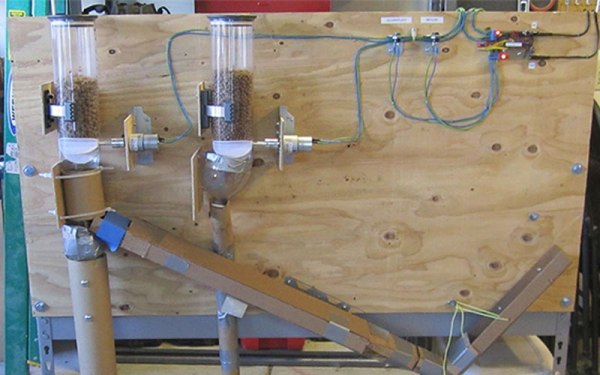
[Domiflichi] likes his cats, but not the drudgery of feeding them. So, like any good engineer, this simple problem became his next project: building an automatic cat feeder. Based on an Arduino, his creation beeps to let the cats know that it is dinnertime, then dispenses food into a number of bowls. There are also buttons for manual control. This lets him give individual cats a separate feeding. Rounding out the feature set, a DS1307 RTC tracks the feeding times.

One of the most interesting parts of his build is the transfer from breadboard to protoboard. This usually involves taking apart a working version, then putting it back together and trying to figure out why it doesn’t work anymore. [Domiflichi]’s problem (detailed in a follow-up post) was figuring out how to program the real-time clock module to set the time, because it looses the time when you disconnect the power. Rather than use the Arduino to program the RTC,  he used the battery backup feature of the RTC chip, programming it on his computer and then soldering it onto the board. He went on to remove the backup battery after the chip was in place. That’s a solution that will no doubt have many readers waving their fingers disapprovingly, but it worked.

It may seem overly complicated, but his project is worth checking out to see how he approached some of the engineering challenges. The food hoppers themselves are off-the-shelf cereal dispensers. We’ve seen other designs bootstrap this mechanism with 3D printed augers.

Continue reading “Automatic Cat Feeder Dispenses Noms, Wants Cheezburger”

Microsoft Surface Book Teardown Reveals Muscle Wire Mechanism

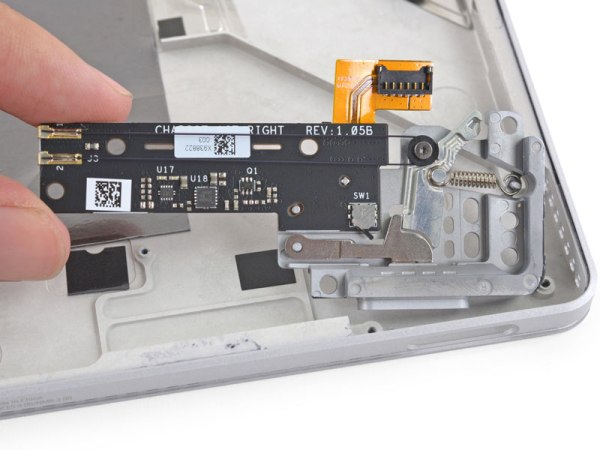
It’s hard to resist the temptation to tear apart a shiny new gadget, but fortunately, iFixIt often does it for us. This helps to keep our credit cards safe, and reveal the inner workings of new stuff. That is definitely the case with the Microsoft Surface Book teardown that they have just published. Apart from revealing that it is pretty much impossible to repair yourself, the teardown reveals the mechanism for the innovative hinge and lock mechanism. The lock that keeps the tablet part in place when in laptop mode is held in place by a spring, with the mechanism being unlocked by a piece of muscle wire.

We are no strangers to muscle wire (AKA Nitinol wire or Shape Metal Alloy, as it is sometimes called) here: we have posted on its use in making strange robots, robotic worms and walls that breathe. Whatever you call it, it is fun stuff. It is normally a flexible wire, but when you apply a voltage, it heats up and contracts, much like the muscles in your body. Remove the voltage, and the wire cools and reverts to its former shape. In the Microsoft Surface Book, a single loop of this wire is used to retract the lock mechanism, releasing the tablet part.

Unfortunately, the teardown doesn’t go into much detail on how the impressive hinge of the Surface Book works. We would like to see more detail on how Microsoft engineered this into the small space that it occupies. The Verge offered some details in a post at launch, but not much in the way of specifics beyond calling it an “articulated hinge”.

UPDATE: This post was edited to clarify the way that muscle wire works. 11/4/15.

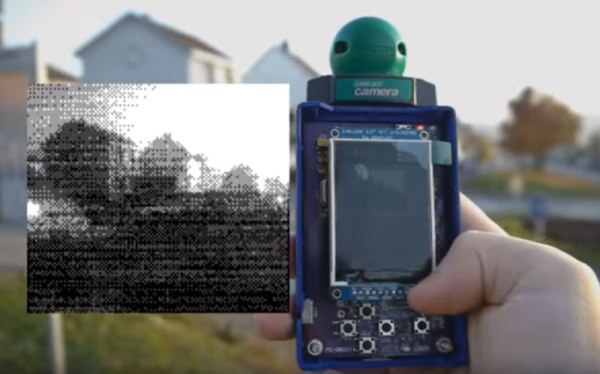
Gameboy Camera Becomes Camcorder

[Furrtek] is a person of odd pursuits, which mainly involve making old pieces of technology do strange things. That makes him a hero to us, and his latest project elevates this status: he built a device that turns the Nintendo Gameboy camera cartridge into a camcorder. His device replaces the Gameboy, capturing the images from the camera, displaying them on the screen and saving them to a micro SD card.

Before you throw out your cellphone or your 4K camcorder, bear in mind that the captured video is monochrome (with only 4 levels between white and black), at a resolution of 128 by 112 pixels and at about 14 frames per second. Sound is captured at 8192Hz, producing the same buzzy,  grainy sound that the Gameboy is famous for. Although it isn’t particularly practical, [Furrtek]s build is extremely impressive, built around an NXP LPC1343 ARM Cortex-M3 MCU processor. This processor repeatedly requests an image from the camera, receives the image and then collects the images and sound together to form the video and save it to the micro SD card. As always, [Furrtek] has made all of the source code and other files available for anyone who wants to try it out.

For those who aren’t familiar with his previous work, [Furrtek] has done things like making a Speak & Spell swear like a sailor, adding a VGA out to a Virtualboy, and hacking a Gameboy Color to control electronic shelf labels.

Continue reading “Gameboy Camera Becomes Camcorder”