OpenThread, A Solution To The WiFi Of Things

The term ‘Internet of Things’ was coined in 1999, long before every laptop had WiFi and every Starbucks provided Internet for the latte-sucking masses. Over time, the Internet of Things meant all these devices would connect over WiFi. Why, no one has any idea. WiFi is terrible for a network of Things – it requires too much power, the range isn’t great, it’s beyond overkill, and there’s already too many machines and routers on WiFi networks, anyway.

There have been a number of solutions to this problem of a WiFi of Things over the years, but none have caught on. Now, finally, there may be a solution. Nest, in cooperation with ARM, Atmel, dialog, Qualcomm, and TI have released OpenThread, an Open Source implementation of the Thread networking protocol.

The physical layer for OpenThread is 802.15.4, the same layer ZigBee is based on. Unlike ZigBee, the fourth, fifth, and sixth layers of OpenThread look much more like the rest of the Internet. OpenThread features IPv6 and 6LoWPAN, true mesh networking, and requires only a software update to existing 802.15.4 radios.

OpenThread is OS and platform agnostic, and interfacing different radios should be relatively easy with an abstraction layer. Radios and networking were always the problem with the Internet of Things, and with OpenThread – and especially the companies supporting it – these problems might not be much longer.


Hackaday Prize Entry: Raspberry Pi Zeros And Drones

How do you get eyeballs on a blog post? Put Raspberry Pi Zero in the headline. How do you get even more eyeballs? Put the word drone in there too. Lucky for us, there’s one very special project in the Hackaday Prize that combines both. It’s the Pi0drone from [Victor], and it’s exactly what it looks like: a flying Raspberry Pi Zero.

[Victor] has been working on the PXFmini, a ‘shield’ or ‘hat’ for the Raspberry Pi that integrates a barometer, IMU, and a few PWM outputs into a very small form factor that is just a shade larger than the Raspberry Pi Zero itself. It comes with standard connector ports for UART and I2C to attach GPS and on screen display for FPV flying.

Of course, there are dozens of flight controllers for drones and quads out there, but very few are running Linux, and even fewer platforms are as well supported as the Raspberry Pi. To leverage this, [Victor] is running Dronecode on the Pi for mission planning, real autopilot, and everything else that turns a remote controlled quadcopter into a proper drone. It works, and it’s flying, and you can check out the video proof below.

Continue reading “Hackaday Prize Entry: Raspberry Pi Zeros And Drones”

Hackaday Links: May 29, 2016

Hackaday has a store‽ Yes, it’s true, and we have a Memorial Day sale going on right now. Get a cool robot had t-shirt, a cool clock, or a GoodFET. Spend money. Consume.

[fbustamante] got his hands on an old GP2X Wiz, one of those ARM-based portable media player/emulator things from a few years ago. This is a complete computer, and like the Pandora, it’ll do everything one of those Raspberry Pi laptops can do. The Wiz doesn’t have a keyboard, so [fbustamante] created his own. He etched his own PC, repurposed a keyboard controller from a USB keyboard, and stole the keycaps from an old Sharp digital organizer.

Speaking of portable consoles, [Element18592] built this incredible Nintendo 64 portable. He’s done an XBox 360 laptop and stuffed a Pi into an old brick Game Boy. This N64 mod is great, uses a 3D printed enclosure, and has truly amazing vinyl graphics.

To the surprise of many, [Photonicinduction] is not dead. The drunk brit with a penchant for high voltage electrics and a very, very confused power company is back making videos again. His latest video is a puzzle. It’s a plastic block with a light bulb socket, a UK power outlet, and a switch. Plug in a light bulb, flip the switch, and it turns on. Plug a blender into the outlet, and that turns on too. No wires, so how is he doing it?

Introduced at CES last January, Monoprice – yes, the same place you get HDMI and Ethernet cables from – has released their $200 3D printer. This one is on our radar and there will be a review, but right away the specs are fantastic for a $200 printer. The build area is 120mm³, it has a heated bed, and appears to be not completely locked down like the DaVinci printers were a few years ago.

Hackaday Prize Entry: Adding HDMI To Small Displays

LCDs come in a lot of sizes, and there’s a lot written about pushing pixel data out to larger displays. Smaller LCDs, like the 4, 5 and 7 inch variety, aren’t used much, because no one seems to know how to drive the things. For [Joe]’s Hackaday Prize Entry, he’s creating an open source interface for tiny LCDs, making it easy and cheap to add one to everything with an HDMI port.

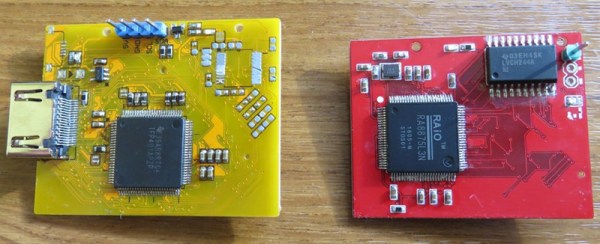
[Joe]’s Open LCD Interface comes on two boards, with the first providing connections to an LCD, all the power circuitry required, and a bunch of pads to break out every IO line. The second part of the puzzle is a decoder that takes HDMI signals and drives a small LCD.

HDMI decoders are nothing new to the world of hobby electronics – there are multiple projects that give the BeagleBoard a display through HDMI. Even Adafruit sells one of these converters. [Joe]’s board has another trick up its sleeve, though: it can give any microcontroller a high-resolution display, too.

There’s another module that connects to [Joe]’s breakout board that turns the LCD into an SPI display. This means any microcontroller can drive a high-resolution display. It’s fast, too: in the video below, [Joe]’s SPI display can push pixels at least as fast as any other microcontroller-based display we’ve seen.

It’s a great project, and a by opening up the doors to millions of cheap LCDs on eBay and Alibaba, [Joe] has a great entry for the Hackaday Prize on his hands.

Continue reading “Hackaday Prize Entry: Adding HDMI To Small Displays”

Hamvention: The Flea Market

Last weekend was Hamvention, the place you want to be on the third weekend in May. It is the world’s largest gathering of amateur radio enthusiasts, and an exceedingly large flea market containing all sorts of electronica.

The booths of Hamvention include a few notable Open Hardware folk, but for the most part, you’re looking a few big booths from Yaesu, an entire section dedicated to everything ARRL, and a few pop-ups from the usual suspects. Rigol was there, showing off their test equipment and selling the DS1052E oscilloscope for far more than it’s worth. The Rigol Zed is a much better buy, anyway.

As with any gathering of hams, antennas are everywhere. The largest by far was the tower at right. With a little more equipment, this antenna could do a moon bounce. It’s a shame the moon was full this weekend, and everyone went to bed early.

Giant antennas and an amateur radio trade show notwithstanding, the biggest draw is the flea market. You’re looking at about two football fields worth of parking spaces, filled with cars, tents, and collapsible tables and the strangest electronic devices you’ve ever seen. What was that like? Read on below.

Continue reading “Hamvention: The Flea Market”

The Booths Of Hamvention

Hamvention was last weekend in Dayton, Ohio. Last weekend was also the Bay Area Maker Faire, and if you want tens of thousands of people who actually make stuff there’s really only one place to be. Bonus: you can also check out the US Air Force Museum at Wright-Patterson AFB. The ‘Space’ hangar was closed, so that’ll be another trip next year.

The biggest draw for Hamvention is the swap meet. Every year, thousands of cars pull up, set up a few tables and tents, and hock their wares. Everything from radios from the 1920s to computers from the 1980s can be found at the swap meet. This post is not about the swap meet; I still have several hundred pictures to go through, organize, label, and upload. Instead, this post is about the booths of Hamvention. Everything imaginable could be found at Hamvention, from the usual ARRL folks, to the preppers selling expired MREs, and even a few heros of Open Hardware.

Continue reading “The Booths Of Hamvention”

The SEC Has A Thing For Crowdfunding

Kickstarter is not a store. Indiegogo is not a store. No matter what crowdfunding platform you’re on, you’re not in a store. This is an undeniable truth, and no matter how angry you are about not being able to bring a cooler with a blender to the beach this summer, you did not buy this cool cooler, you were merely giving someone money to develop this cooler.

This reality may seem strange for the most vocal Internet commenters out there, leading them to the conclusion their pledge for a crowdfunding campaign was an investment. Surely there must be some guarantee in a single pledge, and if it’s not exchanging money for some consumer goods, it is exchanging money for a stake in a company. If that were true, backers of the Oculus Rift would have received several thousand dollars each, instead of a $600 VR headset.

Crowdfunding is not a store, and according to Kickstarter and Indiegogo, it is not an investment, either. Last week, the Securities and Exchange Commission’s rules for “crowdfunded investing”, “Regulation Crowdfunding”, or “Title III Crowdfunding” kicked into gear. Is this the beginning of slack-jawed gawkers throwing their life savings into a pit of despair filled with idiotic consumer products that violate the laws of physics?

Continue reading “The SEC Has A Thing For Crowdfunding”