Hackaday Prize Entry: Worldwide Educational Infrastructure

The future of education is STEM, and for the next generation to be fitter, happier, and more productive, classrooms around the world must start teaching programming, computer engineering, science, maths, and electronics to grade school students. In industrialized countries, this isn’t a problem: they have enough money for iPads, Chromebooks, and a fast Internet connection. For developing economies? That problem is a little harder to solve. Children in these countries go to school, but there are no racks of iPads, no computers, and even electricity isn’t a given. To solve this problem, [Eric] has created a portable classroom for his entry into this year’s Hackaday Prize.

Classrooms don’t need much, but the best education will invariably need computers and the Internet. Simply by the virtue of Wikipedia, a connection to the Internet multiplies the efforts of any teacher, and is perhaps the best investment anyone can make in the education of a child. This was the idea behind the One Laptop Per Child project a decade ago, but since then, ARM boards running Linux have become incredibly cheap, and we’re getting to a point where cheap Internet everywhere is a real possibility.

To build this portable classroom, [Eric] is relying on the Raspberry Pi. Yes, there are cheaper options, but the Pi is good enough. A connection to online resources is required, and for that [Eric] is turning to the Outernet. It’s a system that will broadcast educational material down from orbit, using ground stations made from cheap and portable KU band satellite dishes and cheap receivers.

When it comes to educational resources for very rural communities, the options are limited. With [Eric]’s project, the possibilities for educating students on the basics of living in the modern world become much easier, and makes for a great entry into this year’s Hackaday Prize.

Continue reading “Hackaday Prize Entry: Worldwide Educational Infrastructure”

The Man Who Didn’t Invent The Personal Computer

[John Blankenbaker] did not invent the personal computer. Museums, computer historians, and authors have other realities in mind when they say [John]’s invention, the KENBAK-1, was the first electronic, commercially available computer that was not a kit, and available to the general population.

In a way, it’s almost to the KENBAK’s detriment that it is labelled the first personal computer. It was, after all, a computer from before the age of the microprocessor. It is possibly the simplest machine ever sold and an architecturally unique machine that has more in common with the ENIAC than any other machine built in the last thirty years..

The story of the creation of this ancient computer has never been told until now. [John], a surprisingly spry octogenarian, told the story of his career and the development of the first personal computer at the Vintage Computer Festival East last month. This is his story of not inventing the personal computer.

Continue reading “The Man Who Didn’t Invent The Personal Computer”

Hackaday Prize Entry: Sniffing Defibrillator Data

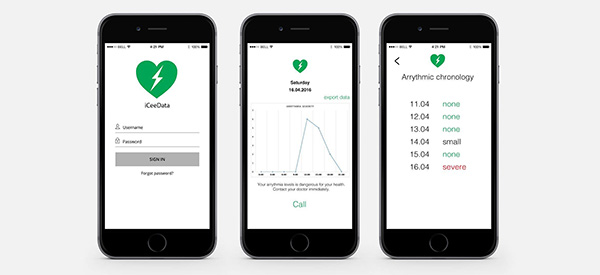
There’s a lot of implantable medical technology that is effectively a black box. Insulin pumps monitor blood sugar and deliver insulin, but you can’t exactly plug in a USB cable and download the data. Pacemakers and cardiac defibrillators are the same way. For these patients, data is usually transmitted to a base station, then sent over the Internet to help doctors make decisions. The patient never gets to see this data, but with a little work and a software defined radio, a team on Hackaday.io is cracking the code to listen in on these implanted medical devices.

The team behind ICeeData was assembled at a Health Tech Hackathon held in Latvia last April. One of the team members has an implanted defibrillator keeping her ticker in shape, and brought along her implant’s base station. The implant communicates via 402-405MHz radio, a region of the spectrum that is easily accessible by a cheap RTL-SDR TV Tuner dongle.

Right now the plan is to intercept the communications between the implant and the base station, decode the packets, decipher the protocol, and understand what the data means. It’s a classic reverse engineering task that would be the same for any radio protocol, only with this ones, the transmissions are coming from inside a human.


The HackadayPrize2016 is Sponsored by:

Hackaday Links: May 22, 2016

Lulzbot’s TAZ 6 has been released. Lulzbot’s printers consistently place in the top three of any 3D printing list, and the TAZ 6 will likely be no exception. [James Bruton] was one of the lucky ones who got a review unit, and first looks are promising. The TAZ 6 has the auto bed leveling found in the Lulzbot Mini, and a ‘power tower’ for all the electronics. There are completely unconfirmed rumors (or someone told me and I forgot who) that the power tower will be available separately at some point.

The most impressive circuit we’ve seen this week month year is the dis-integrated 6502. It’s a discrete 6502 CPU, about a square foot in size. It’s slow, but it works. RAM and ROM is easy to make embiggened, which means someone needs to build a dis-integrated 6522 VIA. Who’s game?

[Jeremy Cook] wanted to learn another CAD package, in this case Onshape. Onshape is the ‘first cloud-only CAD package’, which has one huge bonus – you can run it anywhere, on anything – and one huge minus – it’s in the cloud. He designed a bicycle cupholder.

Last week, several thousand Raspberry Pi Zeros shipped out to retailers in the US and UK. For a time, Pi Zeros were in stock in some online stores. Now? Not so much. Where did they all go? eBay, apparently. It’s called arbitrage, and it’s the only risk-free form of investment.

Remember those ‘bed of nails’ toys, that were basically two sheets of plastic, with hundreds of small pins able to make 3D impressions of your face and hands. No, there is no official name for these devices, but here’s a Kickstarter for a very clever application of these toys. You can use them to hold through hole parts while soldering. Brilliant.

You should not pay attention to 3D printers on Kickstarter. Repeat after me: you should not give money to 3D printers on Kickstarter. Here’s a 3D printer on Kickstarter, promising a 3D printer for $74. I own several hats, and will eat one if this ships by next year.

Remember bash.org? It’s being reimplemented on hackaday.io.

BeagleBone Green, Now Wireless

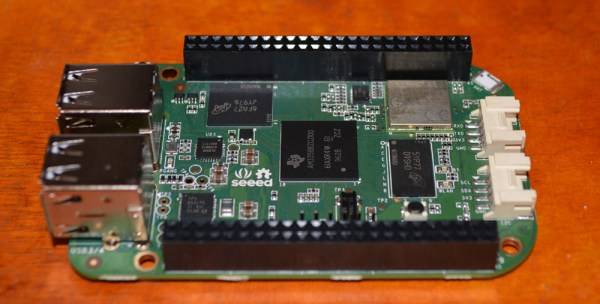
Over the past few years, the BeagleBone ecosystem has grown from the original BeagleBone White, followed two years later by the BeagleBone Black. The Black was the killer board of the BeagleBone family, and for a time wasn’t available anywhere at any price. TI has been kind to the SoC used in the BeagleBone, leading to last year’s release of the BeagleBone Green, The robotics-focused BeagleBone Blue, and the very recent announcement of a BeagleBone on a chip. All these boards have about the same capabilities, targeted towards different use cases; the BeagleBone on a Chip is a single module that can be dropped into an Eagle schematic. The BeagleBone Green is meant to be the low-cost that plays nicely with Seeed Studio’s Grove connectors. They’re all variations on a theme, and until now, wireless hasn’t been a built-in option.

This weekend at Maker Faire, Seeed Studio is showing off their latest edition of the BeagleBone Green. It’s the BeagleBone Green Wireless, and includes 802.11 b/g/n, and Bluetooth 4.1 LE.

Continue reading “BeagleBone Green, Now Wireless”

Hackaday Prize Entry: Internets Of Energy

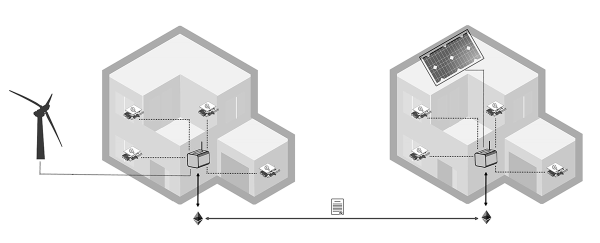
More and more, the power grid is distributed. Houses have solar panels on their roofs, and where possible, that excess power is sold back to the grid. The current trend is towards smart meters that record consumption for an entire household and relay it back to the power plant every day or so. The future is decentralized, through, and a meter that is smart once a day simply won’t do. A team on Hackaday.io has put together the ultimate in decentralized energy modernization. It’s the InternetS of Energy, and it removes the need for power companies completely.

The team has identified a few key features of the current power grid that don’t make sense in the age of the Internet. The power company doesn’t have extremely granular data, and sending power over long distances is either inefficient or expensive. The solution for this is to have distributed power plants, all connected together into a truly intelligent power grid.

This InternetS of Energy uses open-source energy monitoring systems running the Ethereum client to push power-usage data onto the blockchain. This makes the grid secure and pseudonymous, and if the banking industry is any indication, something like this is the future of economic transactions.

While it may not be the best solution for mature power grids, it is an extremely interesting avenue of research for developing nations. Wherever local resources allow it, electricity can be generated and sent to where it’s needed. It’s exactly what the power grid would be if it were re-designed today from scratch, and an excellent candidate for the 2016 Hackaday Prize.

The HackadayPrize2016 is Sponsored by:

Hackaday Prize Entry: Harmonicas, Candy, And Van Halen

Watch enough How It’s Made, and you’ll soon become very enthusiastic about computer vision and compressed air. In factories all around the world, production lines automatically sort the wheat from the chaff by running a product underneath a camera and blowing defective product off the line.

For his Hackaday Prize entry, [Fabien] is attempting this same task. He’s building a machine that will rapidly sort candy with computer vision and precisely controlled jets of air. He’s also planning for the Van Halen reunion and building a CNC harmonica.

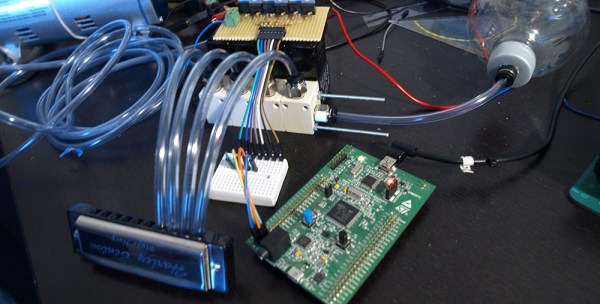
Right now, the design has a hopper full of M&Ms dropping through a channel where a camera looks at each individual piece of candy. A Raspberry Pi, camera, and OpenMV detect all the red, yellow, brown, and blue M&Ms, and send that information to a computer controlling a suite of pneumatic valves. When these valves open, candy of different colors is shuffled off into it’s own bin. It’s the perfect device for someone responsible for reading Van Halen’s rider.

In an interesting little side project, [Fabien] needed a way to test the pneumatic valves before building the color sensor and candy chute. He had a harmonica lying around, and built something we’re surprised we’ve never seen before. It’s a CNC harmonica, capable of belting out a few tunes. You can check out that testing video after the break.

Continue reading “Hackaday Prize Entry: Harmonicas, Candy, And Van Halen”