The Raspberry Pi Model B+ Is Here (Again!)

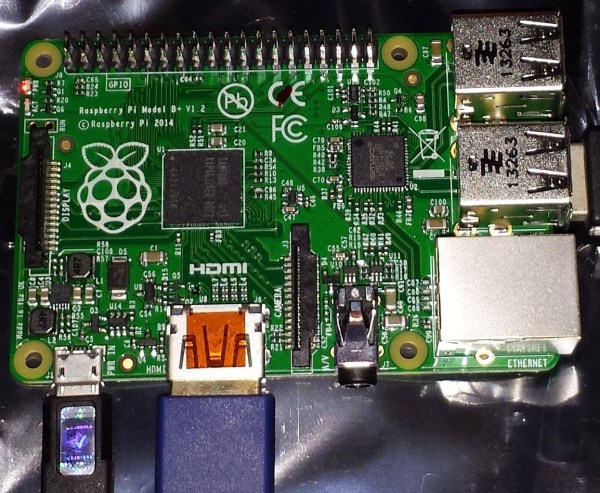
Depending on who you believe, yesterday someone either broke an NDA or was the lucky recipient of an Element 14 shipping error. Nevertheless, we were lucky enough to get a glimpse at the new Raspberry Pi Model B+. Today, everything is live, and Adafruit has a great teardown of what’s new, what’s changed, and what’s completely different in this new board.

The biggest question about this new Pi was the CPU: the Broadcom SoC in the models A and B are looking a little long in the tooth right now, and an upgraded CPU would be a very, very welcome addition. There is no change. This is the same 700 MHz Broadcom chip with 512MB of RAM. There will not be a ‘magical, because you’re awesome’ RAM upgrade the original Model B saw early in production, either – there simply aren’t enough address pins in the SoC.

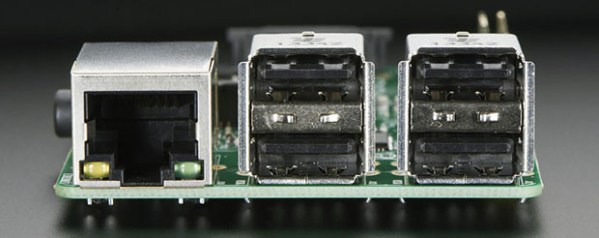
Despite not having an upgraded CPU, there are some neat features that addressed the complaints of the original Pi: The standard sized SD card socket is replaced with a microSD card socket that won’t stick out over the edge of the board. The ports are rearranged, with the analog video out on a TRRS plug with the audio. There are now four USB ports and an Ethernet port thanks to this chip, and mounting holes galore: they’re M2.5 holes in a square 58mm wide and 49mm high. Also included in the B+ is a completely redesigned power supply – the jumbo linear regulator is gone, replaced with an all-around better power supply.

The biggest change for anyone looking making a project with the Pi is the expanded GPIO header. This is a 40 pin header, with the ‘top’ pins identical to the original 26 pin header. Yes, all your existing Pi plates/shields/whatevers will still work. The new pins on this header include nine more GPIO pins, the I2S pins for the Wolfson audio card, and a pair of pins for an ID EEPROM. Connections to an ID EEPROM have been a feature of the BeagleBone for a while now, and this will allow the Pi to configure the appropriate I/Os and kernel modules at boot, depending on what Pi Plates are attached.

The best part about this is the price – it’s the same as the OG Model B. Using the same case as you old Model A or B is out of the question, but that’s totally what Kickstarter is for, right? You might want to grab one of those, because this is probably going to be the form factor for the upgraded Raspberry Pi 2.0 that will probably be released in a year or two.


Hackaday Links: July 13, 2014

hackaday-links-chain

Don’t like sunglasses? Deal with it. They’re the pixeley, retro sunglasses from your favorite animated .GIFs, made real in laser cut acrylic. Points of interest include heat-bent frames made out of a single piece of acrylic.

Remember this really small FPGA board? The kickstarter is ending really soon and they’re upgrading it (for an additional $30) with a much better FPGA.

Sparkfun is now hosting the Internet of Things. They’re giving people a tiny bit of space to push data to, and you can also deploy your own server. That’s interesting, and you can expect us doing a full post on this soon.

Need waveforms? [Datanoise] is building a wavetable synthesizer, and he’s put all his waveforms online. Now if we could just get a look at the synth…

If you only have $20 to spend on a board, you’ll want to pick up at Teensy 3.1. [Karl] wrote some bare metal libraries for this awesome board, and while it’s not as extensive as the standard Arduino libs, it’s more than enough to get most projects off the ground. Included are UARTs, string manipulation tools, support for the periodic interval timers on the chip, and FAT and SD card support.

Introducing The Raspberry Pi B+

It looks like Element 14 screwed up a single shipment, because some lucky soul just received an unreleased model of Raspberry Pi. If you can believe the silkscreen, it’s called the Raspberry Pi Model B+, and while we have no idea what the chipset is, the layout and peripherals look pretty cool.

From the looks of it, this new board features four USB ports, a new, 40-pin GPIO header, and more screw holes that will allow you to secure this to anything. The analog video out is gone, and the SD card connector – a weak point of the original design – might be replaced with a microSD connector. Oh, every Raspi case that has ever been made? They won’t work.

Without booting this Raspi B+ there’s no way of knowing what the chipset is on this new board. The smart money is on the entire SOC being the same: basically, what you’re looking at is the same as a Raspberry Pi Model B, only with a few more ports.

There is no clue when these improved Raspis will be available, but the word “soon™” will probably appear on the Raspberry Pi blog shortly.

Thanks [John] for the tip.

EDIT: [feuerrot] is smarter than me and mirrored all the images in an imgur album.


Astronaut Or Astronot: Shipping Is Killing Us, Man

We’re busy trying to get everyone to vote for their favorite entries in The Hackaday Prize. To encourage this, last week we gave away a pretty nice oscilloscope to a random person on hackaday.io, only because they voted for their favorite projects. Generous, and the shipping to Brazil is going to murder us.

For this round, we are putting up a Bukito 3D printer on the line. To make things extra special, we’re doing this at a little shindig we’re holding at i3 in Detroit.

As you can see by the video above, we’re having a great time with great mead. Also, we just gave away a 3D printer. This is the guy. Send you congratulations to his profile. We’ll shoot you an email, [Damian]. Oh, we’re shipping to New Zealand this time.

The Electric Imp And An Easy Hackaday Prize Entry

impy

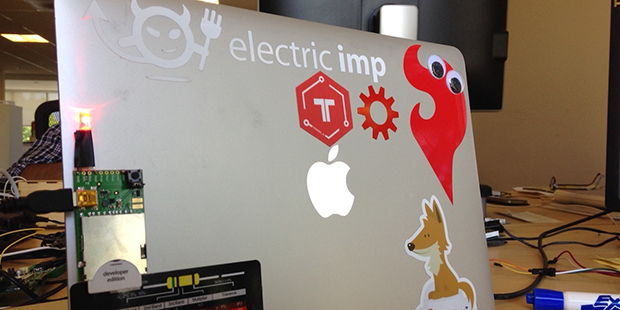
We’re a little under a month until the first cutoff date for The Hackaday Prize, and there have been a few questions we’ve been answering again and again: ‘what does ‘connected’ mean?’ and, ‘do I really have enough time to build something for The Hackaday Prize?’ Lucky for you, [Matt] from Electric Imp put together a very short demo of a sample THP entry. It’s a ‘HACKING’ light, kind of like an ‘on air’ light you’d find in a TV or Radio studio.

The idea for the project came from a tweet to [Matt] that seemed simple enough to implement. After grabbing an Imp and a breakout board, a LED, button, and resistor were wired up, with power supplied over USB. The code for the device was simple enough, and the Imp makes it easy to make that ‘hacking’ button tweet and serve a simple web page.

[Matt] pulled this project together in an afternoon, and although it’s not nearly as complex as the 3D printers, CNC machines, and freakin’ tricorders that are also entered into The Hackaday Prize, it meets all the requirements we’re looking for.

Of course, ‘connected’ is a very broad term, and even if you have a project that communicates with LEDs, a serial connection, or even pigeons, it’ll be more than enough to tick that ‘connected’ check box.

There’s still a few weeks until the first cutoff date for The Hackaday Prize, so get moving.

[via Bearded Inventor]

Homebrew NSA Bugs

NSA

Thanks to [Edward Snowden] we have a huge, publicly available catalog of the very, very interesting electronic eavesdropping tools the NSA uses. Everything from incredibly complex ARM/FPGA/Flash modules smaller than a penny to machines that can install backdoors in Windows systems from a distance of eight miles are available to the nation’s spooks, and now, the sufficiently equipped electronic hobbyist can build their own.

[GBPPR2] has been going through the NSA’s ANT catalog in recent months, building some of the simpler radio-based bugs. The bug linked to above goes by the codename LOUDAUTO, and it’s a relatively simple (and cheap) radar retro-reflector that allows anyone with the hardware to illuminate a simple circuit to get audio back.

Also on [GBPPR2]’s build list is RAGEMASTER, a device that fits inside a VGA cable and allows a single VGA color channel to be viewed remotely.

The basic principle behind both of these bugs is retroreflection, described by the NSA as a PHOTOANGLO device. The basic principle behind these devices is a FET in the bug, with an antenna connected to the drain. The PHOTOANGLO illuminates this antenna and the PWM signal sent to the gate of the FET modulates the returned signal. A bit of software defined radio on the receiving end, and you have your very own personal security administration.

It’s all very cool stuff, but there are some entries in the NSA catalog that don’t deal with radio at all. One device, IRATEMONK, installs a backdoor in hard drive controller chips. Interestingly, Hackaday favorite and current Hackaday Prize judge [Sprite_TM] did something extremely similar, only without, you know, being really sketchy about it.

While we don’t like the idea of anyone actually using these devices, the NSA ANT catalog is still fertile ground for project ideas.

Continue reading “Homebrew NSA Bugs”

A Simple Commodore 64 Cart Dumper

c64

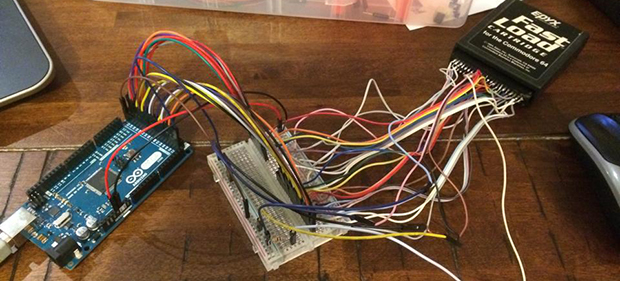
While [Rob] was digging around in his garage one day, he ran across an old Commodore 64 cartridge. With no ROM to be found online, he started wondering what was stored in this ancient device. Taking a peek at the bits stored in this cartridge would require dumping the entire thing to a modern computer, and armed with an Arduino, he created a simple cart dumper, capable of reading standard 8k cartridges without issue.

The expansion port for the C64 has a lot of pins corresponding to the control logic inside these old computers, but the only ones [Rob] were really interested in were the eight data lines and the sixteen address lines. With a little bit of code, [Rob] got an Arduino Mega to step through all the address pins and read the corresponding data at that location in memory. This data is then sent over USB to a C app that dumps everything in HEX and text.

While the ROM for just about every C64 game can be found online, [Rob] was unlucky enough to find one that wasn’t. It doesn’t really matter, though, as we don’t know if [Rob] has the 1541 disk drive that makes this cart useful. Still, it’s a good reminder of how useful an Arduino can be when used as an electronic swiss army knife.