The Homebrew XBox 360 And PS3 Portable

Cross

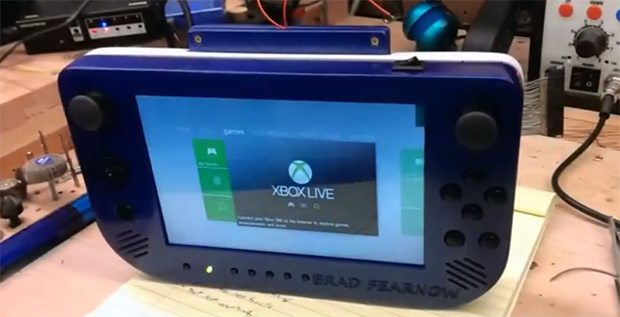
For the past few years now, [Downing] has been working on the dream of all console modders – a console made in the last ten years made portable. He’s spend a lot of time on the effort, and now thanks to a commission, he’s finally done it. Not just one console, either: this thing makes both the Xbox 360 and PS3 a handheld, battery-powered device thanks to some awesome wireless tech and a great deal of skill.

A few months ago, [Downing] and friends [Hailrazer] and [RDC] started a Kickstarter for the Cross Plane, a portable device that uses a wireless HDMI transmitter to offload the heavy and hot parts of running a game to a console, while the display and controls are kept portable. That Kickstarter didn’t see the success [Downing] was looking for, but that didn’t stop one enthusiastic supporter from commissioning a piece.

The display in the Cross Plane is a 7″ HD display, and the latency on the WHDMI transmitter is just about 1ms – basically unnoticeable. The controls on the front of the portable are wired to ‘controller packs’ that plug into the back, one for Xbox and one for PS3. The build quality is immaculate, and if you’ve ever wanted to know how to expertly finish a 3D printed part so it looks like it came off an assembly line, you should probably check out the build log.

Video walkthrough below.

Continue reading “The Homebrew XBox 360 And PS3 Portable”

THP Entry: A Digital Large Format Camera

Click to embiggen. It's seriously worth it.
Click to embiggen. It’s seriously worth it.

After 20 or so years of development, digital cameras may soon be superior to film in almost every way, but there are a few niches where film cameras reign supreme. Large format cameras, for example, are able to produce amazing images, but short of renting one for thousands of dollars a day, you’ll probably never get your hands on one. For his entry to The Hackaday Prize, [Jimmy.c..alzen] decided to build digital large format camera, using an interesting device you don’t see used very often these days – a linear CCD.

[Jimmy]’s camera is built around a TAOS TS1412S, a linear CCD that is able to capture a line of light 1536 pixels across. The analog values are clocked out from this chip in sequence, going straight into an Arduino Due for processing, saving, and displaying on a small screen.

Inside the camera, the sensor is on a pair of rails and driven across the focal plane with the help of a stepper motor. The effect is something like the flatbed scanner to camera conversions we’ve seen in the past, but [Jimmy] is able to adjust the exposure of the camera simply by changing the integration time of the sensor. He can also change the delay between scanning each column of pixels, making for some really cool long-exposure photography techniques; one side of an image could be captured at noon, while the other side could be from a beautiful sunset. That’s something you just can’t do otherwise without significant digital manipulation outside the camera.


SpaceWrencherThe project featured in this post is an entry in The Hackaday Prize. Build something awesome and win a trip to space or hundreds of other prizes.
The Raspi GameBoy For The Rest Of Us

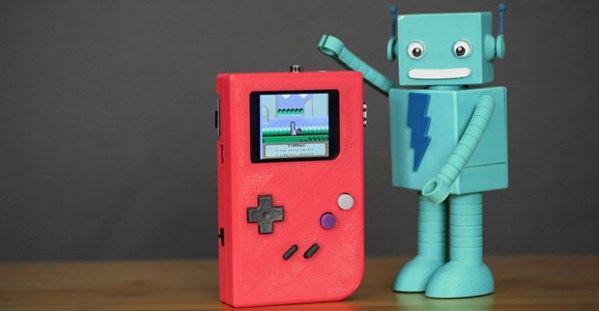
We’ve seen quite a few casemods that stuff a Raspberry Pi into a Game Boy with all the required to turn it into a very cool portable Pi and retro gaming device. Most of these builds use a modified 20-year-old Game Boy for the enclosure, and if you have an attachment to your old green screened friend, you might not want to cut it up for a Pi project. [Noe] over at Adafruit has a solution – a 3D printed Game Boy enclosure that turns a Pi and TFT screen into a barely pocketable Raspberry Pi, with all the buttons and batteries required for taking an installation of RetroPi on the road.

The PiGRRL, as this build is called, uses the Adafruit touchscreen TFT kit for the Pi, effectively turning the Pi into a very tiny tablet. This allows for normal desktop interaction with the Pi, and it’s also small enough to fit in the smallest of enclosures.

The 3D printed enclosure is the star of the show here, allowing complete access to most of the Pi’s ports, while allowing enough space in the rest of the enclosure for a largish battery, charging circuit, and buttons taken from an SNES controller.

The end result is a very usable portable Pi that just happens to be in the perfect form factor for loading up a few ROMs and playing some classic video games. Video below.

Continue reading “The Raspi GameBoy For The Rest Of Us”

Hackaday Links: July 6, 2014

hackaday-links-chain

Power for your breadboards. It’s a USB connector, a 3.3V voltage regulator, and a few pins that plug into the rails of a breadboard.

“Have you seen those ‘Portable battery chargers for smartphones?’ Well the idea of the device is based on it , but the difference here is the internet part.” That’s a direct quote from this Indiegogo campaign. It’s funny because I don’t remember losing my damn mind recently. Wait. It’s $200. Yep. Yep. Definitely lost my mind there.

Putting the Internet on a USB stick not weird enough? Hair Highways. Yep, human hair. It’s just embedding human hair into resin, cutting everything up into plates, and assembling these plates into decorative objects. As a structural material, it’s probably only as strong as the resin itself, but with enough hair set in layers perpendicular to each other, it would be the same idea as fiberglass. Only made out of hair.

Tesla is building a $30,000 car and Harley is building an electric motorcycle. The marketing line for the bike will probably be something like, “living life on your own terms, 50 miles at a time”.

PixelClock? It’s a 64×64 array of red LEDs built to be a clock, and low-resolution display. It looks blindingly bright in the video, something that’s hard to do with red LEDs.

Mains Power Detector For A Thing For Internet

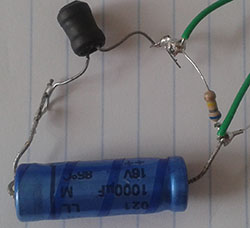
inductor The Internet of Things is fast approaching, and although no one can tell us what that actually is, we do know it has something to do with being able to control appliances and lights or something. Being able to control something is nice, but being able to tell if a mains-connected appliance is on or not is just as valuable. [Shane] has a really simple circuit he’s been working on to do just that: tell if something connected to mains is on or not, and relay that information over a wireless link.
There are two basic parts of [Shane]’s circuit – an RLC circuit that detects current flowing through a wire, This circuit is then fed into an instrumentation amplifier constructed from three op-amps. The output of this goes through a diode and straight to the ADC of a microcontroller, ready for transmission to whatever radio setup your local thingnet will have.

It’s an extremely simple circuit and something that could probably be made with less than a dollar’s worth of parts you could find in a component drawer. [Shane] has a great demo of this circuit connected to a microcontroller, you can check that out below.

Continue reading “Mains Power Detector For A Thing For Internet”

Piles Of Foam With A Hot Wire Slicer

foam

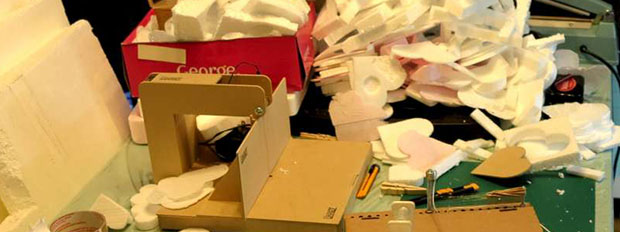
There are a million things you can do with foam, from some very impressive RC airplanes, all the way up to full-scale planes you can fly off into the wild blue yonder. Cutting foam, though, that’s a problem, and your best option is usually a hot wire foam cutter. [Darcy] put up some plans for a very nice bow cutter, but there’s also some experimentation for a foam slicer – a hot wire machine that takes a foam part and slices it like a smokehouse ham.

The bow-style cutter features laser cut parts, a pair of 1/4-20 bolts, a power supply, and about a foot of nichrome wire. It’s the bare minimum for cutting foam, but it seems to work really, really well.

The hot wire foam slicer is a much more interesting contraption, capable of making multiple thin sheets out of foam. Basically, it’s a laser cut tray with a bolt hole pattern running along the sides. Put two bolts along the side, loop some nichrome wire around the screw flights, and you have a way to cut foam in thicknesses of about 1/20th of an inch. Great if you’re trying to skin a model in very thin depron, or you just can’t find the right thickness of foam for your project.

Two Weeks To HOPE X, And We’re Going

hopex_web_topbar_b

In a little less than two weeks, the biannual HOPE conference in NYC will be in full swing. Attendance is more than likely to put you on a list somewhere, so of course we’ll be setting up shop, enjoying the sights and sounds, and throwing swag at hundreds of attendees.

Highlights of HOPE X include a keynote from [Daniel Ellisburg], a video conference with [Edward Snowden], a Q&A with the EFF, a talk I’ll certainly be attending, and the always popular talk on social engineering headed up by [Emmanuel Goldstein].

As with all our extracurriculars, Hackaday will be giving out some swag (200+ tshirts, stickers, and THP goodies), and manning a vendor booth. Look for the eight foot Hackaday flag held up with duct tape. We’ll also be doing the usual video and blog thing from HOPE, for all of you who can’t attend thanks to your company’s security reviews, and some super secret things I can’t believe the overlords signed off on.

In other 2600 news, they ain’t doin too good, with tens of thousands of dollars of debt thanks to rather crappy legal stuff with their distributors. Buying a ticket would help the 2600 guys out, as would buying July’s issue (also on Kindle).