DIY Ultra Wideband Impulse Synthetic Aperture Radar And A MakerBot

state

What could possibly be better than printing out a few low-resolution voxels on a MakerBot? A whole lot of things, but how about getting those voxels with your own synthetic aperture radar? That’s what [Gregory Charvat] has been up to, and he’s documented the entire process for us.

The build began with an ultra wideband impulse radar we saw a while ago. The radar is built from scraps [Greg] picked up on eBay, and is able to image a scene in the time domain, creating nice linear sweeps on a MATLAB plot when [Greg] runs in front of the horns.

With an impulse radar under his belt, [Greg] moved up the technological ladder to something that can produce vaguely intelligible images with his setup. The synthetic aperture radar made from putting his radar horns on the carriage of a garage door opener. The horns slowly scan back and forth along the linear rail, taking single impulse readings and adding them together in an image. In the video below, [Greg] is able to image a few pieces of copper pipe only a few inches in diameter. The necessary equipment for this build only cost [Greg] a few hundred bucks at the Dayton Hamvention, and a similar setup could be put together for even less.

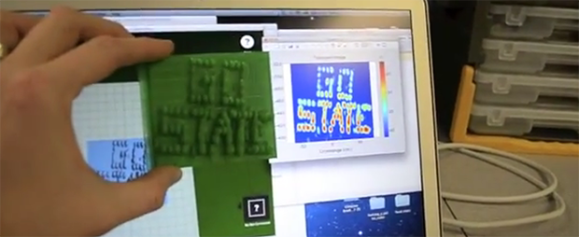
If building an X band impulse synthetic aperture radar isn’t impressive enough. [Greg] also 3D printed one of his radar images on a MakerBot. That’s just applying stlwrite to the 2D radar image and feeding it into MakerWare. Gotta have that blog cred, doe. It also makes for the best headline I’ve ever written.

Continue reading “DIY Ultra Wideband Impulse Synthetic Aperture Radar And A MakerBot”

The Hackaday Prize: Thinking Really, Really Big

Dome

In case you’ve been living under a rock for a few weeks, we’re giving away a trip to space for the best, most grandiose connected hardware project. [coxrandy], a.k.a. [Phillip Cox] realized the best way to build something awesome was to think big, and his plan for building a 1km dome (yes, 1000 meters) is the most ambitious project we’ve ever seen.

The BuckyBot, as [Phil] is calling his build, relies on the ideas of the great [Buckmister Fuller] and his idea to build a huge geodesic dome covering all midtown Manhattan. [Fuller] didn’t have the resources to build a structure this large in the 1950s, and to be honest, we don’t have the resources to build it nowIt would be a ludicrous effort to build something like this one beam at a time, and [Phil] concludes that to build something this big, we need to think small.

Instead of thousand ton cranes and several thousand vehicles trucking in building supplies, [Phil]’s idea uses small “BuckyBots” – a combination 3D printer and robot – that builds one structural cell of a giant dome at a time. These BuckyBots climb around the structure, build the internal and support structure, slowly climbing to the skies on their fractal-inspired creation.

The Hackaday Prize contest will end far before [Phil]’s BuckyBots will have the ability to build a kilometer-wide dome, so the current plans are to modify his RepRap Mendel to crawl. Once that’s done, he’ll have his newly built BuckyBot build a 2 meter hemisphere in his garage. From there, construction moves to the back yard where a 10 meter dome will be built.

Even if this project never makes it past the planning stages, it’s an awesome example of thinking big, something you’re going to need if you’re trying to win a trip to space.

Boost Peak Power Tracking Battery Charger

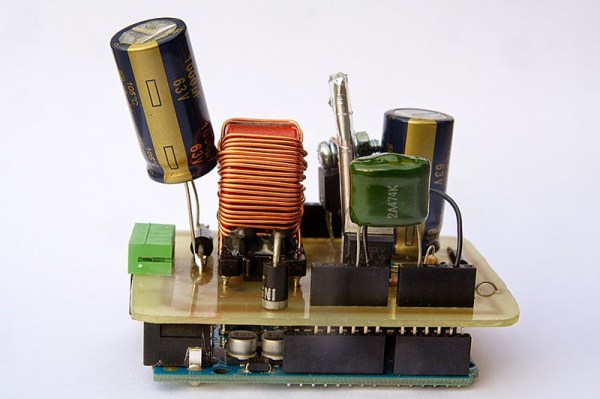
[Rusdy] is building a solar charger for his electric bike, and quickly realized the lithium cells in his bike wouldn’t work well with the most common charge controllers out there. Solar cells have an IV curve, of course, and this changes with the amount of sunlight, requiring some conversion circuitry. Most of the charge controllers out there operate in buck mode, but the commercial boost mode converters [Rusdy] needed for his 36V battery are pricey as all get out. What was [Rusdy] to do? Build his own Boost MPPT solar charger, of course.

The circuit used for the charge circuit is fairly similar to a boost converter, with a little bit of logic required to get the maximum power out of the solar cells. [Rusdy] had an Arduino lying around, so that took care of the logic, and by sampling the voltage and current with the analog pins, he can turn a MOSFET on and off to get the most out of his solar cells.

The finished product works perfectly with an efficiency greater than 87%. Charging current and the final trickle charge is adjustable through software, allowing [Rusdy] to get the most out of his solar panels and electric bike. The board itself is just a prototype and could use a layout revision, but we’ve got to hand it to him for cloning a >$300 charge controller with an Arduino and a few scraps in a part drawer.


Building A CO2 Laser In A Hardware Store

Over on the Projects site, [ThunderSqueak] is pushing the bounds of what anyone would call reasonable and is building a CO2 laser from parts that can be found in any home improvement store.

Despite being able to cut wood, paper, and a bunch of other everyday materials, a carbon dioxide laser is actually surprisingly simple. All you need to do is fill a tube with CO2, put some mirrors and lenses on each end, and run an electric current through the gas. In practice, though, there’s a lot of extra bits and bobs required for a working laser.

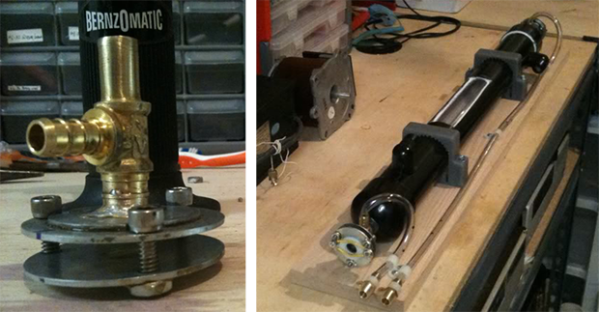
[ThunderSqueak] will need some sort of cooling for his laser, and for that he’s constructed a watercooling jacket out of 2″ PVC. In the end caps, a pair of brass pipe fittings are JB Welded in place, allowing a place for the mirror assembly and lenses.

The mirror mounts are the key component of this build, but the construction method is surprisingly simple. [ThunderSqueak] is using a few brass barbed hose fittings, with washers stuck on one end. The washers are drilled to accept a trio of bolts that will allow the mirrors to be perfectly parallel; anything less and the CO2 won’t lase.

The build isn’t complete yet, but having already built a few lasers, there’s little doubt [ThunderSqueak] will be able to pull this one off as well.


Huge RGB Ring Light Clock

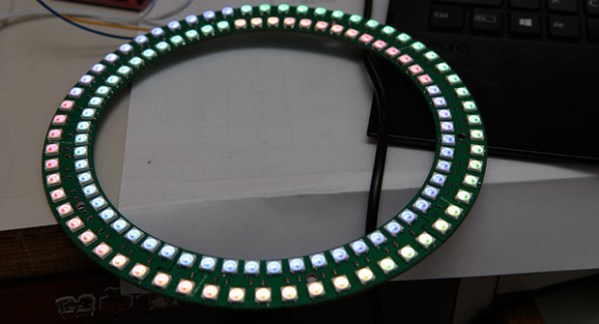
After several months of work, [Greg] has completed one of the most polished LED clocks we’ve ever seen. It’s based on the WS2812 RGB LEDs, with an interesting PCB that allowed [Greg] to make a huge board without spending a lot of money.

The board is made of five interlocking segments, held together with the connections for power and data. Four of these boards contain only LEDs, but the fifth controller board is loaded up with an MSP430 microcontroller, a few capsense pads for a 1-D touch controller, and programming headers.

Finishing up the soldering, [Greg] had a beautiful LED ring light capable of being programmed as a clock, but no enclosure. A normal plastic case simply wouldn’t do, so [Greg] decided to try something he’d never done before: casting the PCB inside a block of resin.

A circular mold was made out of a piece of MDF and a router, and after some problems with clear resin that just wouldn’t cure, his ring light was embedded in a hard, transparent enclosure.  Conveniently stuck in the mold, of course. The MDF had absorbed a little bit of the resin, forcing [Greg] to mill the resin ring free from the wood, with a lot of finish sanding to make the clock pretty.

It’s a clock that demonstrates [Greg]’s copious manufacturing skills, and also his ability to troubleshoot the problems that arose. While he probably won’t be casting things inside an MDF mold anymore, with the right tools [Greg] could easily scale this up for some small-scale manufacturing.


Hackaday Links: May 4, 2014

hackaday-links-chain

We’ve seen a few builds from the Flite Test guys before, like a literal flying toaster, airsoft guns mounted to planes, and giving an electric plane an afterburner (that actually produced a little extra thrust). Now the Flite Test crew is gearing up for the Flite Fest, an all things remote-controlled flight convention in Malvern, Ohio during the last weekend in July. Seems like a pretty cool way to spend spend a weekend.

Unless you get one of those fancy resistor kits where every value has its own compartment in a case or plastic baggie, you’ll soon rue the day your loose resistors become disorganized. [Kirll] has an interesting solution to hundreds of loose resistors: packaging tape. If you want a resistor, just grab a pair of scissors.

Okay, these Adafruit “totally not Muppets™” are awesome. The latest video in the Circuit Playground series is titled, “C is for Capacitor“. There’s also “B is for Battery“, because when life gives you lemons, light up an LED. Here’s the coloring book.

A few years ago, a couple of people at the LA Hackerspace Crashspace put together an animated flipbook device – something between a zoetrope and the numbers in those old electromechanical clocks – and launched a kickstarter. Now they’re putting on a show, presented by Giant Robot, featuring the animated art of dozens of artists.

Vintage electronics? Yes. Vintage Soviet electronics? Here’s 140 pages of pictures, mostly of old measurement devices.


Listening To A Swarm Of Satellites In Orbit

kicksat

A few months ago, we heard of a Kickstarter with an amazing goal: give everyone with $300 burning a hole in their pocket their very own satellite orbiting Earth. Time passes, the mothership has been launched, and in just a few short hours, over a hundred of these personal femtosatellites will be released into low Earth orbit.

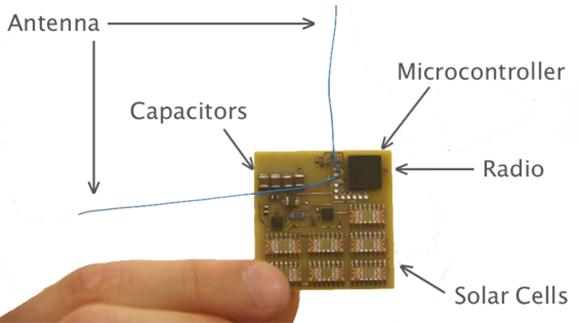
The Kicksat consists of a 3U cubesat that was recently launched aboard the SpaceX CRS-3 mission to the International Space Station. Inside this cubesat are over one hundred satellites called Sprites, loaded up with solar cells, magnetometers, a microcontroller and a radio to communicate with ground stations below. The current mission is a proof of concept, but if everything goes as planned, similar satellites can be deployed into the path of incoming asteroids, or whenever a mission calls for a swarm of small smart devices covering a huge area.

Already the Kicksat mothership has been tracked by a few enterprising amateur radio enthusiasts but the deployment of the Sprites isn’t scheduled until today at 4:00 PM EDT (20:00 GMT). After that, the Sprites will be on their own, spewing out data and the initials of kickstarter backers to most of the population of Earth.

For anyone worrying about these Sprites causing an ablation cascade or a Kessler syndrome, don’t. Orbital decay is a function of surface area and mass, and these extremely lightweight thin rectangles will burn up in the atmosphere in a few week’s time. The lack of radiation hardening on the Sprites won’t be a problem, either. This shouldn’t be a surprise, as they’re orbiting well within our wonderful, protective magnetosphere, and there are digital cameras, tablets, and other much more radiation sensitive electronics that have been working perfectly on the ISS for years now.

You can check out the current location of the orbiting Kicksat mothership on the project website, read the updates on the project blog, or check out our coverage of the Kicksat program from last year’s world maker faire in New York. Relevant videos below.

Oh, and if you have a USB TV tuner, a good antenna, LNA, and some experience with SDR, here’s what you need to listen in.

Continue reading “Listening To A Swarm Of Satellites In Orbit”