The Tiniest Video Game

As we read [Adam]’s writeup for an extremely tiny video game system through coke bottle glasses, we’re reminded of the countless times we were told that sitting, ‘too close to the Nintendo’ would ruin our eyes. We’ll happily dismiss any article from a medical journal that says there was any truth to that statement, but [Adam]’s tiny video game system will most certainly hurt your eyes.

A few years ago, Atari sold keychain-sized joysticks that contained classics such as PongBreakout, Centipede, and Asteroids. [Adam] apparently ran into a cache of these cool classic baubles and immediately thought of turning them into a stand-alone video game system.

For the display, [Adam] used a CRT module from an old Sony Handicam. These modules had the right connections – power, ground, and composite video input – to connect directly to the Atari keychain games. The result is a video game that’s even smaller than a postage stamp. The picture above shows the tiny CRT next to a 25mm postage stamp; it’s small by any measure.
The Raspberry Pi Becomes A Form Factor

Despite the cries for updated hardware, the Raspberry Pi foundation has been playing it cool. They’re committed to getting the most out of their engineering investment, and the current board design for the Raspi doesn’t support more than 512Mb of memory, anyway.

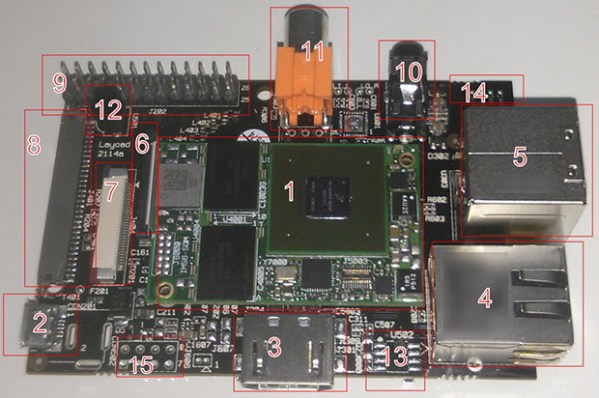
What you see above isn’t a Raspberry Pi, though. It’s the Carrier-one from SolidRun. All loaded out, it has a system-on-module with a quad core ARM Cortex-A9, 2GB of RAM, 1000 Mbps Ethernet, USB host ports, eSATA, and LVDS display connector, a real time clock, and everything else you get with a Raspberry Pi, header pins included. It’s all the awesomesauce of the newer ARM boards that will still work with all your Raspberry Pi hardware.

If you’re thinking this is a product announcement, though, think again. The folks at SolidRun are merely using this Raspberry Pi form factor board as a prototyping and development platform for their CuBox-i device, In its lowest configuration, the CuBox-i1 is still no slouch and would be more than able to keep up with the most demanding Raspberry Pi applications.

Still, though, a hugely powerful board with lots of I/O is something we’d all love, and if SolidRun gets enough complaints praise, it seems like they might be willing to release the Carrier-one as an actual product.

Finding Shiny Pokemon Automatically

In case you’re not up to speed with the world of Pokemon, nearly every species of this game’s titular creatures have a ‘shiny’ variety – a differently colored sprite for each pokemon. As far as gameplay goes, they’re exactly the same as their non-shiny brethren, but the shiny varieties are so impossibly rare not many players have seen them. [dekuNukem] over on Youtube has come up with a great way to find these shiny Pokemon automatically with the Hackaday reader’s favorite tools – an Arduino and a few parts from Sparkfun.

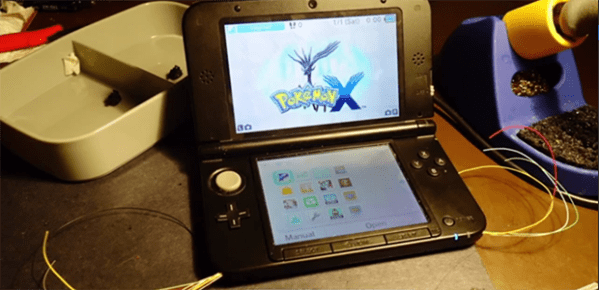
The build hinges on the fact that all shiny pokemon have a short animation whenever the player encounters them in the wild. This setup uses a fishing rod, so an Arduino Micro first presses the Y button to cast the rod, while the ‘duinos ADC listens to the audio signal until a bite is indicated.

A light sensor taped to the bottom screen of the 3DS then measures the amount of time the screen is blacked out. The extra animation for every shiny pokemon means this blackout period is about half a second longer. If the Arduino doesn’t see a shiny, it ‘runs away’, but if a shiny is detected a buzzer sounds to tell the extremely lazy pokemon trainer they have a shiny on their line.

From the video, it took about 36 minutes to find a single shiny pokemon, and about 8 shinies in the three hours of testing this rig has under its belt.

Continue reading “Finding Shiny Pokemon Automatically”

Do It Yourself Nuclear Fusion

By far the coolest projects we see are those dealing with high voltages and deep vacuums. Vacuum tubes of all types fall into this category, as do the electron microscopes we see from time to time. The king of all vacuum and electron hacks is the Farnsworth Fusor, a machine that will both transmute the elements and bathe you in neutrons. Fun stuff, and [Daniel] has a great tutorial for building your own.

[Dan]’s fusor is surprisingly simple to make. Obviously, the most important part is the vacuum chamber which in this build is based around a glass oil cup cylinder. With just a few roughly machined parts – the only tool needed to make the metal plates is a drill press – it can hold a low enough vacuum to contain a star in a jar.

For reasons of safety and sanity, [Dan] isn’t running his fusor at a high enough voltage to actually fuse deuterium into helium. This is really just a beautiful, glowey demonstration of what can be done with enough knowledge, the skills, and a handful of parts.

Open Source Telescope Control

board

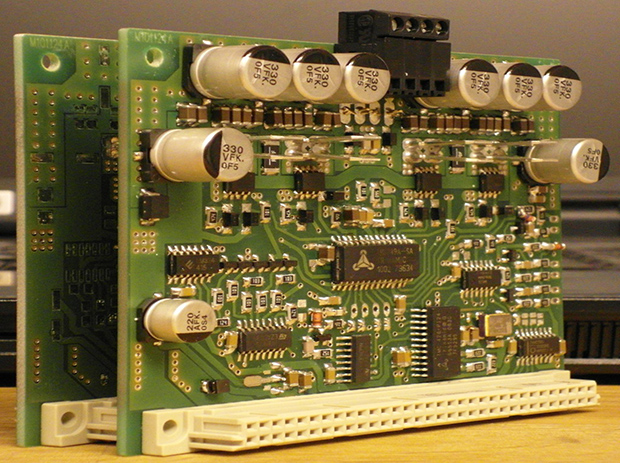
Telescope mounts connected to computers and stepper motors have been available to the amateur astronomer for a long time, and for good reason, too. With just the press of a button, any telescope can pan over to the outer planets, nebula, or comets. Even if a goto command isn’t your thing, a simple clock drive is a wonderful thing to have. As with any piece of professional equipment, hackers will want to make their own version, and thus the openDrive project was born. It’s a project to make an open source telescope controller.

Right now, the project is modular, with power supply boards, a display board, motor driver, an IO board (for dew heaters and the like), and a hand-held controller. There’s an openDrive forum that’s fairly active covering both hardware and software. If you’re looking for a project to help you peer into the heavens, this is the one for you. If telescope upgrades aren’t enough to quench your astronomical thirst you could go full out with a backyard observatory build.

Danke [Håken] for the tip.

Manufacturer-Crippled Flir E4 Thermal Camera Hacked To Perform As High-End Model

Last month, [Mike] took a look at the Flir E4 thermal imaging camera. It’s a great tool for those occasions when you need the vision of a Predator, but what he found inside was substantially cooler: it seems the engineers behind the Flir E4 made their lives easier by making the circuits inside the $1000 E4 the same as the $6000 Flir E8.

This only means one thing, and [Mike] has delivered. He’s upgraded the firmware in the Flir E4 to the E8, giving it a vastly increased resolution – 80×40 for the E4 to 320×240 for the E8.

The hack itself is as easy as putting the serial number of the E4 in a config file, zipping a few files up, and installing it with the Flir tools. An amazingly simple mod (with an awesome teardown video) that turns a $1000 thermal imaging camera into the high-end $6000 model.

Continue reading “Manufacturer-Crippled Flir E4 Thermal Camera Hacked To Perform As High-End Model”

The Trials Of Printing Mil-Spec Connectors

conn

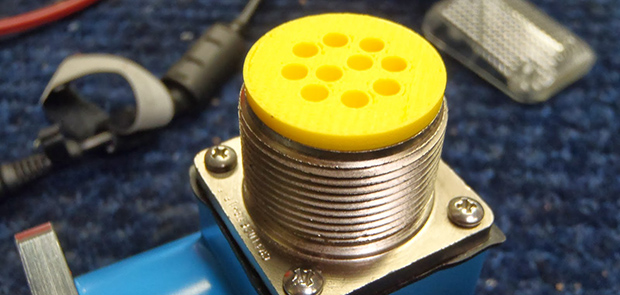
[Chris] over at the 23B hackerspace had a bit of a problem – a project required the use of a very old rotary encoder with a mil-spec connector. While it might be possible to simply buy one of these mating connectors on Digikey or Mouser, that’s not [Chris]’ usual MO. He has a nice 3D printer, and this connector is basically a cylinder with some holes. How hard could printing out one of these connectors be?

The dimensions for [Chris]’ first attempt at creating a mating connector came from Solidworks’ “Sketch Picture” command where an image can be superimposed over a model and the 3D features created from that guide. If it worked, it would be far too easy, and the printed model didn’t fit at all.

This failure led [Chris] to page through MIL-STD-1651, a portly tome of 200+ pages covering every circular connector possible.  After 20 minutes of scanning the specs, [Chris] found what he was looking for: the correct specification showing him where all the pins and holes should go.

After some fine modeling in Solidworks, [Chris] had his very own custom printed Mil-Spec connector. Sure, he ate up more time than it was worth for one connector, but now that he has the STL file, he can print out as many as he needs.